Briefs · Reference
Script and language policy in East Asia
Every general reference will tell you that Japan simplified its writing after the war, that Korea moved to hangul, that China simplified characters. Almost none will tell you which instrument did it, on what date, issued by whom, or what it concretely changed. This chronology has 20 documented instrument entries, 0 reported-only entries and 1 unresolved claim. Its recorded dates span 1443 to 2013; source status is shown for each entry.
Correction, 18 October 2026. The 1977 Second Scheme and its 1986 withdrawal are now sourced to the contemporaneous draft and State Council notice Guofa [1986] No. 64 instead of Wikipedia; an unsupported 21 December 1977 effective date was removed, the April and July 1978 suspensions were clarified, and documented, reported-only and unresolved entries are counted separately.
Reference explorer
Five states, one inherited script, nearly six centuries of arguing about it
Every jurisdiction here began with the same Han characters and ended somewhere different — two of them writing characters that no longer match, one that stopped using them altogether, and one that spent thirty years removing them and then put some back. Start anywhere.
-
China
中国
-
Taiwan
臺灣
-
North Korea
조선
-
Korea
한국
-
Japan
日本
Script and language policy / Chronology
An instrument, not a legend
Move through the dated record. A document appearing here does not mean it remains in force.
21 entries recorded by 2013 across 5 jurisdictions.
China
-
汉字简化方案 Source-verified
Scheme for Simplifying Chinese Characters
Issuing body: 国务院 / State Council of the PRC
Record date type: passed · Separate effective date: 1956-02-01
Recorded effect: Passed at the State Council’s 23rd plenary session. Table 1 — 230 characters — became mandatory in printed matter from 1 February 1956. Table 2, of 285 characters, and a table of 54 simplified radicals were issued for trial. The resolution directs that traditional forms “should stop being used in printed matter”, excepting reprints of classical texts.
Source caveat / popular account: The figure of 1,055 variant characters abolished is often attached to this scheme. It belongs to a different instrument — the First Table of Variant Characters, December 1955 — and is not folded in here.
中华人民共和国教育部 (Ministry of Education, PRC): 国务院关于公布汉字简化方案的决议(1956年) ↗ primary · Full text of the resolution
Wikisource: 汉字简化方案 ↗ official-secondary · Resolution and table text
Read the full chronology ↗ -
汉语拼音方案 Source-verified
Scheme for the Chinese Phonetic Alphabet
Issuing body: 全国人民代表大会 / National People’s Congress
Record date type: approved
Recorded effect: Approved at the fifth session of the first National People’s Congress. The resolution adopts Pinyin “as a tool for helping people learn Chinese characters and promote Putonghua”, directs that it be taught first in teacher-training and in primary and secondary schools, and that it be extended gradually into publishing.
Source caveat / popular account: Pinyin is widely said to have been intended to replace Chinese characters. The 1958 resolution does not say that — it adopts Pinyin as an auxiliary tool. Zhou Enlai’s separate report of 10 January 1958 states explicitly that Pinyin “is not a phonetic script meant to replace Chinese characters”, but that is his report, which the resolution approves only in principle, and not the enacting text. A long-range romanisation current did exist within the script-reform committee; it is not what this instrument enacts, and the popular claim is misattributed rather than invented. The NPC’s own hosting of the resolution could not be retrieved — the connection fails at the TLS handshake — so the wording rests on convergent reproductions.
中国人大网 (National People’s Congress): 第一届全国人民代表大会第五次会议关于汉语拼音方案的决议 ↗ primary · Full resolution — located, not retrievable (TLS handshake failure)
中国新闻网: 与汉语拼音相伴60年:从国家规范到国际标准 ↗ reported · Resolution text quoted
Read the full chronology ↗ -
简化字总表 Source-verified
Complete List of Simplified Characters
Issuing body: 中国文字改革委员会 / Committee for Reforming the Chinese Written Language
Record date type: published
Recorded effect: Consolidated the 1956 scheme into three tables: 352 characters not used as components, 132 usable as components together with 14 simplified radicals, and 1,754 derived by analogy from those components. Not a State Council instrument — a publication of the script-reform agency, which is why its legal weight differs from the 1956 resolution it consolidates.
Source caveat / popular account: The component figures sum to 2,238. Secondary sources almost universally give 2,236, explained as two characters double-listed — but the table’s own footnote already states its 1,754 figure is deduplicated, and the pair invoked to reach 2,236 is not the pair that footnote describes. The 1964 gazette is not online. No winner is picked here.
Wikisource: 简化字总表(1964年版) ↗ official-secondary · Tables 1–3 and the count footnote
Read the full chronology ↗ -
第二次汉字简化方案(草案) Source-verified
Second Scheme for Simplifying Chinese Characters (Draft)
Issuing body: 中国文字改革委员会 / Committee for Reforming the Chinese Written Language
Record date type: published
Recorded effect: The draft appeared in the People’s Daily on 20 December 1977. Table 1 listed 248 simplified forms, including 55 derived by analogy, for trial use in publications. Table 2 listed 605 for public discussion. Education authorities stopped trial use in textbooks in April 1978; the propaganda department stopped trial use in newspapers, books and periodicals in July. State Council notice Guofa [1986] No. 64, dated 24 June 1986, formally withdrew the draft.
Source caveat / popular account: The first table was authorized for trial in publications. Neither table was a definitive replacement for the existing official character list. The record is documented by a contemporaneous draft and a later State Council notice.
国务院 (State Council; Beijing government archive): 国发〔1986〕64号:废止《第二次汉字简化方案(草案)》 ↗ primary · 1977 publication, 1978 trial-use withdrawals, 1986-06-24 rescission
人民日报 (digitized transcript hosted by CN Gov Open Data): 第二次汉字简化方案(草案), 1977-12-20 ↗ official-secondary · Original draft text, table definitions and counts: 248 and 605
Read the full chronology ↗ -
国务院批转国家语言文字工作委员会关于废止《第二次汉字简化方案(草案)》的通知 Source-verified
State Council notice transmitting the request to abolish the Second Scheme (Draft)
Issuing body: 国务院 / State Council of the PRC
Record date type: promulgated
Recorded effect: Ended use of the 1977 draft from the date of the notice, nine years after it was issued and eight after it stopped being used in practice. The Complete List of Simplified Characters was reissued in a new edition dated 10 October 1986, un-merging four characters — 叠, 覆, 像, 囉 — that had been treated as variant equivalents, taking Table 1 from 352 to 350 and the analogy table from 1,754 to 1,753.
Source caveat / popular account: The revised components sum to 2,235. Secondary sources repeat “2,274 characters and 14 radicals”, which does not reconcile with the table’s own stated components under any combination. 2,235 is the figure that adds up; the origin of 2,274 could not be traced, so it is reported rather than dismissed.
Wikisource: 简化字总表(1986年版) ↗ official-secondary · Header dated 1986-10-10; footnote on the four un-merged characters
国务院 (State Council; Beijing government archive): 国发〔1986〕64号:废止《第二次汉字简化方案(草案)》 ↗ primary · State Council notice number and issue date, 1986-06-24
Read the full chronology ↗ -
通用规范汉字表 Source-verified
Table of General Standard Chinese Characters
Issuing body: 国务院 / State Council of the PRC
Record date type: approved · Separate effective date: 2013-08-19
Recorded effect: 8,105 characters in three levels: 3,500 for general literacy, a further 3,000 by frequency, and 1,605 covering surnames, place names, scientific terms and classical characters used in textbooks. The notice directs that general usage follow this table and that previously relevant tables cease to be used. Released publicly on 19 August 2013. It is the instrument currently in force.
Source caveat / popular account: The notice states the supersession in general terms. It could not be confirmed that it names the 1986 Complete List by title — the tables are published as images rather than extractable text — so the repeal is recorded here as implicit rather than express.
中国政府网 (State Council): 国务院关于公布《通用规范汉字表》的通知 ↗ primary · Document number, date, supersession clause
中华人民共和国教育部 (Ministry of Education, PRC): 国务院公布《通用规范汉字表》 ↗ primary · Total of 8,105 and the three-level breakdown
Read the full chronology ↗
Taiwan
-
常用國字標準字體表 Source-verified
Table of Standard Forms of Common National Characters
Issuing body: 教育部 / Ministry of Education, Republic of China
Record date type: announced
Recorded effect: Fixed 4,808 standard forms for common use. This is the instrument by which Taiwan standardised traditional characters rather than simplifying them — the same problem the mainland answered by simplification, answered instead by fixing which of several received forms is correct. A companion table of less-common characters was promulgated in the same window.
Source caveat / popular account: The companion table’s count differs by revision rather than by disagreement: 6,341 at the 1982 promulgation, 6,343 in the 1993 kai-script revision, 6,329 after a 2017 variant-character revision. Three states of one table. The ministry document number for the 1982 announcement could not be confirmed and is omitted.
教育部語文成果入口網 (Ministry of Education, ROC): 常用字下載 ↗ primary · Date and character count
教育部 (Ministry of Education, ROC): 教育部4808個常用字說明 ↗ primary · Date, count, source table name
Read the full chronology ↗
North Korea
-
— Unverified entry, not an established instrument
No instrument located
Issuing body: — / Not established
Record date type: recorded
Recorded effect: North Korea’s abandonment of hanja is generally dated to March 1949 and is the most complete script change any state in the region carried out. No dated instrument for it could be found — no cabinet decision, no Supreme People’s Assembly enactment, no named directive. The date rests on a South Korean academic encyclopedia describing the outcome, which cites no DPRK document.
Source caveat / popular account: This entry is published unverified and shown apart from the others because the gap is the finding. A separate and genuinely dated DPRK instrument does exist nearby — the 1948 New Orthography of the Korean Language, issued by the Korean Language Research Society — but that is a spelling reform, not a hanja abolition, and merging the two would be exactly the bridging this publication does not do.
한국학중앙연구원 (Academy of Korean Studies): 한자폐지사업 — 한국민족문화대백과사전 ↗ reported · “1949년 3월…한자를 쓰지 않게 되었다” — no instrument cited
Read the full chronology ↗
Korea
-
세종실록 102권, 세종 25년 12월 Source-verified
Veritable Records of Sejong, vol. 102
Issuing body: 조선 왕조 / Joseon court
Record date type: recorded
Lunisolar date; not silently converted to Gregorian
Recorded effect: The entry reads 上親制諺文二十八字 — “the King personally created twenty-eight letters of the vernacular script” — and names them Hunminjeongeum. This is the earliest record that the script existed. Nothing was published and nothing was released; the letters are documented, not announced.
Source caveat / popular account: The record is placed at the last day of the twelfth lunar month. That is the Sillok convention for events logged without a day, not a claim about the date of invention.
국사편찬위원회 (National Institute of Korean History): 조선왕조실록 — 세종실록 102권, 세종 25년 12월 30일 ↗ primary · Entry text
Read the full chronology ↗ -
훈민정음 해례본 (訓民正音解例本) Source-verified
Hunminjeongeum, with Explanations and Examples
Issuing body: 집현전 (정인지 외 8인) / Hall of Worthies — Jeong In-ji and eight scholars
Record date type: published
Lunisolar date; not silently converted to Gregorian
Recorded effect: The Sillok records 訓民正音成 — “Hunminjeongeum was completed”. What was completed is the book: Sejong’s preface, the rules of use, the technical commentary explaining how the letters were designed, worked examples, and Jeong In-ji’s postscript. The commentary was written by the Hall of Worthies scholars at the King’s direction, not by the King. Its colophon dates it to the first ten days of the ninth month.
Source caveat / popular account: This is the entry that “1446 promulgation” refers to, and the word 반포 (promulgate) does not appear in it. The National Institute of Korean Language states there is no record of any official promulgation ceremony having been held. Hangul Day’s 9 October is a modern conversion of the colophon’s ten-day window, calculated after the manuscript was rediscovered in Andong in 1940 — an anniversary of a book’s completion, not of a proclamation.
국사편찬위원회 (National Institute of Korean History): 조선왕조실록 — 세종실록 113권, 세종 28년 9월 29일 ↗ primary · Entry text 訓民正音成 and Jeong In-ji’s postscript
국립국어원 (National Institute of Korean Language): 알고 싶은 한글 — 한글날이 오늘날과 같이 10월 9일로 정해지기까지 ↗ official-secondary · Derivation of 9 October; absence of any promulgation-ceremony record
Read the full chronology ↗ -
칙령 제1호 「공문식(公文式)」 제14조 Source-verified
Royal Edict No. 1, “Official Document Format”, article 14
Issuing body: 조선 왕실 / 의정부 / Joseon court, under King Gojong
Record date type: promulgated
Lunisolar date; not silently converted to Gregorian
Recorded effect: Article 14: laws and edicts shall take 국문 — the Korean script — as their base text, with a Chinese translation attached, or shall use mixed Korean-Chinese script. After five centuries in which the language of the state was literary Chinese, this is the instrument that gives Korean script formal standing in law.
Source caveat / popular account: Two things are commonly overstated. The edict permits hanja-annotated and mixed-script versions alongside the Korean base text; it does not mandate hangul-only documents. And its date is lunisolar — Korea did not adopt the Gregorian calendar until 1896 — so “21 November 1894” as usually printed is a lunar date in Gregorian dress. No converted equivalent is asserted here. The format itself was revised at least twice more, in mid-1894 and again in 1895.
국사편찬위원회 (National Institute of Korean History): 조선왕조실록 — 고종실록 32권, 고종 31년 11월 21일 ↗ primary · Royal Edict No. 1, article 14
한국학술지인용색인 (Korea Citation Index): 갑오개혁기 공문식과 공문서의 변화 ↗ reported · Abstract — the 1894–1895 revision sequence
Read the full chronology ↗ -
한글전용에관한법률 Source-verified
Act on the Exclusive Use of Hangul
Issuing body: 대한민국 국회 / National Assembly of the Republic of Korea
Record date type: promulgated · Separate effective date: 1948-10-09
Recorded effect: One substantive sentence, in force the day it was promulgated — a date chosen to fall on Hangul Day: “The official documents of the Republic of Korea shall be written in hangul. Provided that, for some time, hanja may be used alongside where necessary.” It is the first statute of the new republic to legislate on script, and among the earliest it passed at all. Repealed in 2005 on the enactment of the Framework Act on the Korean Language.
Source caveat / popular account: This act is routinely described as banning hanja. Its own text does the opposite: the second clause expressly permits concurrent hanja use. It defines neither “official document” nor “for some time” nor “where necessary”, sets no penalty and names no enforcement mechanism — which is why Korean legal scholarship treats it as a declaratory statement of linguistic independence rather than an operative prohibition.
법제처 국가법령정보센터 (Ministry of Government Legislation): 한글전용에관한법률 [시행 1948.10.9.] [법률 제6호, 1948.10.9., 제정] ↗ primary · Enactment record — law number, date, operative text
한국학중앙연구원 (Academy of Korean Studies): 한글전용법 — 한국민족문화대백과사전 ↗ official-secondary · Characterisation as declaratory rather than operative
Read the full chronology ↗ -
한글전용 촉진 7개 사항 Source-verified
Seven Measures to Promote the Exclusive Use of Hangul
Issuing body: 대통령 / President of the Republic of Korea
Record date type: announced
Recorded effect: Moved the target for removing hanja from schooling and administration forward from 1973 to 1970, directed that hanja be taken out of textbooks, and called for the 1948 Act to be amended. A curriculum ordinance of September 1969 then removed the legal basis for hanja instruction, and elementary Korean-language textbooks reverted to hangul-only in March 1970.
Source caveat / popular account: The change is popularly attributed to a presidential special directive of 1 March 1970. The National Archives’ own chronology shows March 1970 only as the month the textbooks changed, within the 1968–69 chain above, and no separate 1970 directive could be located.
국가기록원 (National Archives of Korea): 한글이 걸어온 길 — 연표 ↗ official-secondary · Dated entries, 1968–1974
Read the full chronology ↗ -
한문교육용 기초한자 1800자 Source-verified
1,800 Basic Hanja for Classical Chinese Education
Issuing body: 문교부 / Ministry of Education
Record date type: announced
Recorded effect: Fixed 1,800 characters for school instruction — 900 for middle school and 900 for high school — after an August 1972 amendment to the Education Act’s enforcement decree restored a legal basis for teaching hanja. Instruction resumed the following month. The set of 1,800 has proved durable and still governs school hanja teaching.
Source caveat / popular account: Called “the 1972 reversal”, but 1972 supplies only an enforcement-decree amendment and this character list. The binding curriculum ordinances that made classical Chinese an independent required subject came later — ministry ordinance No. 325 of 31 August 1973 for middle schools, No. 350 of 31 December 1974 for high schools. The Ministry’s own archive page for this announcement would not load; the date and the figure rest on the National Archives chronology and search metadata.
국가기록원 (National Archives of Korea): 한글이 걸어온 길 — 연표 ↗ official-secondary · 1972 enforcement-decree amendment and resumption of instruction
국가기록원 (National Archives of Korea): 제3차 교육과정 ↗ official-secondary · Ministry ordinances No. 325 (1973-08-31) and No. 350 (1974-12-31)
Read the full chronology ↗ -
국어의 로마자 표기법 Source-verified
Romanization of Korean
Issuing body: 문화관광부 / Ministry of Culture and Tourism
Record date type: promulgated
Recorded effect: Removed the diacritics that could not survive a keyboard. The breve goes — ㅓ becomes “eo” rather than “ŏ”, ㅡ becomes “eu” rather than “ŭ” — and the apostrophes marking aspiration go with it. It is the only instrument in this chronology whose stated problem is computer input, and the reason Korean place names are spelled as they now are in every airport and on every road sign.
Source caveat / popular account: It replaced the South Korean government’s own 1984 standard — Ministry of Education notification No. 84-1, itself an adaptation of McCune–Reischauer — and not the McCune–Reischauer system of 1939, which remains in scholarly use and was never Korea’s to repeal. Amended in turn by notification No. 2014-42 of 5 December 2014, which is the version now in force.
국립국어원 (National Institute of Korean Language): 국어의 로마자 표기법 — 어문 규범 ↗ primary · Notification numbers and dates: 84-1, 2000-8, 2014-42
Read the full chronology ↗
Japan
-
小学校令施行規則 Source-verified
Enforcement Regulations for the Elementary School Order
Issuing body: 文部省 / Ministry of Education
Record date type: promulgated
Recorded effect: Article 16 fixed, for elementary-school instruction, a single kana shape per sound — collapsing the many pre-modern variant forms (変体仮名) into what is essentially today’s standard hiragana — together with a standard on-reading kana usage, and directed that kanji be reduced in number to those of broad application. The article sets no numeric limit on kanji. The ordinance itself is no longer in force; the syllabary it fixed is still the one in use.
Source caveat / popular account: A widely circulated account attaches a 1,200-character kanji cap to this reform and cites 文部省令第24号. Both details are contradicted by the sources read here: the National Diet Library’s law index gives Ordinance No. 14, and the transcribed text of Article 16 contains no numeric cap. Treat the 1,200 figure as wrong rather than merely unconfirmed. Which later instrument formally repealed this ordinance could not be established, so no repeal date is claimed.
国立国会図書館 日本法令索引 (National Diet Library, Japan Law Index): 小学校令施行規則 明治33年8月21日文部省令第14号 ↗ official-secondary · Index record — ordinance number, date, current status
Wikisource: 小学校令施行規則 ↗ official-secondary · Article 16, full text
Read the full chronology ↗ -
当用漢字表 Source-verified
List of Kanji for Current Use
Issuing body: 内閣 / Cabinet of Japan
Record date type: promulgated
Recorded effect: 1,850 characters. The preface states that the list “shows the range of kanji to be used in laws, official documents, newspapers, magazines and general society”, and that words which cannot be written with them are to be replaced with other words or written in kana. A cabinet decision of 5 November 1946 approved its submission.
Wikisource: 当用漢字表 ↗ official-secondary · 前書き (preface), full text
国立公文書館 (National Archives of Japan): 昭和21年(1946)11月|当用漢字・新かなづかいが告示される ↗ official-secondary · Page body — date and notification
Read the full chronology ↗ -
現代かなづかい Source-verified
Modern Kana Orthography
Issuing body: 内閣 / Cabinet of Japan
Record date type: promulgated
Recorded effect: Issued the same day as the kanji list, and the larger change of the two. Moved kana spelling off historical orthography and onto modern pronunciation, for colloquial writing specifically — classical texts excepted. ゐ and ゑ go to い and え; を survives only as the object particle; くわ and ぐわ become か and が; ぢ and づ become じ and ず with compound exceptions; は and へ keep their historical spellings only where they are particles. Superseded in 1986 by 現代仮名遣い, cabinet notification No. 1.
Wikisource: 現代かなづかい (昭和21年内閣告示第33号) ↗ official-secondary · 前書き and rule body
国立公文書館 (National Archives of Japan): 昭和21年(1946)11月|当用漢字・新かなづかいが告示される ↗ official-secondary · Page body
Read the full chronology ↗ -
送り仮名の付け方 Source-verified
Rules for Attaching Okurigana
Issuing body: 内閣 / Cabinet of Japan
Record date type: promulgated
Recorded effect: Seven general rules, each with a principle and its exceptions, plus an appendix of set forms. Its own preface calls it a よりどころ — something to go by — applying to ordinary writing in general social life and expressly excluding technical and specialist terminology and proper nouns. It is the clearest statement in this chronology that a cabinet notification is a reference standard rather than a mandate. Revised on 1 October 1981 to track the new jōyō kanji table.
Source caveat / popular account: Legal drafting follows a separate and narrower Cabinet Legislation Bureau practice, not this notification; the two are frequently merged in secondary accounts. The instrument number for the 1981 revision could not be confirmed and is omitted.
文化庁 (Agency for Cultural Affairs): 送り仮名の付け方 ↗ primary · 前書き and 通則 1–7
国立国会図書館 日本法令索引 (National Diet Library, Japan Law Index): 送り仮名の付け方 昭和48年6月18日内閣告示第2号 ↗ official-secondary · Index record — date and notification number
Read the full chronology ↗ -
常用漢字表 Source-verified
List of Kanji for Common Use
Issuing body: 内閣 / Cabinet of Japan
Record date type: promulgated
Recorded effect: 1,945 characters, replacing the 1,850 of 1946 — and replacing its character too. Where the 1946 list set a range outside which words were to be rewritten, this one is framed as a guide (目安). The restriction becomes a recommendation.
Source caveat / popular account: Two dates circulate for this table and only one is the instrument. The National Language Council reported on 23 March 1981; the Cabinet promulgated on 1 October 1981. Chronologies pick whichever they encountered first. Separately, the commonly quoted breakdown of 95 characters added and none removed could not be confirmed — it traces to ministry pages that would not render. The 1,945 total and the notification number are confirmed on the Agency for Cultural Affairs’ own site.
文化庁 (Agency for Cultural Affairs): 「常用漢字表」を知っていますか。―「常用漢字表」シリーズ①― ↗ primary · Article body — “昭和56年内閣告示第1号”の1,945字
Read the full chronology ↗ -
常用漢字表 Source-verified
List of Kanji for Common Use (revised)
Issuing body: 内閣 / Cabinet of Japan
Record date type: promulgated
Recorded effect: 2,136 characters. Technically a fresh promulgation superseding the 1981 notification rather than an amendment to it. The Council for Cultural Affairs reported on 7 June 2010; the Cabinet promulgated on 30 November. The revision is the first to be shaped by the fact that most Japanese writing is now typed rather than handwritten — characters readers recognise but few could write by hand were admitted on that basis.
Source caveat / popular account: Two framings circulate and both are correct: 196 characters added and 5 removed (勺, 錘, 銑, 脹, 匁 — moved to the names-use list rather than dropped), or a net increase of 191. 1,945 + 196 − 5 = 2,136 = 1,945 + 191. Quoting one figure without the other is what makes two accounts look contradictory. The gross figures rest on a ministry PDF that could not be rendered; the 2,136 total, the date and the notification number are confirmed on the issuing body’s own page.
文化庁 (Agency for Cultural Affairs): 常用漢字表(平成22年内閣告示第2号) ↗ primary · Page body and linked instrument PDFs
文化庁 (Agency for Cultural Affairs): 「常用漢字表」を知っていますか。 ↗ primary · Article body — 2,136字種、191字増
Read the full chronology ↗
Script connections / Study desk
One character, three languages.
Compare a Japanese school kanji with its Korean hanja reading and its Traditional Chinese form. Readings vary by word and context.
No verified match in this set. Try a different character or reading.
study, learningJapanese Grade 1Japanese example: 大学 (だいがく)
Study this Japanese collection Single-character readings are not a promise about compound-word pronunciation.
Data: Unicode Unihan 17.0.0 and the Japanese study banks. Inspect source data ↗
Japan, South Korea and China have dated instruments in the postwar sequence. The North Korean 1949 claim has no located dated directive and is held apart. Across the chronology, 11 entries carry a primary overall tier, 9 an official-secondary tier and 0 a reported-only tier. Another 1 claim lacks a citable instrument.
Worked example: the 1977 Chinese draft. The 20 December 1977 committee text calls itself a draft and permits trial use of its first table in publications. The State Council notice of 24 June 1986 records the 1978 suspension of trial use and explicitly abolishes the draft. Read the instrument's original status and the subsequent official order together; publication alone did not make all 853 proposed forms a binding standard.
Before the state took an interest
Korea 1443 세종실록 102권, 세종 25년 12월 Veritable Records of Sejong, vol. 102 Korea 1446 훈민정음 해례본 (訓民正音解例本) Hunminjeongeum, with Explanations and ExamplesThe modernising state
Korea 1894 칙령 제1호 「공문식(公文式)」 제14조 Royal Edict No. 1, “Official Document Format”, article 14 Japan 1900 小学校令施行規則 Enforcement Regulations for the Elementary School OrderThe postwar settlement
Japan 1946 当用漢字表 List of Kanji for Current Use Japan 1946 現代かなづかい Modern Kana Orthography Korea 1948 한글전용에관한법률 Act on the Exclusive Use of Hangul North Korea 1949 No instrument located North Korea 1949: dated directive not located China 1956 汉字简化方案 Scheme for Simplifying Chinese Characters China 1958 汉语拼音方案 Scheme for the Chinese Phonetic AlphabetDivergence
China 1964 简化字总表 Complete List of Simplified Characters Korea 1968 한글전용 촉진 7개 사항 Seven Measures to Promote the Exclusive Use of Hangul Korea 1972 한문교육용 기초한자 1800자 1,800 Basic Hanja for Classical Chinese Education Japan 1973 送り仮名の付け方 Rules for Attaching Okurigana China 1977 第二次汉字简化方案(草案) Second Scheme for Simplifying Chinese Characters (Draft) Japan 1981 常用漢字表 List of Kanji for Common Use Taiwan 1982 常用國字標準字體表 Table of Standard Forms of Common National CharactersStandardisation
China 1986 国务院批转国家语言文字工作委员会关于废止《第二次汉字简化方案(草案)》的通知 State Council notice transmitting the request to abolish the Second Scheme (Draft) Korea 2000 국어의 로마자 표기법 Romanization of Korean Japan 2010 常用漢字表 List of Kanji for Common Use (revised) China 2013 通用规范汉字表 Table of General Standard Chinese CharactersBefore the state took an interest
The script exists for four and a half centuries before any government undertakes to regulate it — and, as the record shows, without the promulgation ceremony later attributed to it.
December 1443 recorded lunisolar calendar
세종실록 102권, 세종 25년 12월
Sejong sillok gwon 102
Veritable Records of Sejong, vol. 102
Court record — not a promulgating instrument · Joseon court 조선 왕조
The entry reads 上親制諺文二十八字 — “the King personally created twenty-eight letters of the vernacular script” — and names them Hunminjeongeum. This is the earliest record that the script existed. Nothing was published and nothing was released; the letters are documented, not announced.
What is contested The record is placed at the last day of the twelfth lunar month. That is the Sillok convention for events logged without a day, not a claim about the date of invention.
Primary source 1 source · 1 primary
September 1446 published lunisolar calendar
훈민정음 해례본 (訓民正音解例本)
Hunminjeongeum Haerye-bon
Hunminjeongeum, with Explanations and Examples
Published commentary · Hall of Worthies — Jeong In-ji and eight scholars 집현전 (정인지 외 8인)
The Sillok records 訓民正音成 — “Hunminjeongeum was completed”. What was completed is the book: Sejong’s preface, the rules of use, the technical commentary explaining how the letters were designed, worked examples, and Jeong In-ji’s postscript. The commentary was written by the Hall of Worthies scholars at the King’s direction, not by the King. Its colophon dates it to the first ten days of the ninth month.
What is contested This is the entry that “1446 promulgation” refers to, and the word 반포 (promulgate) does not appear in it. The National Institute of Korean Language states there is no record of any official promulgation ceremony having been held. Hangul Day’s 9 October is a modern conversion of the colophon’s ten-day window, calculated after the manuscript was rediscovered in Andong in 1940 — an anniversary of a book’s completion, not of a proclamation.
Primary source 2 sources · 1 primary
The modernising state
Korea and Japan legislate on script within six years of each other, both as part of building a modern bureaucracy rather than out of any literary motive.
21 November 1894 promulgated lunisolar calendar
칙령 제1호 「공문식(公文式)」 제14조
Chingnyeong je-1-ho Gongmunsik, je-14-jo
Royal Edict No. 1, “Official Document Format”, article 14
Royal edict · Joseon court, under King Gojong 조선 왕실 / 의정부
Article 14: laws and edicts shall take 국문 — the Korean script — as their base text, with a Chinese translation attached, or shall use mixed Korean-Chinese script. After five centuries in which the language of the state was literary Chinese, this is the instrument that gives Korean script formal standing in law.
What is contested Two things are commonly overstated. The edict permits hanja-annotated and mixed-script versions alongside the Korean base text; it does not mandate hangul-only documents. And its date is lunisolar — Korea did not adopt the Gregorian calendar until 1896 — so “21 November 1894” as usually printed is a lunar date in Gregorian dress. No converted equivalent is asserted here. The format itself was revised at least twice more, in mid-1894 and again in 1895.
Primary source 2 sources · 1 primary
21 August 1900 promulgated
小学校令施行規則
Shōgakkō-rei shikō kisoku
Enforcement Regulations for the Elementary School Order
Ministry ordinance · Ministry of Education 文部省 明治33年文部省令第14号
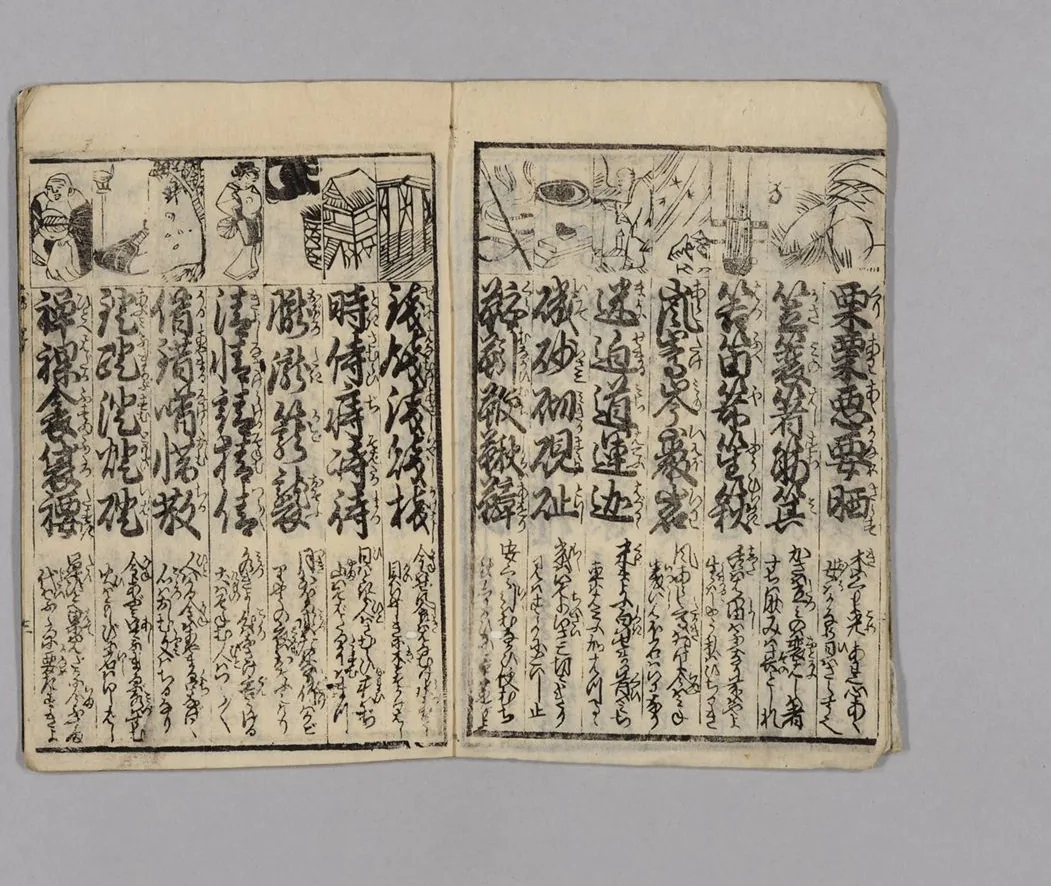
Article 16 fixed, for elementary-school instruction, a single kana shape per sound — collapsing the many pre-modern variant forms (変体仮名) into what is essentially today’s standard hiragana — together with a standard on-reading kana usage, and directed that kanji be reduced in number to those of broad application. The article sets no numeric limit on kanji. The ordinance itself is no longer in force; the syllabary it fixed is still the one in use.
What is contested A widely circulated account attaches a 1,200-character kanji cap to this reform and cites 文部省令第24号. Both details are contradicted by the sources read here: the National Diet Library’s law index gives Ordinance No. 14, and the transcribed text of Article 16 contains no numeric cap. Treat the 1,200 figure as wrong rather than merely unconfirmed. Which later instrument formally repealed this ordinance could not be established, so no repeal date is claimed.
Official secondary 2 sources
The postwar settlement
Within a dozen years of 1945 every state in the region legislated on its own script — and each did it by a different kind of instrument, which is the difference that later explains how durable each proved.
16 November 1946 promulgated
当用漢字表
Tōyō kanji hyō
List of Kanji for Current Use
Cabinet notification · Cabinet of Japan 内閣 内閣告示第32号
1,850 characters. The preface states that the list “shows the range of kanji to be used in laws, official documents, newspapers, magazines and general society”, and that words which cannot be written with them are to be replaced with other words or written in kana. A cabinet decision of 5 November 1946 approved its submission.
Official secondary 2 sources
16 November 1946 promulgated
現代かなづかい
Gendai kanazukai
Modern Kana Orthography
Cabinet notification · Cabinet of Japan 内閣 内閣告示第33号
Issued the same day as the kanji list, and the larger change of the two. Moved kana spelling off historical orthography and onto modern pronunciation, for colloquial writing specifically — classical texts excepted. ゐ and ゑ go to い and え; を survives only as the object particle; くわ and ぐわ become か and が; ぢ and づ become じ and ず with compound exceptions; は and へ keep their historical spellings only where they are particles. Superseded in 1986 by 現代仮名遣い, cabinet notification No. 1.
Official secondary 2 sources
9 October 1948 promulgated
한글전용에관한법률
Hangeul jeonyong-e gwanhan beomnyul
Act on the Exclusive Use of Hangul
Statute · National Assembly of the Republic of Korea 대한민국 국회 법률 제6호
One substantive sentence, in force the day it was promulgated — a date chosen to fall on Hangul Day: “The official documents of the Republic of Korea shall be written in hangul. Provided that, for some time, hanja may be used alongside where necessary.” It is the first statute of the new republic to legislate on script, and among the earliest it passed at all. Repealed in 2005 on the enactment of the Framework Act on the Korean Language.
What is contested This act is routinely described as banning hanja. Its own text does the opposite: the second clause expressly permits concurrent hanja use. It defines neither “official document” nor “for some time” nor “where necessary”, sets no penalty and names no enforcement mechanism — which is why Korean legal scholarship treats it as a declaratory statement of linguistic independence rather than an operative prohibition.
Primary source 2 sources · 1 primary
28 January 1956 passed in force 1 February 1956
汉字简化方案
Hànzì jiǎnhuà fāng’àn
Scheme for Simplifying Chinese Characters
State Council resolution · State Council of the PRC 国务院
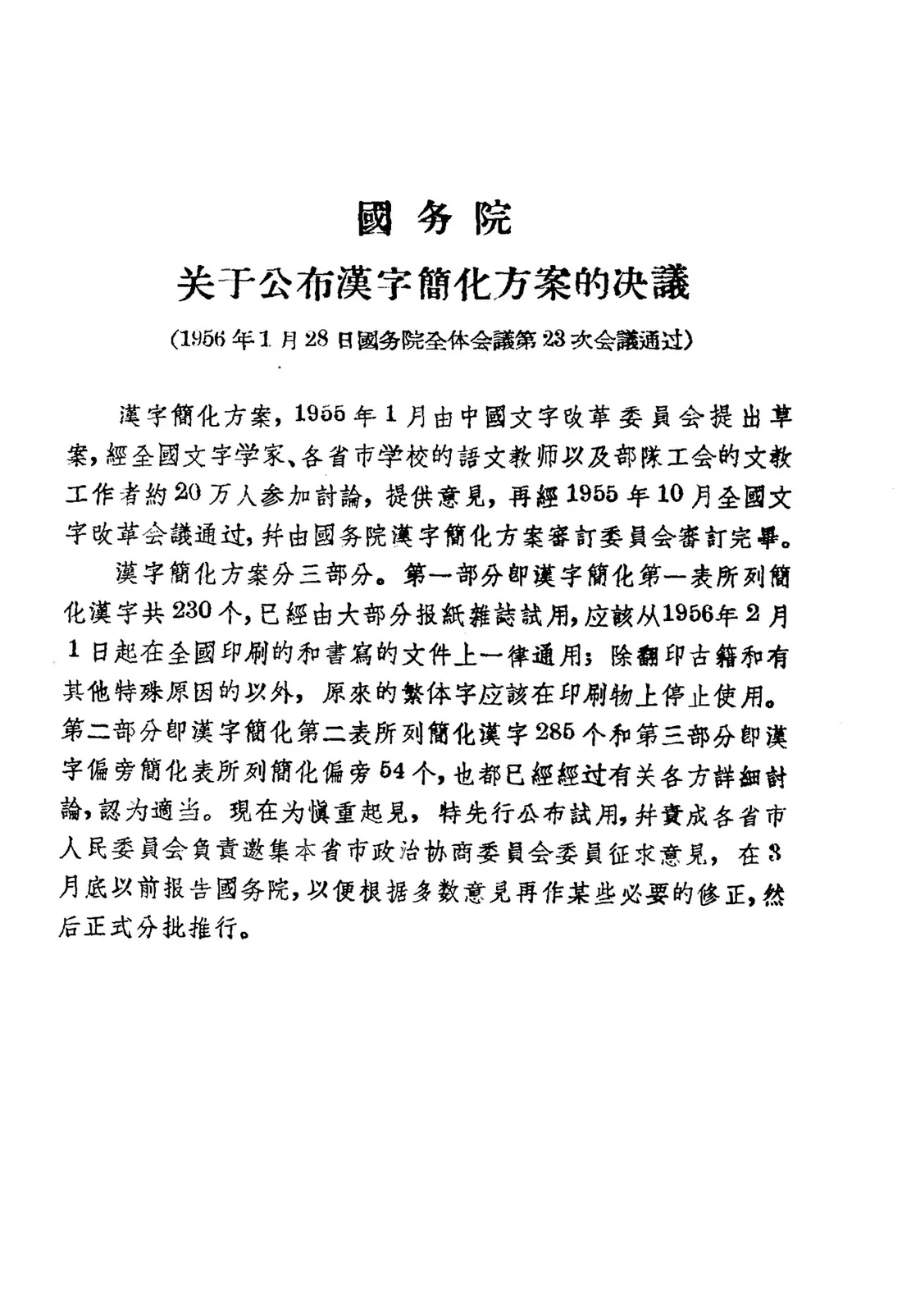
Passed at the State Council’s 23rd plenary session. Table 1 — 230 characters — became mandatory in printed matter from 1 February 1956. Table 2, of 285 characters, and a table of 54 simplified radicals were issued for trial. The resolution directs that traditional forms “should stop being used in printed matter”, excepting reprints of classical texts.
What is contested The figure of 1,055 variant characters abolished is often attached to this scheme. It belongs to a different instrument — the First Table of Variant Characters, December 1955 — and is not folded in here.
Primary source 2 sources · 1 primary
11 February 1958 approved
汉语拼音方案
Hànyǔ pīnyīn fāng’àn
Scheme for the Chinese Phonetic Alphabet
National People’s Congress resolution · National People’s Congress 全国人民代表大会
Approved at the fifth session of the first National People’s Congress. The resolution adopts Pinyin “as a tool for helping people learn Chinese characters and promote Putonghua”, directs that it be taught first in teacher-training and in primary and secondary schools, and that it be extended gradually into publishing.
What is contested Pinyin is widely said to have been intended to replace Chinese characters. The 1958 resolution does not say that — it adopts Pinyin as an auxiliary tool. Zhou Enlai’s separate report of 10 January 1958 states explicitly that Pinyin “is not a phonetic script meant to replace Chinese characters”, but that is his report, which the resolution approves only in principle, and not the enacting text. A long-range romanisation current did exist within the script-reform committee; it is not what this instrument enacts, and the popular claim is misattributed rather than invented. The NPC’s own hosting of the resolution could not be retrieved — the connection fails at the TLS handshake — so the wording rests on convergent reproductions.
Official secondary 2 sources · 1 primary
Divergence
The mainland and Taiwan fix measurably different characters, Korea removes hanja from schooling and then restores it, and one reform overreaches badly enough to be withdrawn.
May 1964 published
简化字总表
Jiǎnhuàzì zǒngbiǎo
Complete List of Simplified Characters
Committee-issued standard table · Committee for Reforming the Chinese Written Language 中国文字改革委员会
Consolidated the 1956 scheme into three tables: 352 characters not used as components, 132 usable as components together with 14 simplified radicals, and 1,754 derived by analogy from those components. Not a State Council instrument — a publication of the script-reform agency, which is why its legal weight differs from the 1956 resolution it consolidates.
What is contested The component figures sum to 2,238. Secondary sources almost universally give 2,236, explained as two characters double-listed — but the table’s own footnote already states its 1,754 figure is deduplicated, and the pair invoked to reach 2,236 is not the pair that footnote describes. The 1964 gazette is not online. No winner is picked here.
Official secondary 1 source
25 October 1968 announced
한글전용 촉진 7개 사항
Hangeul jeonyong chokjin 7-gae sahang
Seven Measures to Promote the Exclusive Use of Hangul
Presidential directive · President of the Republic of Korea 대통령
Moved the target for removing hanja from schooling and administration forward from 1973 to 1970, directed that hanja be taken out of textbooks, and called for the 1948 Act to be amended. A curriculum ordinance of September 1969 then removed the legal basis for hanja instruction, and elementary Korean-language textbooks reverted to hangul-only in March 1970.
What is contested The change is popularly attributed to a presidential special directive of 1 March 1970. The National Archives’ own chronology shows March 1970 only as the month the textbooks changed, within the 1968–69 chain above, and no separate 1970 directive could be located.
Official secondary 1 source
16 August 1972 announced
한문교육용 기초한자 1800자
Hanmun gyoyuk-yong gicho hanja 1800-ja
1,800 Basic Hanja for Classical Chinese Education
Ministry announcement · Ministry of Education 문교부
Fixed 1,800 characters for school instruction — 900 for middle school and 900 for high school — after an August 1972 amendment to the Education Act’s enforcement decree restored a legal basis for teaching hanja. Instruction resumed the following month. The set of 1,800 has proved durable and still governs school hanja teaching.
What is contested Called “the 1972 reversal”, but 1972 supplies only an enforcement-decree amendment and this character list. The binding curriculum ordinances that made classical Chinese an independent required subject came later — ministry ordinance No. 325 of 31 August 1973 for middle schools, No. 350 of 31 December 1974 for high schools. The Ministry’s own archive page for this announcement would not load; the date and the figure rest on the National Archives chronology and search metadata.
Official secondary 2 sources
18 June 1973 promulgated
送り仮名の付け方
Okurigana no tsukekata
Rules for Attaching Okurigana
Cabinet notification · Cabinet of Japan 内閣 昭和48年内閣告示第2号
Seven general rules, each with a principle and its exceptions, plus an appendix of set forms. Its own preface calls it a よりどころ — something to go by — applying to ordinary writing in general social life and expressly excluding technical and specialist terminology and proper nouns. It is the clearest statement in this chronology that a cabinet notification is a reference standard rather than a mandate. Revised on 1 October 1981 to track the new jōyō kanji table.
What is contested Legal drafting follows a separate and narrower Cabinet Legislation Bureau practice, not this notification; the two are frequently merged in secondary accounts. The instrument number for the 1981 revision could not be confirmed and is omitted.
Primary source 2 sources · 1 primary
20 December 1977 published
第二次汉字简化方案(草案)
Dì-èr cì hànzì jiǎnhuà fāng’àn (cǎo’àn)
Second Scheme for Simplifying Chinese Characters (Draft)
Committee draft, issued for trial use · Committee for Reforming the Chinese Written Language 中国文字改革委员会
The draft appeared in the People’s Daily on 20 December 1977. Table 1 listed 248 simplified forms, including 55 derived by analogy, for trial use in publications. Table 2 listed 605 for public discussion. Education authorities stopped trial use in textbooks in April 1978; the propaganda department stopped trial use in newspapers, books and periodicals in July. State Council notice Guofa [1986] No. 64, dated 24 June 1986, formally withdrew the draft.
What is contested The first table was authorized for trial in publications. Neither table was a definitive replacement for the existing official character list. The record is documented by a contemporaneous draft and a later State Council notice.
Official secondary 2 sources · 1 primary
1 October 1981 promulgated
常用漢字表
Jōyō kanji hyō
List of Kanji for Common Use
Cabinet notification · Cabinet of Japan 内閣 昭和56年内閣告示第1号
1,945 characters, replacing the 1,850 of 1946 — and replacing its character too. Where the 1946 list set a range outside which words were to be rewritten, this one is framed as a guide (目安). The restriction becomes a recommendation.
What is contested Two dates circulate for this table and only one is the instrument. The National Language Council reported on 23 March 1981; the Cabinet promulgated on 1 October 1981. Chronologies pick whichever they encountered first. Separately, the commonly quoted breakdown of 95 characters added and none removed could not be confirmed — it traces to ministry pages that would not render. The 1,945 total and the notification number are confirmed on the Agency for Cultural Affairs’ own site.
Primary source 1 source · 1 primary
1 September 1982 announced
常用國字標準字體表
Chángyòng guózì biāozhǔn zìtǐ biǎo
Table of Standard Forms of Common National Characters
Ministry of Education announcement · Ministry of Education, Republic of China 教育部
Fixed 4,808 standard forms for common use. This is the instrument by which Taiwan standardised traditional characters rather than simplifying them — the same problem the mainland answered by simplification, answered instead by fixing which of several received forms is correct. A companion table of less-common characters was promulgated in the same window.
What is contested The companion table’s count differs by revision rather than by disagreement: 6,341 at the 1982 promulgation, 6,343 in the 1993 kai-script revision, 6,329 after a 2017 variant-character revision. Three states of one table. The ministry document number for the 1982 announcement could not be confirmed and is omitted.
Primary source 2 sources · 2 primary
Standardisation
Reform gives way to consolidation: superseding tables, un-merged characters, and romanisation settled by administrative notification rather than by usage.
24 June 1986 promulgated
国务院批转国家语言文字工作委员会关于废止《第二次汉字简化方案(草案)》的通知
Guówùyuàn pīzhuǎn … fèizhǐ … de tōngzhī
State Council notice transmitting the request to abolish the Second Scheme (Draft)
State Council notice · State Council of the PRC 国务院
Ended use of the 1977 draft from the date of the notice, nine years after it was issued and eight after it stopped being used in practice. The Complete List of Simplified Characters was reissued in a new edition dated 10 October 1986, un-merging four characters — 叠, 覆, 像, 囉 — that had been treated as variant equivalents, taking Table 1 from 352 to 350 and the analogy table from 1,754 to 1,753.
What is contested The revised components sum to 2,235. Secondary sources repeat “2,274 characters and 14 radicals”, which does not reconcile with the table’s own stated components under any combination. 2,235 is the figure that adds up; the origin of 2,274 could not be traced, so it is reported rather than dismissed.
Official secondary 2 sources · 1 primary
7 July 2000 promulgated
국어의 로마자 표기법
Gugeo-ui romaja pyogibeop
Romanization of Korean
Administrative notification · Ministry of Culture and Tourism 문화관광부 문화관광부 고시 제2000-8호
Removed the diacritics that could not survive a keyboard. The breve goes — ㅓ becomes “eo” rather than “ŏ”, ㅡ becomes “eu” rather than “ŭ” — and the apostrophes marking aspiration go with it. It is the only instrument in this chronology whose stated problem is computer input, and the reason Korean place names are spelled as they now are in every airport and on every road sign.
What is contested It replaced the South Korean government’s own 1984 standard — Ministry of Education notification No. 84-1, itself an adaptation of McCune–Reischauer — and not the McCune–Reischauer system of 1939, which remains in scholarly use and was never Korea’s to repeal. Amended in turn by notification No. 2014-42 of 5 December 2014, which is the version now in force.
Primary source 1 source · 1 primary
30 November 2010 promulgated
常用漢字表
Jōyō kanji hyō
List of Kanji for Common Use (revised)
Cabinet notification · Cabinet of Japan 内閣 平成22年内閣告示第2号
2,136 characters. Technically a fresh promulgation superseding the 1981 notification rather than an amendment to it. The Council for Cultural Affairs reported on 7 June 2010; the Cabinet promulgated on 30 November. The revision is the first to be shaped by the fact that most Japanese writing is now typed rather than handwritten — characters readers recognise but few could write by hand were admitted on that basis.
What is contested Two framings circulate and both are correct: 196 characters added and 5 removed (勺, 錘, 銑, 脹, 匁 — moved to the names-use list rather than dropped), or a net increase of 191. 1,945 + 196 − 5 = 2,136 = 1,945 + 191. Quoting one figure without the other is what makes two accounts look contradictory. The gross figures rest on a ministry PDF that could not be rendered; the 2,136 total, the date and the notification number are confirmed on the issuing body’s own page.
Primary source 2 sources · 2 primary
5 June 2013 approved in force 19 August 2013
通用规范汉字表
Tōngyòng guīfàn hànzì biǎo
Table of General Standard Chinese Characters
State Council notice · State Council of the PRC 国务院 国发〔2013〕23号
8,105 characters in three levels: 3,500 for general literacy, a further 3,000 by frequency, and 1,605 covering surnames, place names, scientific terms and classical characters used in textbooks. The notice directs that general usage follow this table and that previously relevant tables cease to be used. Released publicly on 19 August 2013. It is the instrument currently in force.
What is contested The notice states the supersession in general terms. It could not be confirmed that it names the 1986 Complete List by title — the tables are published as images rather than extractable text — so the repeal is recorded here as implicit rather than express.
Primary source 2 sources · 2 primary
Listed, not verified
Shown here rather than omitted. For a chronology of instruments, the absence of a citable instrument is itself the finding — and omitting the entry would hide it.
March 1949 recorded
North Korea — No instrument located
North Korea’s abandonment of hanja is generally dated to March 1949 and is the most complete script change any state in the region carried out. No dated instrument for it could be found — no cabinet decision, no Supreme People’s Assembly enactment, no named directive. The date rests on a South Korean academic encyclopedia describing the outcome, which cites no DPRK document.
Why it is held This entry is published unverified and shown apart from the others because the gap is the finding. A separate and genuinely dated DPRK instrument does exist nearby — the 1948 New Orthography of the Korean Language, issued by the Korean Language Research Society — but that is a spelling reform, not a hanja abolition, and merging the two would be exactly the bridging this publication does not do.
Reported 1 source
How to read this
Which date. These instruments routinely carry two or three dates — recommended, passed, promulgated, in force — that can sit months apart, and published chronologies get this wrong more often than they get anything else wrong. Each entry states which date it is placed on. Where an instrument took effect on a different day, that is given too.
Which calendar. Three Korean entries predate Korea's adoption of the Gregorian calendar in 1896 and are marked lunisolar. Sources that print the Gabo edict as "21 November 1894" without qualification are quoting a lunar date in Gregorian dress. No converted equivalent is asserted here.
Contested figures are printed, not resolved. 19 of these entries carry a note where sources disagree or where the popular account departs from the text of the instrument. In two cases the arithmetic of the table itself disagrees with the total every secondary source repeats, and the original gazettes are not online. Picking the figure that adds up and printing it clean would assert a resolution this publication has not earned.
Tier. Each source carries its own grade — the instrument or its issuing body; another government body, national archive or law index, or a verbatim transcription; or press and academic reporting. An entry is graded by the weakest source it actually rests on, not the best one it can cite. A verbatim transcription counts as official secondary even where it reproduces the text exactly, because it is not the issuing body's own publication.
- Reading
- Written variant
- Romanized place name (not a verified pronunciation)
- Literal sense
- In context