Confucian texts crossed borders; Buddhist teachers translated their ideas into new languages; intellectuals wrestled with the arrival of Western philosophy; modern regimes claimed competing inheritances. Shared sources did not produce a single East Asian worldview. They produced arguments.
East Asian Journal Editorial
Revised
8 regional settings
42 selected placements
Long read / Interactive reference
仁마음道ном
Four writing traditions, no universal translation.
The central finding
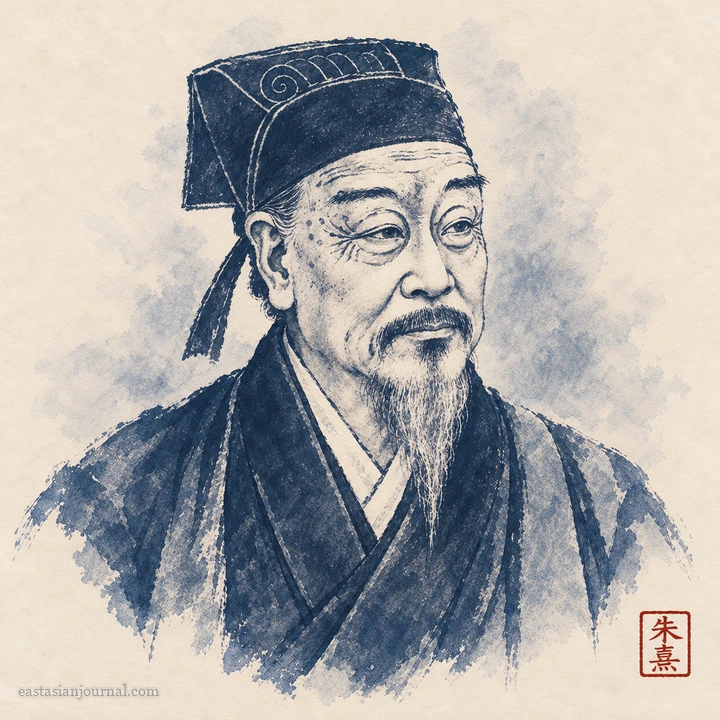
A shared text does not carry a single historical meaning. Zhu Xi’s language of principle could anchor Song scholarship, become the material of Joseon debates about feeling, and meet an Edo philosopher who considered the whole method mistaken. Those arguments are the subject of this feature. Zhu Xi sourceKorean debatesEdo criticism
How to read a philosophical map
Open a survey of East Asian intellectual history and certain names will appear so often that they seem to explain everything. Confucius is one. Zhu Xi is another. A reader soon learns a familiar itinerary: China produced the classics, Korea institutionalized them, Japan adapted them, and later Asian societies encountered Western ideas. The outline is not entirely wrong. It is too tidy to explain the history. Texts did travel. They were copied, taught, annotated and prescribed. Yet each movement changed the questions being asked, the people permitted to answer and the institutions that gave one answer authority over another.
Consider 仁, often translated as humaneness or benevolence. The English word makes it look like an abstract virtue with one permanent meaning. In the Analects, the surrounding discussion concerns trained conduct and obligations among people. In later Confucian philosophy it becomes part of intricate arguments over the source of moral feeling. Twentieth-century thinkers returning to this vocabulary ask a further question: can a moral tradition centered on relationships make room for individual autonomy and democracy? The graph remains familiar. The philosophical problem changes. ConfuciusKorean debatesModern Confucianism
The same caution applies to Buddhism. The word enlightenment tells the uninitiated reader very little about differences among Shingon, Zen, Korean Buddhist synthesis, and Mongolian ritual or didactic literature. One strand makes embodied speech and action central to realization; another asks what it means to practice without separating practice from awakening; another attempts to reconcile conflicting doctrinal statements; a Mongolian poet makes complex teaching intelligible through the imagery of pastoral life. Calling all four simply Buddhist philosophy conceals the labor of interpretation. KūkaiJapanese ZenKorean philosophyMongolian poetry
Nor did texts circulate only through learned agreement. Translators, rulers, religious emissaries, educators, librarians, dissidents and critics altered what could be said and who could hear it. A text could become a civil-service syllabus, a contested religious commentary, a classroom guide or an official ideology. These settings matter, because a political doctrine promoted by a state is not automatically a systematic philosophy, and the reach of an institution is not evidence that its beliefs were unanimously accepted. We keep philosophers, religious thinkers, reform writers, historians and ideological officials visibly distinguished.
The eight regions below are the contemporary editorial organizing frame of East Asian Journal: Japan, South Korea, Taiwan, mainland China, Hong Kong, Macau, Mongolia and North Korea. They are not eight eternally separated civilizations. Silla and Joseon thinkers predate both Korean states. Confucius and Zhu Xi lived long before the People’s Republic of China or the Republic of China’s postwar political geography. The Jesuit mission period in Macau belonged to a different political order again. It would be an error to impose today’s passport on yesterday’s thinker.
Two kinds of movement run through the guide. In Japan, Korea, Taiwan, mainland China and Hong Kong, writers argued over a shared corpus of classics in literary Chinese, and their disagreements can be traced passage by passage. Elsewhere the material that travelled was different. Buddhist teaching reached Mongolia largely through Tibetan; Jesuit missionaries in Macau studied Chinese learning for religious ends of their own; the North Korean state built its doctrine in the twentieth century from Marxism-Leninism and nationalism. Across both kinds the guide asks the same two questions: what did later people do with what reached them, and which institution gave their reading authority?
These observations also change how to write about influence. A later writer might say they learned from a predecessor while revising almost everything. Two contemporaries may work on a shared manifesto yet disagree about its central philosophy. A modern revolutionary might use inherited vocabulary for a fundamentally different political project. For this reason the network below permits relations such as reinterpretation, contestation and collaboration, and documents them individually. An arrow does not automatically mean that the first thinker directly taught the second.
One passage, three readings
Begin with a scene from the Mencius (2A.6). Anyone who suddenly sees a small child about to fall into a well, Mencius says, feels alarm and distress, and the feeling arrives before any thought of pleasing the parents, earning the neighbours’ praise or avoiding a reputation for coldness. From that moment he draws four beginnings, the 四端. The heart of compassion (惻隱之心) is the sprout of humaneness; shame and aversion, of rightness; deference, of propriety; the sense of right and wrong, of wisdom. Everyone has them, and they still have to grow: Mencius compares extending them to a fire catching or a spring breaking through. Mencius
Zhu Xi read the scene with a distinction Mencius never drew. Human nature (性) is principle (理), complete and good in everyone. What a person feels (情) belongs to the activity of the heart-mind. The alarm at the well is therefore a feeling through which the principle of humaneness becomes visible, and Zhu Xi glosses 端 as the end of a thread that shows a thread lies within. Cultivation means investigating principle and keeping the heart-mind attentive so that feeling issues correctly. Zhu Xi
That account left Joseon scholars a problem. If the Four Sprouts are feelings, how do they differ from the Seven Emotions listed in the Book of Rites: joy, anger, sorrow, fear, love, hatred and desire? Yi Hwang answered that the Four issue from principle with vital force (氣) following, while the Seven issue from vital force with principle riding on it. Ki Taesŭng objected that the Four are simply the good part of the Seven, so they cannot have a separate source. Yi I later took Ki’s side on the central point: only vital force issues, and principle always rides on it. The practical question was whether moral feeling has a source of its own that a person can recognise and protect, or whether all moral training works through ordinary emotion. The Four-Seven debateYi I
Ogyū Sorai, in Edo Japan, moved the question somewhere else. For him the Way (道) was the rites, music, punishments and government created by the ancient sage kings (先王之道). Inspecting one’s own feelings could not produce order in a realm; people became good by being shaped over time through those institutions. The sprouts mattered less to Sorai than the arrangements that train the people who have them. Sorai
One passage now carries three questions. What begins moral goodness? What explains moral feeling? What makes good government possible? Mencius answered the first, Zhu Xi and the Korean debaters contested the second, and Sorai put the weight on the third. The essays below follow the same kind of movement through eight settings.
A practical test
Ask more than who influenced whom. Ask what a thinker actually argued, what text survives, which institution transmitted it, who disputed it and what cannot be established from the evidence.
8 regions · 42 regional selections · 40 distinct people and textual traditions
Choose a region, follow a scholar to their works, or start with a question about what an inherited character can mean. Each profile marks the person’s role and cites its claims.
The eight sections are all visible if scripts are disabled. With scripts enabled, the selector focuses one region at a time. Every thinker has a permanent link.
01 / 6 selected
Japan日本
Classical inheritance, Zen practice, philology and the encounter with modern philosophy
Japan did not passively receive a ready-made Chinese worldview. Buddhist monks, Edo philologists and modern academics read imported ideas against local practice, texts and institutions.
Why this selection: Six people who made original arguments in Japan, from Kūkai’s Shingon to Nishida’s Kyoto School.
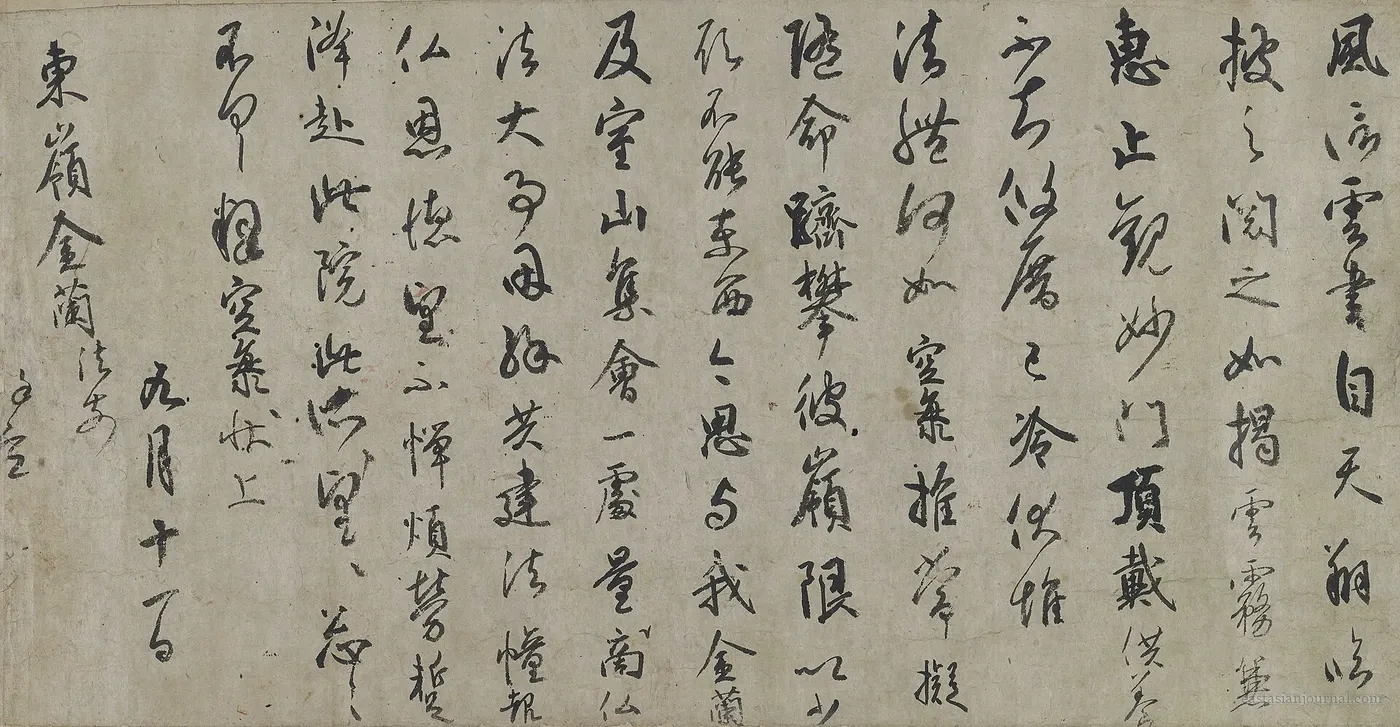
01 · BuddhistKūkai空海 · 774–835Religious philosopherKūkai developed Shingon accounts of embodiment and the three mysteries of body, speech and mind as means of awakening.Read the argument & sources ↓
Fūshinjō (風信帖), letters from Kūkai to Saichō, early ninth century. Tō-ji, Kyoto.Original: Tō-ji, Kyoto. Public domain, via Wikimedia Commons.
Names: Kūkai · Kōbō Daishi
Life and setting
The study of Buddhist ritual took Kūkai (774–835) from Japan to Tang China. He had first pursued a classical education before turning to Buddhist ascetic practice. In 804 he traveled to Chang’an; there, the esoteric master Huiguo initiated him into a transmission organized around the Buddha Mahāvairocana (Dainichi). He returned in 806 with scriptures and ritual materials. Imperial patronage and the establishment of a mountain center at Kōyasan from 816 gave that learning a durable Japanese setting. [2]
The work
即身成仏義 (Meaning of Becoming a Buddha in This Body). This doctrinal treatise asks how Buddhahood can be realized within embodied life. It brings cosmology, scriptural interpretation and ritual practice into one argument. The title is a claim about the possibility of realization in this body, not a promise that it happens without training. [2]
The idea, step by step
Begin with the supposed boundary between an ordinary practitioner and the cosmic Buddha. For Kūkai, the six elements, including consciousness, constitute both the cosmos and embodied existence; the body is already implicated in the field of awakening. [2]
The practitioner then trains body, speech and mind together. A ritual gesture (mudra), an articulated mantra and visualization of a mandala coordinate those three activities with the Buddha’s corresponding “mysteries.” [2]
This changes the role of practice. An embodied act can manifest the relationship the doctrine describes, so liberation need not be placed in a remote future or outside bodily existence. Its realization still depends on disciplined esoteric practice. [2]
Who disagreed
Kūkai argued within a Buddhist landscape that included Saichō’s Tendai school and older Nara traditions. In his later classification of ten stages of mind he placed Shingon above the other schools, including Tendai, as the fullest articulation of the Dharma. The ranking was Kūkai’s sectarian argument about what counted as complete teaching and practice; it should not be mistaken for a consensus among the schools he assessed. [2]
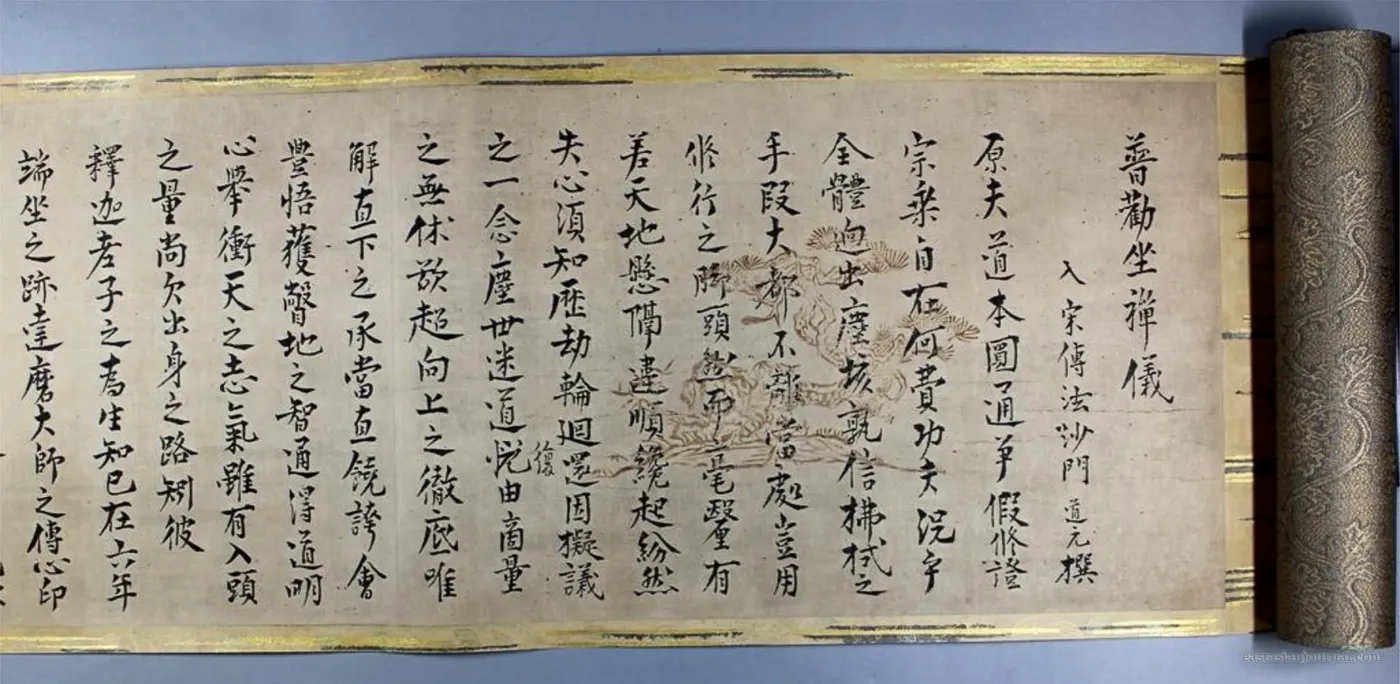
02 · BuddhistDōgen道元 · 1200–1253Religious philosopherDōgen made sitting practice central to philosophical inquiry into time, practice and realization.Read the argument & sources ↓
Fukan zazengi (普勧坐禅儀), Dōgen's instructions for seated meditation, in his own hand, 1233. Eihei-ji.Original: Eihei-ji. Public domain, via Wikimedia Commons.
Names: Dōgen
Life and setting
Dōgen (1200–1253) studied within Japanese Buddhist institutions before crossing to Song China, where he trained under the Chan master Rujing. On returning to Japan he developed a community centered on seated practice. Its move from the Kyoto region to Echizen in the 1240s, and the monastery later named Eiheiji, placed his teaching within a demanding communal routine rather than an isolated exercise of meditation. [46]
The work
正法眼蔵 (Treasury of the True Dharma Eye). The Shōbōgenzō is a developing collection of essays, many written in Japanese, on practice, language, being and time. Its fascicles circulated and were assembled in differing arrangements after Dōgen’s death; treating the collection as a single book finalized by its author obscures that textual history. [46]
The idea, step by step
Suppose sitting meditation is merely a technique for obtaining enlightenment later. The result is always somewhere beyond the current activity. Dōgen challenges that separation of means from fulfillment. [3][46]
In shikantaza, disciplined sitting is itself an expression of practice-realization. Posture, attention and the conduct of the monastery matter because awakening is enacted through activity, rather than held as an idea detached from it. [3][46]
His discussion of being-time (有時, uji) presses the point further: existence and temporality must be considered together, through the changing activity of things. This is a philosophical proposal, and its precise interpretation remains debated. [46]
Who disagreed
The later Rinzai master Hakuin Ekaku organized kōan training around cases tested in consultation with a teacher. Dōgen’s Sōtō emphasis on seated practice gives the relation between practice and realization a different center of gravity. This is a comparison of later lineages, not a personal exchange: Dōgen himself also interpreted kōans and worked intensely with language. [3][46]
03 · ConfucianOgyū Sorai荻生徂徠 · 1666–1728Political philosopherSorai questioned Zhu Xi school moral psychology and instead studied the rites, language and institutions of ancient kings.Read the argument & sources ↓
Names: Ogyū Sorai · Sorai
Life and setting
In Tokugawa Edo, Ogyū Sorai (1666–1728) worked within the household of the powerful daimyo Yanagisawa Yoshiyasu. His encounters with spoken Chinese were practical as well as scholarly: he later urged Japanese readers to study contemporary Chinese speech and founded a translation society in 1711. The project challenged the habit of reading Chinese classics as though familiar Japanese scholarly conventions carried their meanings intact. [4][47]
The work
弁名 (Distinguishing Names). Benmei is an inquiry into the meanings of moral and political terms in the classical tradition. Sorai approached words as instruments through which ancient sages taught an order of life. Recovering what the names meant was therefore also an inquiry into government. [4]
The idea, step by step
Start with a word such as 道, the Way. A reader may assume it names an inner moral principle that a person discovers by introspection. Sorai asks what actions and arrangements the ancient texts attach to the term. [4]
Those arrangements include rites, music, law and official institutions established by the early kings. They organize repeated public conduct. Their effects depend on learning how to perform them, much as knowledge of ceremonial form requires participating in the ceremony. [4]
A ruler therefore cannot repair public disorder simply by demanding purer thoughts. In Sorai’s account, good government supplies institutions within which conduct is trained and coordinated; language matters because it identifies what those institutions were made to do. [4]
Who disagreed
Zhu Xi’s tradition treated the investigation of principle and cultivation of the mind as central to ethical learning. Sorai objected that a mind cannot simply divide into a controller and a thing controlled. Itō Jinsai, another critic of orthodoxy, placed particular weight on the Analects and Mencius; Sorai privileged the Six Classics as records of a political order established before Confucius. Their disagreement concerned both the archive to study and the activity learning was meant to produce. [4]
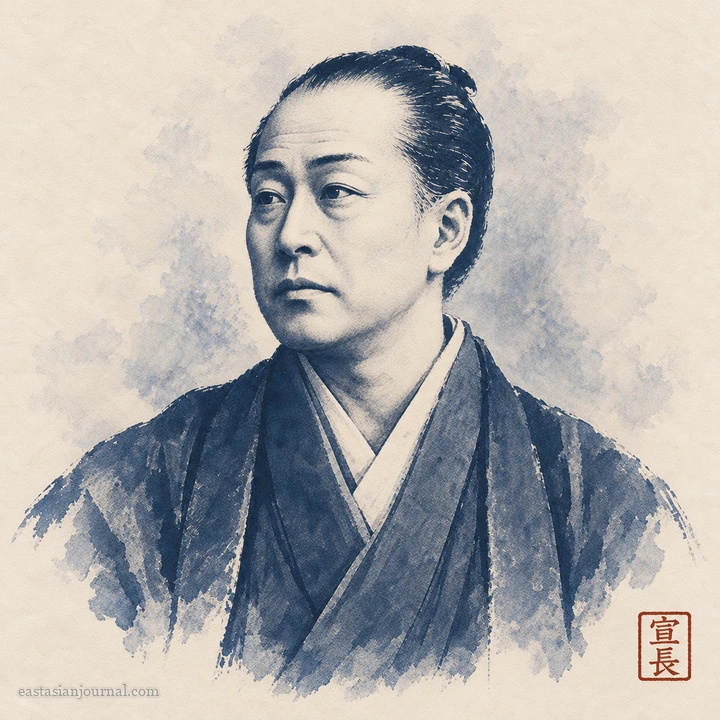
04 · Classical philologyMotoori Norinaga本居宣長 · 1730–1801Philologist and philosopherMotoori read early Japanese texts philologically to reconstruct a native way distinct from scholarly Chinese models.Read the argument & sources ↓
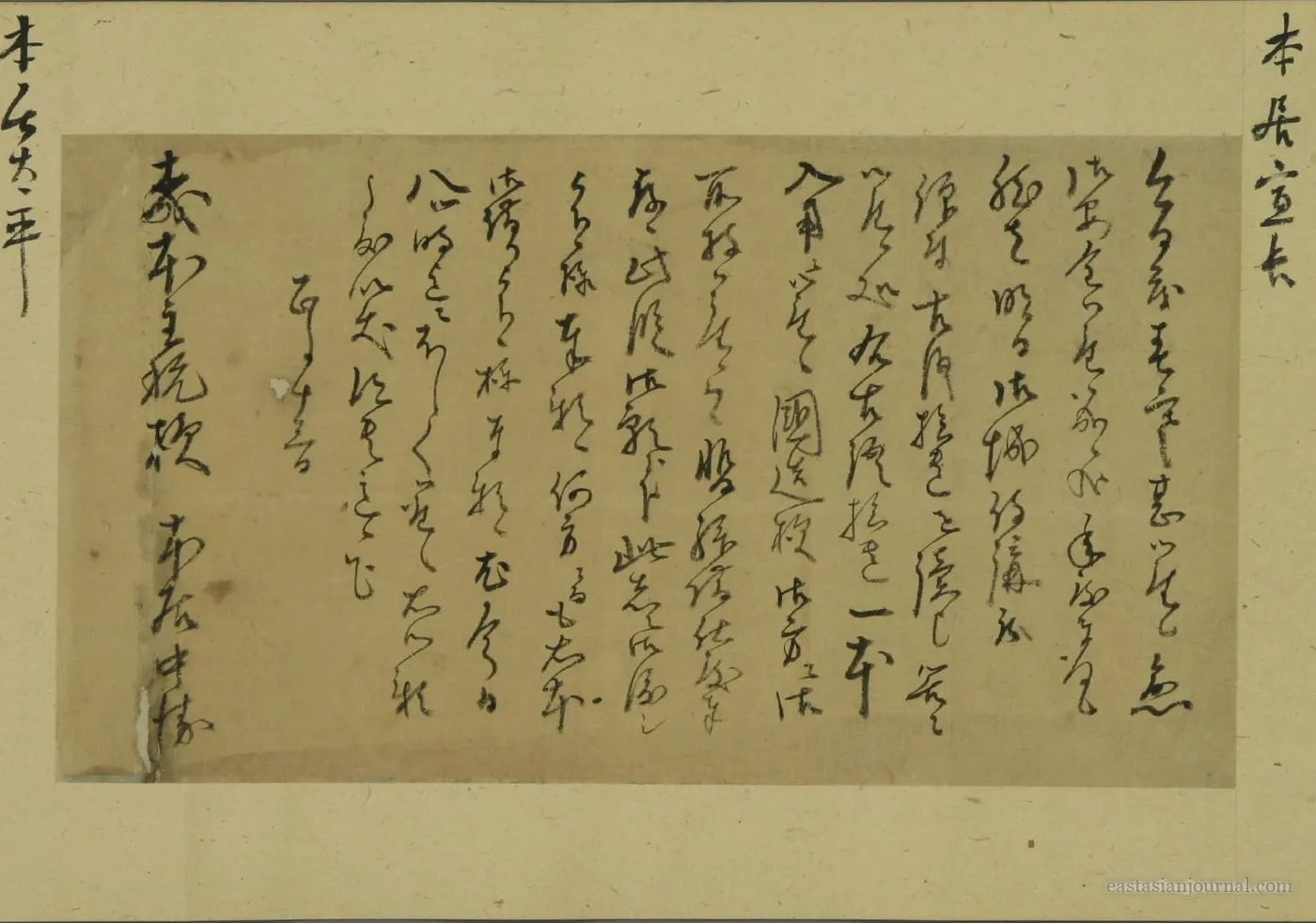
A letter in Motoori Norinaga's hand, about 1801, with his name on the mounting slip.Original: Waseda University Library. Public domain, via Wikimedia Commons.
Names: Motoori Norinaga
Life and setting
Motoori Norinaga (1730–1801) did much of his scholarship in Matsusaka, near the Ise shrines, rather than in an official Edo academy. He met the older Kokugaku scholar Kamo no Mabuchi during a single evening in 1763. Their common interest in early Japanese texts concealed a real dispute about which periods and literary forms best disclosed Japan’s past. [5]
The work
古事記伝 (Commentary on the Kojiki). Kojikiden is a sustained philological commentary on the Kojiki, compiled in 712. Motoori worked to establish the meanings of archaic words and readings before using the ancient narratives to argue for a Way of the kami. The commentary is thus both linguistic inquiry and a theological-historical construction; its claims about a divine past are his interpretation of the text. [5]
The idea, step by step
The Kojiki survives in writing shaped by Chinese characters. A later reader can too easily import learned Chinese meanings into old Japanese expressions. Motoori begins by reconstructing usage and pronunciation to recover what a passage was understood to say. [5]
His literary criticism applies a related restraint. In The Tale of Genji, a moral verdict can obstruct attention to a character’s suffering. Motoori first asks readers to recognize the emotional force of a scene. [5]
He then treats the archaic record as evidence for a distinctive kami-centered order. That move exceeds philological recovery: treating divine history as authoritative is Motoori’s commitment, not a modern historical finding. [5]
Who disagreed
Mabuchi elevated the older Man’yōshū and distrusted the refinement of Heian court literature, whereas Motoori defended The Tale of Genji as an unusually penetrating record of feeling. Later, Hirata Atsutane remade Motoori’s troubling account of the underworld, Yomi, into a doctrine in which the dead inhabit a concealed spiritual realm. These are two different revisions of Kokugaku: one about literary authority, the other about what ancient narratives permit scholars to claim about death. [5]
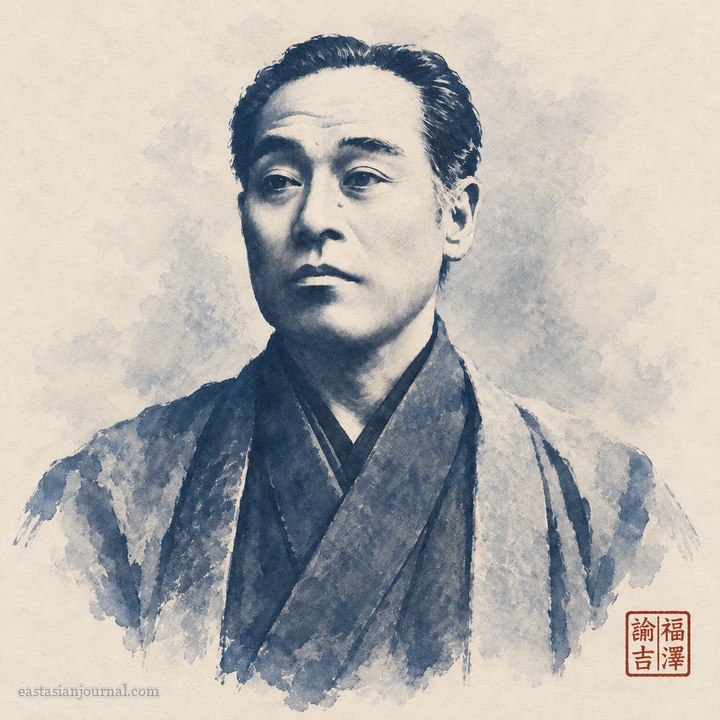
05 · Modern philosophyFukuzawa Yukichi福澤諭吉 · 1835–1901Public intellectual and educatorFukuzawa argued that learning and personal independence were foundations of a modern society.Read the argument & sources ↓
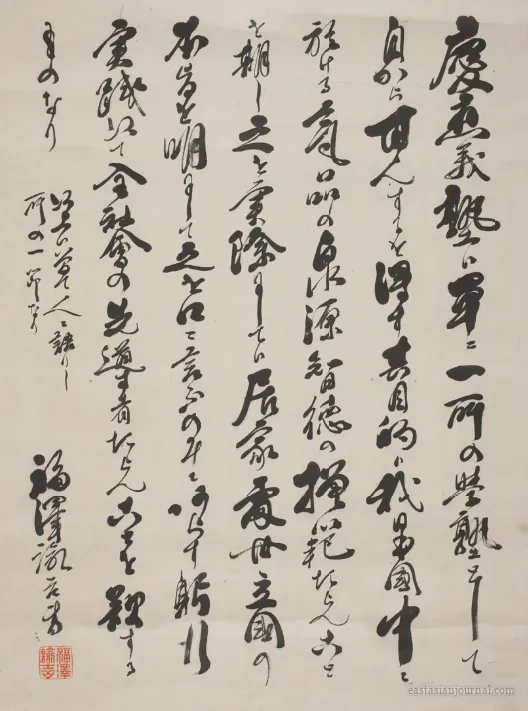
Keiō Gijuku no mokuteki (慶應義塾之目的), the purpose of Keio, in Fukuzawa Yukichi's own hand.Original: Keio University. Public domain, via Wikimedia Commons.
Names: Fukuzawa Yukichi
Life and setting
Fukuzawa Yukichi (1835–1901) came of age as Japan’s political order was being dismantled. The son of a samurai in the Nakatsu domain, he studied Dutch learning and later traveled on Japanese missions to the United States and Europe. He built a career in teaching, publishing and public argument instead of taking an official post in the new Meiji government; the institution he developed became Keio. [7]
The work
学問のすゝめ (An Encouragement of Learning). First issued in 1872, this work appeared as seventeen pamphlets through 1876 and was gathered into a volume in 1880. It was addressed to readers confronting new political and social institutions, beginning with an installment connected to a school in Fukuzawa’s native Nakatsu. It presents study as a means of escaping the constraints of inherited rank. [48][8]
The idea, step by step
Begin with status: hereditary rank once assigned people unequal positions before they had done anything. Fukuzawa asks what should replace that hierarchy in a society where people must be able to direct their affairs. [7][48]
Practical study supplies part of the answer. Literacy, calculation and knowledge of the world help an individual judge claims, earn a living and understand institutions. Formal equality alone cannot perform those tasks on the individual’s behalf. [7][48][50]
He then scales the argument upward. A country populated by dependent subjects will have difficulty sustaining national independence. Education connects the individual’s ability to act with a state’s capacity to resist domination; his later political journalism, however, cannot be read off that educational argument as though his position never changed. [7][49]
Who disagreed
An unsigned 1885 editorial in the newspaper Jiji shinpō, later associated with Fukuzawa, made the phrase 脱亜 (datsu-A, “leaving Asia”) a flashpoint. Historians have disputed its authorship, contemporary prominence and relation to Japanese imperial expansion. Hirayama Yō questioned its attribution and subsequent reputation; Maruyama Masao analyzed the period meaning of “Asia,” while postwar critics read it through Japan’s later aggression. Later events cannot settle the editorial’s disputed authorship or original meaning. [49]
Why here. His Meiji-era educational writing made institutional reform and Western knowledge matters of public debate. [7][8]
What the popular account misses. His political positions changed over time; an early defense of independence cannot stand in for all his later foreign-policy writing. [7][8]
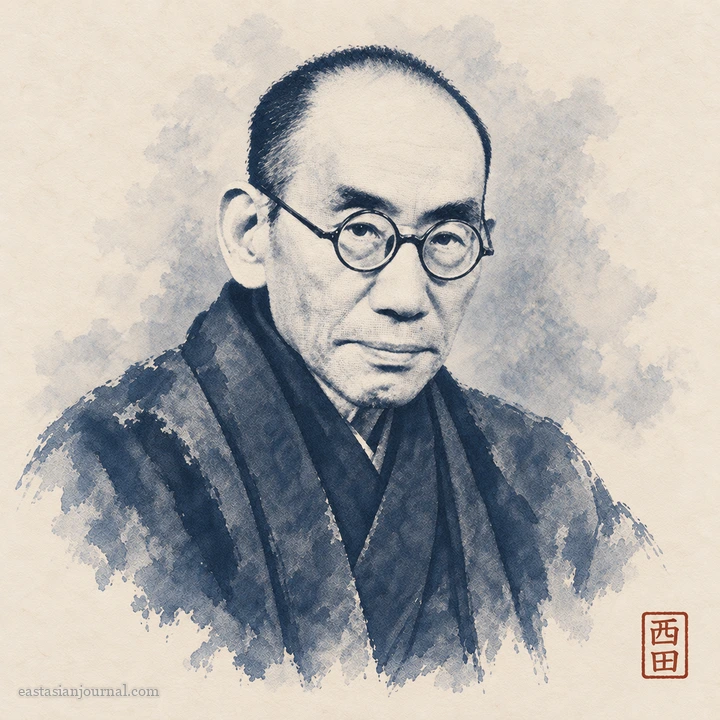
06 · Modern philosophyNishida Kitarō西田幾多郎 · 1870–1945Systematic philosopherNishida moved from pure experience toward an account of place and absolute nothingness in dialogue with European philosophy.Read the argument & sources ↓
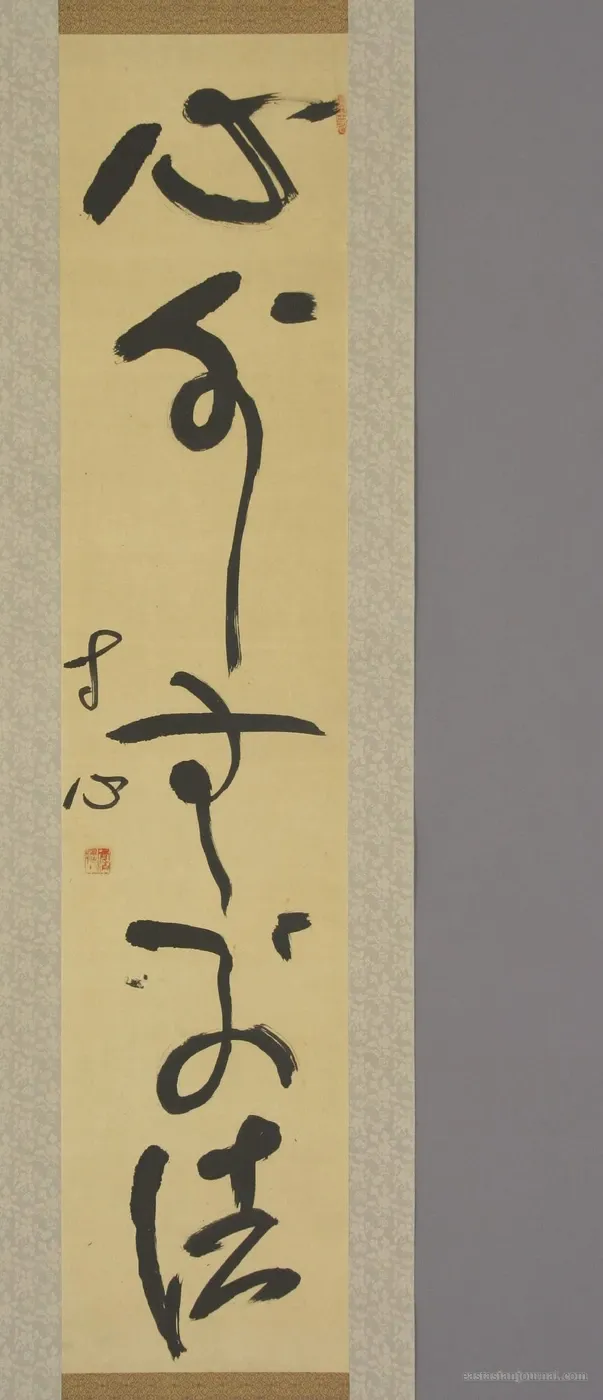
Calligraphy scroll by Nishida Kitarō.Original: Waseda University Library. Public domain, via Wikimedia Commons.
Names: Nishida Kitarō
Life and setting
At Kyoto University, Nishida Kitarō (1870–1945) helped establish a place for systematic philosophy in modern Japan. His reading moved between Buddhist resources and European and American philosophy, including William James. The intellectual circle around him later included Tanabe Hajime, Miki Kiyoshi and Tosaka Jun, who did not simply inherit his positions unchanged. [6]
The work
善の研究 (An Inquiry into the Good). Published in 1911, this philosophical work starts from pure experience and asks how knowing, willing and ethical life emerge from it. Later Nishida developed a logic of place (場所, basho) and absolute nothingness; those later formulations should not be smuggled back into the 1911 book as though they were already complete. [6]
The idea, step by step
Consider hearing a note before deciding what produced it. Attention first encounters the sound; only then may reflection describe a perceiver, a source and an act of perception. Nishida calls the prior, undivided occurrence pure experience. [6]
Subject and object are therefore distinctions that emerge within experience. If they are assumed at the outset, inquiry loses sight of the activity through which both become recognizable. Nishida wants to begin from that activity. [6]
The early argument expands from knowing to action and the good, understood through the integration and expression of life. His later question changes: what encompassing “place” allows opposed determinations, including self and world, to arise and relate? [6]
Who disagreed
Tanabe Hajime, joined in different ways by Miki Kiyoshi and Tosaka Jun, challenged the insufficient place Nishida initially gave to historical action and social reality. Nishida’s writings of the 1930s responded with the idea of a historical world formed through acting individuals. That turn raises another difficult issue: the language of state and world in his wartime-era philosophy has received conflicting political interpretations, and philosophical influence does not by itself resolve his relationship to Japanese nationalism. [6]
Korean Buddhism, Joseon disputation and women’s philosophical voices
The term South Korea names today’s destination for the comparison, not the political community to which Silla, Goryeo or Joseon scholars belonged. Their work forms a shared Korean inheritance from before division.
Why this selection: Wonhyo, Yi Hwang, Yi I and Jeong Yak-yong, with the Joseon philosopher Im Yunjidang and the twentieth-century Buddhist writer Kim Iryeop.
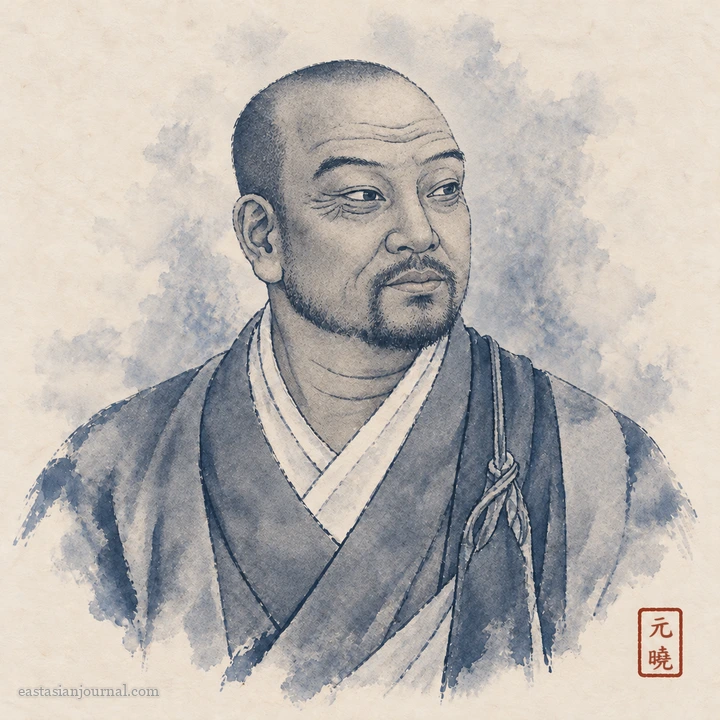
01 · BuddhistWonhyo원효 · 元曉 · 617–686Buddhist philosopherWonhyo worked to reconcile divergent Buddhist interpretations through a philosophy of One Mind.Read the argument & sources ↓
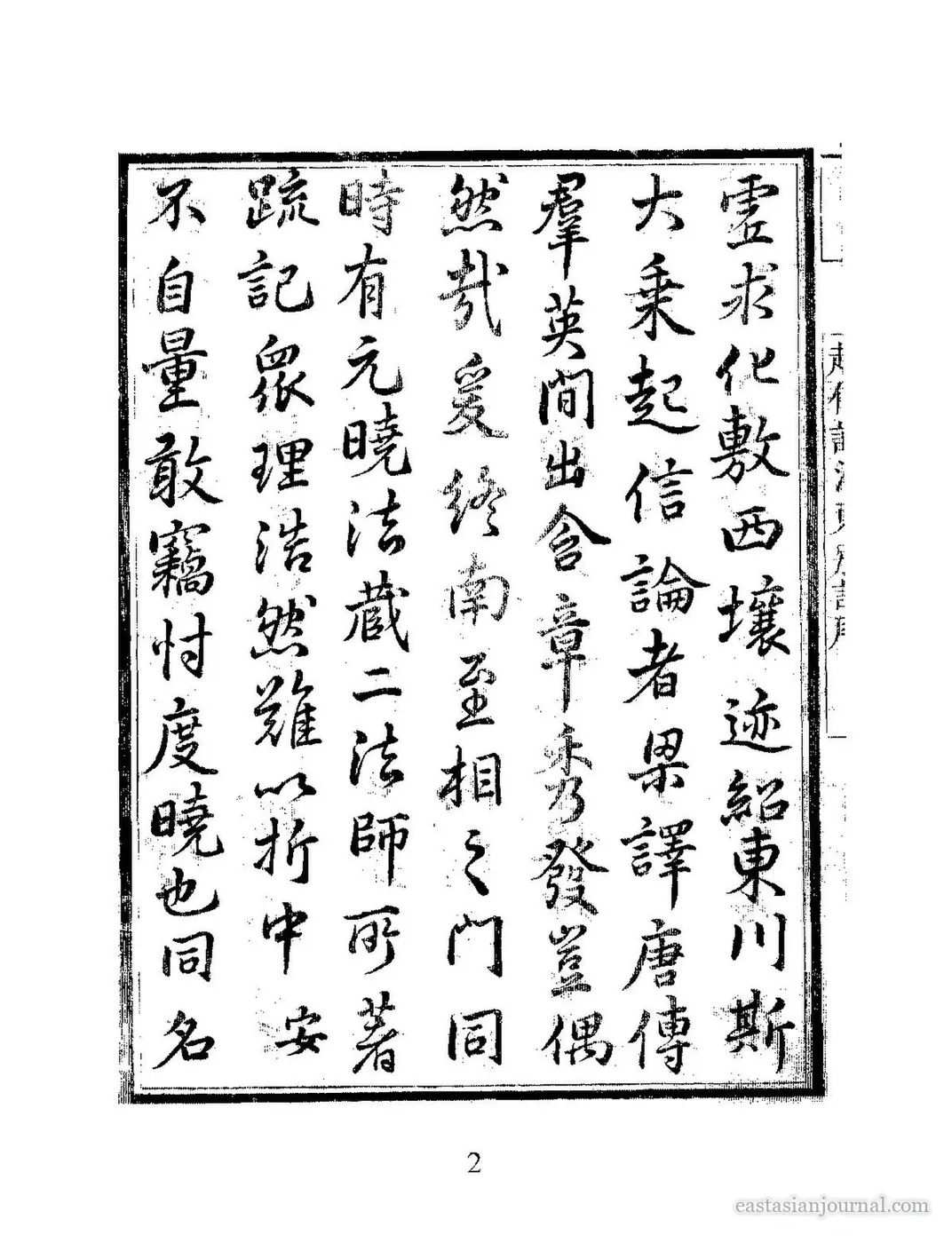
Daeseung gisillon byeolgi (大乘起信論別記), Wonhyo's commentary on the Awakening of Faith, in a Japanese woodblock edition of 1781.Original: National Library of Korea. Public domain, via Wikimedia Commons.
Names: Wŏnhyo
Life and setting
When Wŏnhyo (617–686) wrote in the Silla kingdom, Buddhist teachings reaching the Korean peninsula carried competing accounts of consciousness, emptiness and liberation. Scholars often sorted them into ranked schools. Wŏnhyo instead examined why doctrines that appeared contradictory might describe different aspects of a shared problem. His intellectual setting belonged to Silla’s transregional Buddhist networks, long before modern national borders. [9][51]
The work
大乘起信論疏 (Commentary on the Awakening of Faith). This commentary interprets the influential East Asian Buddhist treatise Awakening of Faith in the Mahāyāna. It examines how an originally enlightened mind can appear deluded, and how transformations in consciousness make practice intelligible. Wŏnhyo is the commentator here, not the author of the underlying treatise. [9][51]
The idea, step by step
Start with an apparent contradiction: if awakening is intrinsic to mind, why do ignorance and suffering persist? Assigning a pure mind and a corrupt mind to two unrelated beings would leave their relation unexplained. [9]
Wŏnhyo describes One Mind through two aspects or “gates”: suchness, the unchanging dimension, and arising-and-ceasing, the dimension in which habits and disturbances are experienced. The storehouse consciousness (ālayavijñāna) helps explain how earlier actions condition later experience. [9]
The distinction preserves a path of cultivation. Defilement is real at the level of conditioned activity, while original enlightenment remains possible within the same mind. Doctrinal harmonization can then ask what each school explains instead of flattening all differences into identical propositions. [9]
Who disagreed
The Chinese Huayan thinker Fazang drew on Wŏnhyo yet interpreted the relation between tathāgatagarbha and storehouse consciousness differently. In Sumi Lee’s analysis, Fazang allows original Buddha-nature to interact directly with the arising-and-ceasing mind, while Wŏnhyo’s twofold account also preserves an aspect untouched by arising and ceasing. The difference affects how commentators reconcile the Awakening of Faith with earlier Yogācāra accounts of consciousness. It is a comparison of commentaries, not evidence of a personal dispute. [51]
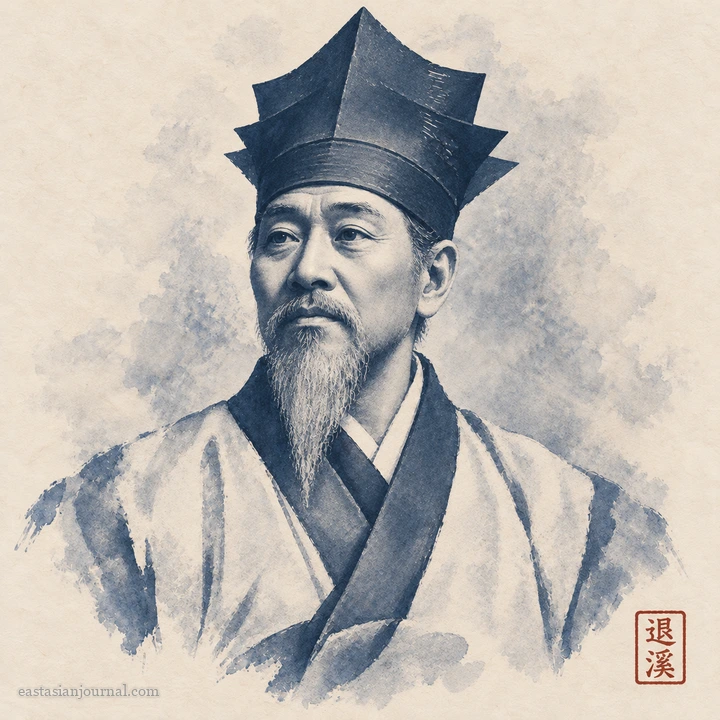
02 · ConfucianYi Hwang이황 · 李滉 · 1501–1570Neo-Confucian philosopherToegye investigated the Four Sprouts and Seven Emotions through the interrelation of principle and vital force.Read the argument & sources ↓
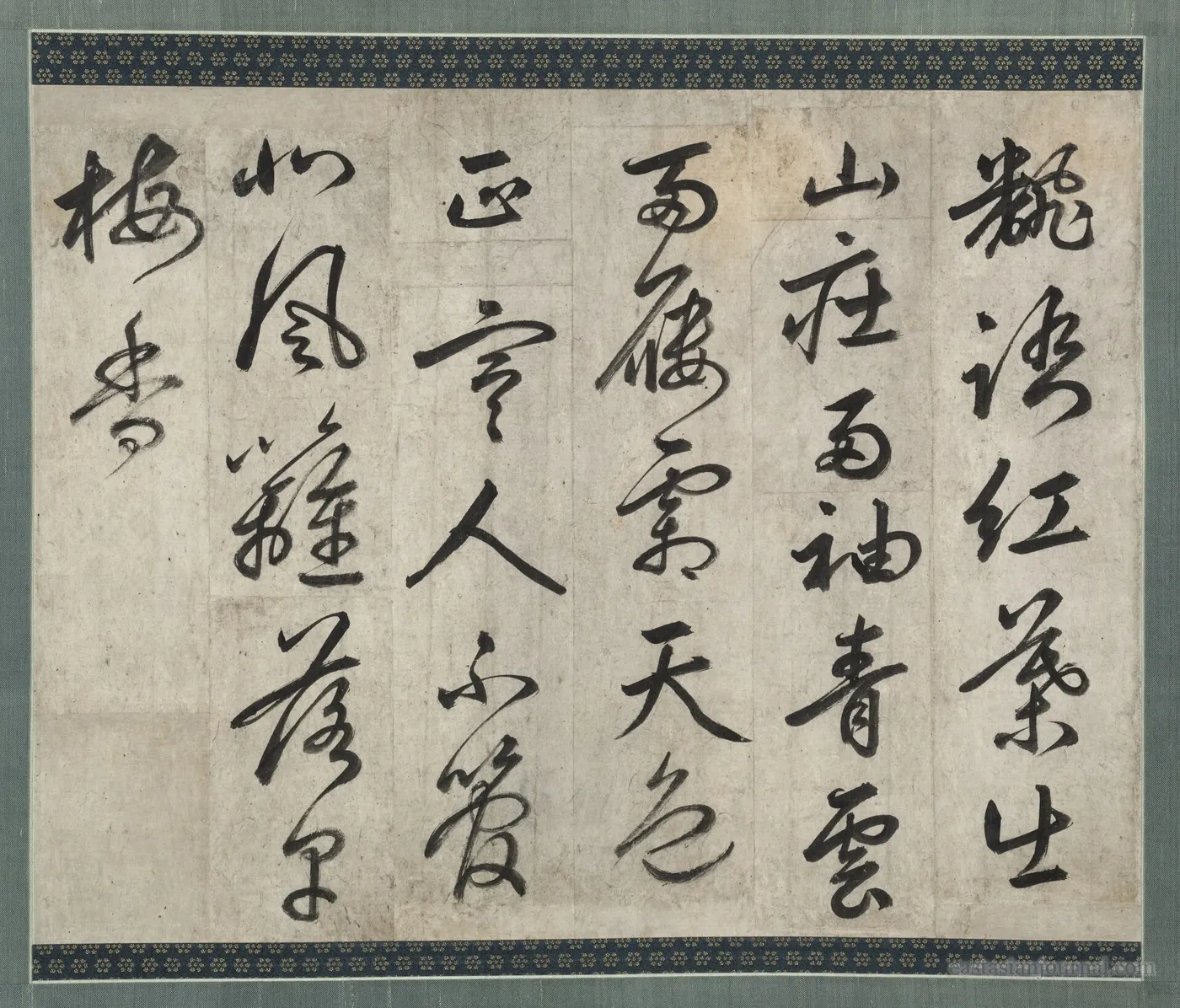
Poem on Plum, calligraphy by Yi Hwang (Toegye), Joseon, sixteenth century.Original: Cleveland Museum of Art, 1992.138. CC0.
Names: Yi Hwang · Toegye
Life and setting
In sixteenth-century Joseon, scholar-official Yi Hwang (1501–1570), known as Toegye, worked within a state that made Neo-Confucian learning a matter of governance. Its scholars inherited Zhu Xi’s account of good human nature, but still had to explain why ordinary feelings lead to both generous and harmful conduct. Yi’s exchanges with the younger Ki Taesŭng turned that difficulty into an unusually precise debate. [10]
The work
聖學十圖 (Ten Diagrams on Sage Learning). Completed in 1568, this visual teaching work assembles ten diagrams by Chinese and Korean thinkers, including three by Yi himself. It leads the learner from cosmology and social relations toward the governance of the heart-mind. Its organizing discipline is reverent attentiveness (敬), a demand on conduct as much as on understanding. [10]
The idea, step by step
Mencius describes spontaneous compassion, such as distress at a child approaching danger, as one of four beginnings of virtue. The Book of Rites also enumerates seven ordinary emotions, including joy, anger and sorrow. Both accounts concern feelings; their moral sources are the puzzle. [10][52][53]
Yi gives moral beginnings explanatory priority through principle (理, i), with vital force (氣, ki) following. For the seven emotions, vital force initiates and principle accompanies it. This asymmetry protects the goodness of principle without calling every emotion good. [10]
Ki Taesŭng objected that principle and vital force cannot operate as independent substances. Yi modified his earlier formulation while preserving the distinction between kinds of arising. In practice, a response of compassion must still be sustained by attention and expressed in action. [10]
Who disagreed
Ki Taesŭng denied Yi’s initial suggestion of two independent origins for the Four Beginnings and Seven Emotions. Yi revised that account, retaining principle’s primacy while recognizing its inseparability from vital force in actual feeling. Yi I later advanced a sharper alternative: vital force activates both the Four and the Seven, while principle rides along. The issue was what moral cultivation can rely on when feeling is always embodied and variable. [10][9]
Why here. The correspondence with Ki Taesŭng established distinctively Korean arguments about moral psychology. [9][10]
What the popular account misses. He revised initial formulations during debate; portraying his theory as a single unchanging slogan is misleading. [9][10]
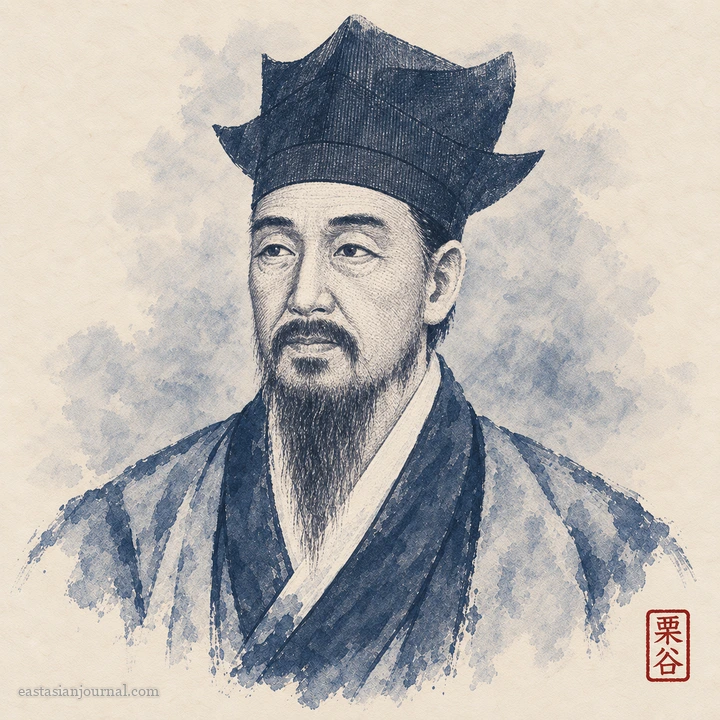
03 · ConfucianYi I이이 · 李珥 · 1536–1584Neo-Confucian philosopherYulgok emphasized the inseparability of principle and material force in actual human life.Read the argument & sources ↓
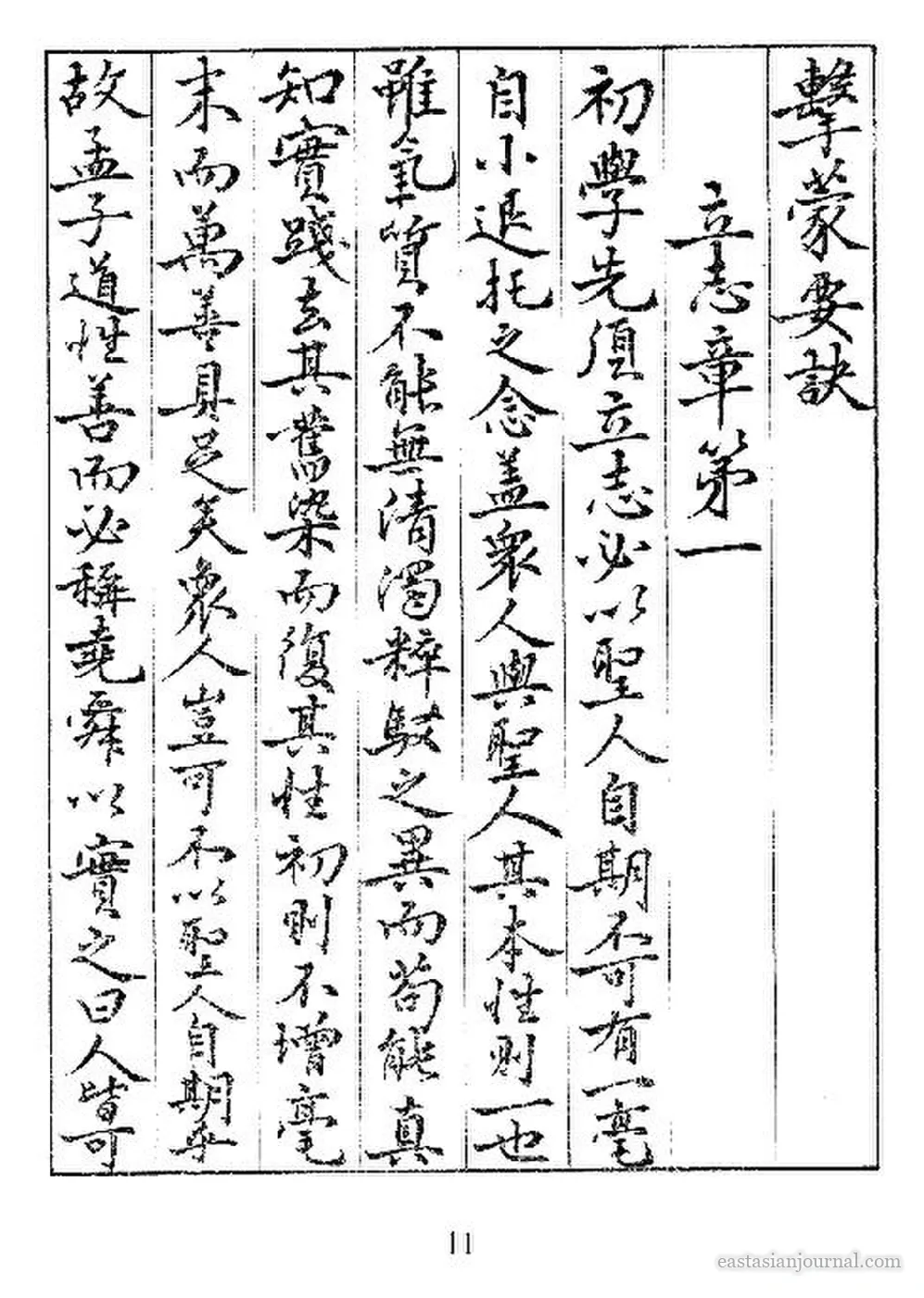
Gyeongmong yogyeol (擊蒙要訣), the opening chapter on setting one's resolve (立志), from a 1928 facsimile of Yi I's own draft of 1577.Original: National Library of Korea. Public domain, via Wikimedia Commons.
Names: Yi I · Yulgok
Life and setting
For Yi I (Yulgok, 1536–1584), the education of a Joseon ruler was a problem of moral psychology with consequences for government. Court counsel placed the king under the same demands of self-scrutiny that a scholar faced. Yi worked within the Neo-Confucian tradition shaped by Zhu Xi, yet regarded the division of moral and ordinary feelings as a danger to its account of human action. [10][9]
The work
聖學輯要 (Essentials of the Learning of the Sages). This compilation of instructions for royal sage learning joins the rectification of the mind to the task of governing people. A king cannot rely on the dignity of his office as evidence of virtue; the work asks what discipline makes his conduct worthy of it. [10][11]
The idea, step by step
The Four Beginnings in Mencius describe unmistakably good moral responses, while the Seven Emotions name the wider range of human feeling. For Yi, the Four belong within the Seven. One need not posit a second kind of emotional event to explain compassion. [9][10]
An emotion takes place through vital force (氣, ki), which moves and takes particular form. Principle (理, i) supplies its intelligible moral pattern but does not initiate a separate physical occurrence. Thus an episode of anger must be judged by its occasion and expression, rather than classified as bad simply because it belongs to the Seven. [10][9]
Cultivation consequently works upon actual feeling. Sincerity (誠) and the disciplined heart-mind enable a person to respond according to principle within changing circumstances; the king's duty to govern well extends that work beyond private character. [9][10]
Who disagreed
Yi Hwang (Toegye) distinguished the issuance of the Four Beginnings from that of the Seven Emotions, giving principle a more initiating role in the former. Yi I, in arguments also developed against Seong Hon (Ugye), resisted that division. The disagreement concerned how to recognize goodness in feelings without explaining the mind as though it had two separate mechanisms of arousal. [10][9]
04 · ConfucianIm Yunjidang임윤지당 · 任允摯堂 · 1721–1793Neo-Confucian philosopherIm argued that women have the same underlying capacity for Confucian sagehood as men.Read the argument & sources ↓
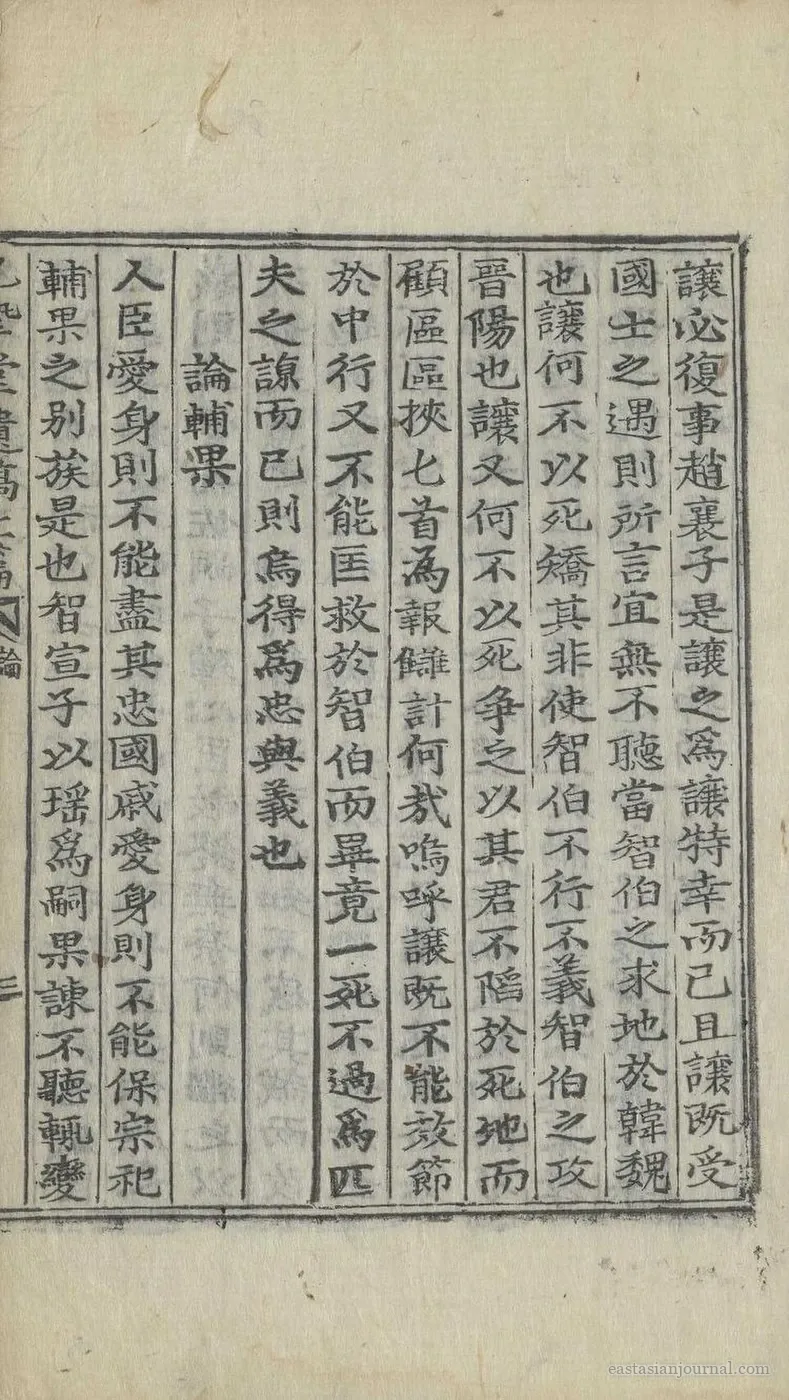
Yunjidang yugo (允摯堂遺稿), Im Yunjidang's posthumous writings, first woodblock edition, 1796.Original: National Library of Korea. Public domain, via Wikimedia Commons.
Names: Im Yunjidang · Im Yunji-dang
Life and setting
An edition printed three years after Im Yunjidang's death preserves a voice rarely admitted to the public learned world of late Joseon. Im (1721–1793) studied Neo-Confucian questions in a society where women faced severe limits on scholarly recognition. Her younger brother Im Jeongju collected her writings for publication in 1796, leaving evidence of an argument conducted in classical Chinese within an overwhelmingly male tradition. [10][12][83]
The work
允摯堂遺稿 (Posthumous Writings of Yunjidang). Issued in two fascicles bound as one volume, the collection includes arguments on mind, nature, principle and vital force, as well as judgments on figures from history. In 'On Yu Rang' (論豫讓), she tests a celebrated account of loyalty against the obligation to correct a ruler while correction remains possible. [83]
The idea, step by step
Each being receives a nature expressed through a particular psycho-physical endowment. Differences in embodied nature are real: the question of whether humans and animals are alike cannot be answered by naming universal principle alone. [10][12]
For women and men, however, those differences do not establish unequal access to moral goodness. The underlying Heaven-endowed principle makes the cultivation required for sagehood possible for either sex. [10][12]
Cultivation must be tested in conduct. Her essay on Yu Rang criticizes a retainer who avenged his defeated lord after failing to restrain that lord's wrongdoing in time. Fidelity is therefore evaluated at the moment a person could have prevented harm, not merely at the dramatic moment of sacrifice. [83]
Who disagreed
The Ho–rak dispute divided Yi Kan and Han Won-jin over the sameness of human and animal nature; Im addressed its underlying problem of universal principle and differentiated embodiment. She also departed in part from the account of vital force associated with Yi I and accepted by her brothers. Sungmoon Kim reads the consequence for gender as especially significant: a society could restrict women's scholarly roles while its own doctrine of moral nature supplied grounds for questioning that restriction. [10][12]
Why here. Her intervention in the human-nature debates demonstrates both female intellectual agency and disagreement within Joseon orthodoxy. [12][10]
What the popular account misses. Her claim concerned moral potential and self-cultivation; it should not be equated uncritically with every aspect of contemporary feminism. [12][10]
05 · ConfucianJeong Yak-yong정약용 · 丁若鏞 · 1762–1836Scholar-official and moral philosopherDasan brought Confucian moral inquiry into conversation with effective administration and close attention to human action.Read the argument & sources ↓
Mongmin simseo (牧民心書), Jeong Yak-yong's admonitions on governing the people, in a nineteenth-century manuscript copy.Original: National Library of Korea. Public domain, via Wikimedia Commons.
Names: Chŏng Yagyong · Dasan
Life and setting
Jeong Yak-yong (Dasan, 1762–1836) knew local government from both sides of its desk. He served under King Jeongjo, inspected provincial conditions and held local office, then spent eighteen years in exile at Gangjin after the political and religious persecution of 1801. This reversal gave his account of official responsibility an unusually concrete setting: the magistrate's obligations would be judged by people who lived with the consequences. [10][84]
The work
牧民心書 (Admonitions on Governing the People). Completed in 1818, the local-administration manual organizes twelve sections and seventy-two topics across forty-eight chapters. It covers taking office, self-discipline, personnel, taxation, punishment, famine relief and departure from office. Each topic offers principles, explanation and cases so an official can locate guidance when a specific problem arises. [84]
The idea, step by step
A public office imposes concrete obligations toward those governed. Jeong begins with the official's self-discipline and service, then places these habits alongside the rules for collecting revenue and managing subordinates; character is tested by administrative decisions. [84]
The magistrate must distinguish written law from local practices that permit abuse. Jeong's treatment of village functionaries and taxation turns an abstract commitment to just rule into a question of enforceable procedure. [84]
Human beings also exercise moral judgment in specific relationships. In Jeong's broader philosophy, choosing how to act matters more than treating goodness as the automatic effect of an impersonal cosmic principle. Famine relief makes the distinction palpable: the official must decide, organize and answer for what is done. [10][84]
Who disagreed
Zhu Xi's school explained moral cultivation through the relationship of principle and vital force. Jeong questioned the capacity of impersonal principle to account for moral agency, giving greater weight to conscious choice and obligations in human relations. Scholars including Mark Setton also find a significant reworking of Neo-Confucian categories in Jeong's engagement with ideas circulating through Catholic texts; the extent of that intellectual debt requires distinguishing textual influence from claims about personal belief. [10][9]
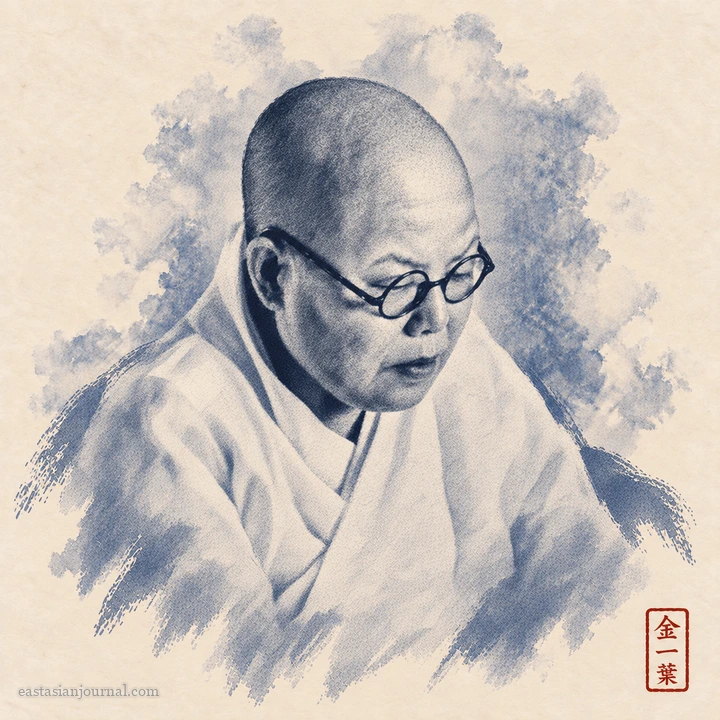
06 · BuddhistKim Iryeop김일엽 · 金一葉 · 1896–1971Buddhist thinker and writerKim connected Buddhist discipline to questions of women’s self-understanding, freedom and modern identity.Read the argument & sources ↓
Names: Kim Iryŏp
Life and setting
Kim Iryeop (1896–1971) first wrote as a prominent advocate of the New Woman in Japanese-ruled Korea, arguing for women's capacity to determine the terms of marriage, sexuality and intellectual life. In her late twenties she turned toward Buddhist practice and entered the monastic community. At her teacher's urging she ceased publishing for more than twenty years before returning to writing in her sixties. [45][86]
The work
어느 수도인의 회상 (Reflections of a Zen Buddhist Nun). This late autobiographical and philosophical collection appeared in Korea when Kim was in her sixties; Jin Y. Park's English translation appeared in 2014. Its reflections on solitude, love, identity and religious discipline speak from a monastic life the author had chosen after years of public reformist writing. [85][86]
The idea, step by step
Early essays located a central form of women's suffering in social controls on intimate decisions. Demands for divorce rights and sexual freedom made the ordinary organization of women's lives a proper subject of public argument. [45][86]
Buddhist training raised another question: even after a person secures an outward choice, what happens when identity is held as a fixed possession? Kim's later autobiographical writing investigates attachments, loneliness and the effort of practice from within that question. [85][86]
Her movement from social criticism to religious discipline changes the field on which freedom is examined. A chosen renunciation can still demand scrutiny of power, especially when the decision to cease publishing followed a teacher's instruction; the surviving writings should be read alongside that institutional fact. [86][85]
Who disagreed
Jin Y. Park's reading disputes the easy interpretation that entering a monastery simply ended Kim's concern with women's agency. Park relates Kim's earlier criticism of unequal sexual norms to her later investigation of identity and Buddhist practice. That continuity is a scholarly interpretation, however, and must be weighed against the documented interruption in Kim's public authorship under monastic authority. [86][85]
Liberty, democratic argument, modern Confucianism and Indigenous interpretation
Taiwan is not merely a destination for inherited Chinese classics. Republican political theory, liberal critique, Indigenous perspectives and Taiwan-centered historical argument have competed on the island.
Why this selection: Philosophers and political theorists, each labeled by role, with Indigenous intellectual work in its own place.
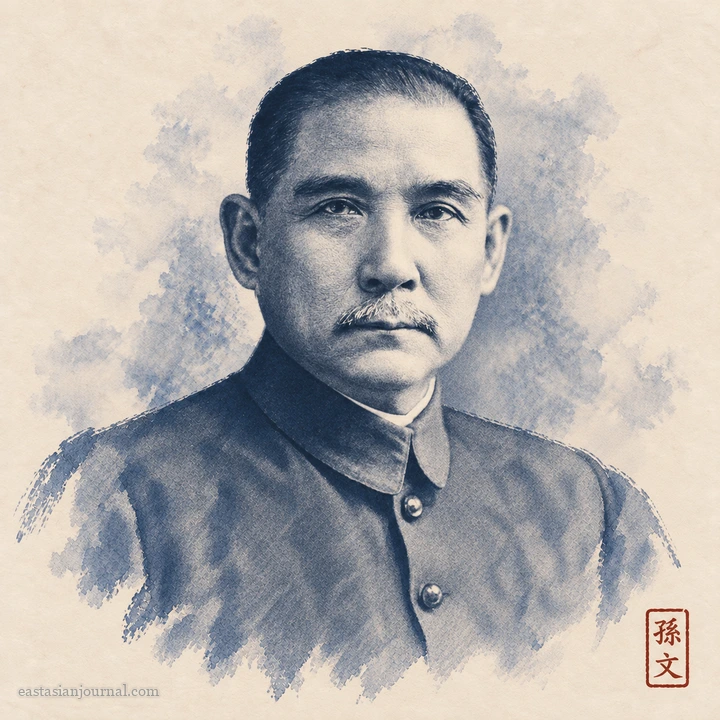
01 · Political thoughtSun Yat-sen孫中山 · 1866–1925Political theorist and statesmanSun formulated nationalism, political rights and the people’s livelihood as related goals of republican state-building.Read the argument & sources ↓
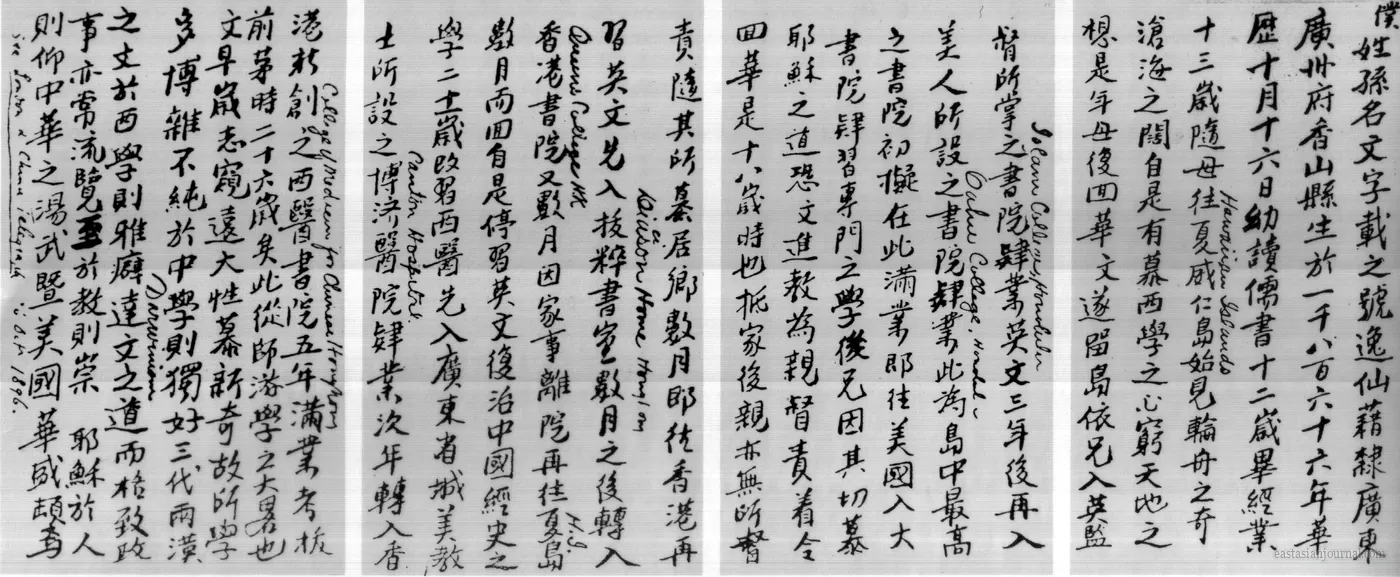
Sun Yat-sen's handwritten account of his life, 1896, with English annotations.Public domain, via Wikimedia Commons.
Names: Sūn Zhōngshān
Life and setting
By 1918, six years after the Chinese republic was founded, military commanders controlled much of the country. Sun Yat-sen (1866–1925), a revolutionary leader and Nationalist Party organizer, was proposing how republican institutions might survive. His doctrine emerged amid repeated failures of state authority and continuing foreign pressure. [87][14]
The work
三民主義 (Three Principles of the People). Sun presented the mature Three Principles in 1924 lectures: national independence, political power for the people, and livelihood. This program of state-building should be read alongside his 1918 proposal for a staged transition from revolution to constitutional government. [14][15][87]
The idea, step by step
Begin with the political community. Sun's nationalism changed from opposition to Manchu Qing rule toward opposition to foreign imperial domination. A nominal republic would remain vulnerable if other powers could dictate its decisions. [14]
Independence requires a distribution of political power. Sun distinguished the people's rights from officials' governing functions and proposed five branches, adding examination and control to executive, legislative and judicial institutions. Authority needed a design that citizens could exercise and supervise. [14][87]
Political rights also require livelihood. Equalization of land rights, restraint of private capital and industrial development formed an economic counterpart to constitutional plans. Sun treated the capacity to sustain life as part of making the new state secure. [14]
His proposed sequence exposed a tension: military government, political tutelage, then constitutional rule. Under the 1918 plan, revolutionary authorities supervised local self-government while citizens learned to exercise their rights. The body promising popular sovereignty thus also reserved the power to decide when its full exercise could begin. [87]
Who disagreed
Liang Qichao favored gradual constitutional reform under a monarchy and feared the disorder of armed revolution; Sun pressed for overthrowing the Qing and establishing a republic. Both sought Chinese independence and political renewal, and Liang later supported republican government. Sun's own account introduced a further difficulty: what would prevent a party claiming to prepare citizens for self-government from prolonging its control? [88][87]
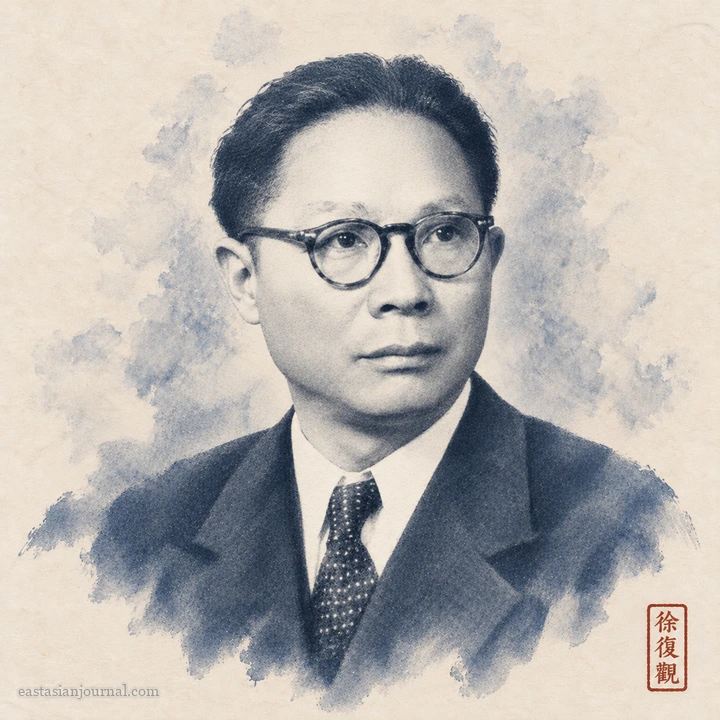
02 · ConfucianXu Fuguan徐復觀 · 1903–1982Modern Confucian philosopherXu explored classical accounts of human nature, history and political ethics in modern conditions.Read the argument & sources ↓
Names: Xú Fùguān
Life and setting
Xu Fuguan (1903–1982) spent fifteen years in the Nationalist army, including service as Chiang Kai-shek's aide. After retiring in 1946, he settled in Taiwan and taught Chinese intellectual history at Tunghai University. Criticism of Nationalist rule cost him that post in 1969, after which he moved to Hong Kong. The problem of restraining rulers runs through his later thought. [13]
The work
中國人性論史 (A History of Chinese Theories of Human Nature). Published in 1963, this historical study examines classical theories of human nature, including Mencius's account of moral beginnings. Xu uses those texts to investigate what moral experience reveals about persons, a question that also guides his political argument. [13]
The idea, step by step
In Mencius 2A.6, someone sees a child about to fall into a well and feels alarm. For Xu, the response is known immediately through embodied recognition: a capacity encountered in lived experience before it becomes a theory. [13]
Compassion alone does not decide what to do. Xu distinguishes moral nature (德性), which responds to suffering, from cognitive nature (知性), which learns circumstances and effective means. Additional information can direct concern; it cannot create the original moral capacity. [13]
King Xuan in Mencius 1A.7 is troubled by an ox's suffering yet overlooks his subjects. This is a scholarly illustration of Xu's distinction, rather than an example attributed directly to him: judgment must identify where and toward whom moral concern belongs. [13]
Political institutions carry the lesson outward. For Xu, physical survival and subsistence precede programs of moral education. Democratic constraints make respect for persons an obligation rulers must observe, reducing the danger of depending upon an exceptionally virtuous sovereign. [13]
Who disagreed
Mou Zongsan grounded autonomy in a transcendental heart-mind and intellectual intuition. Xu rejected that metaphysical division of the self while recognizing moral experience as irreducible to scientific measurement. Both defended democracy as consistent with Confucian values; they disagreed over whether that defense required a reality beyond embodied human life. [13]
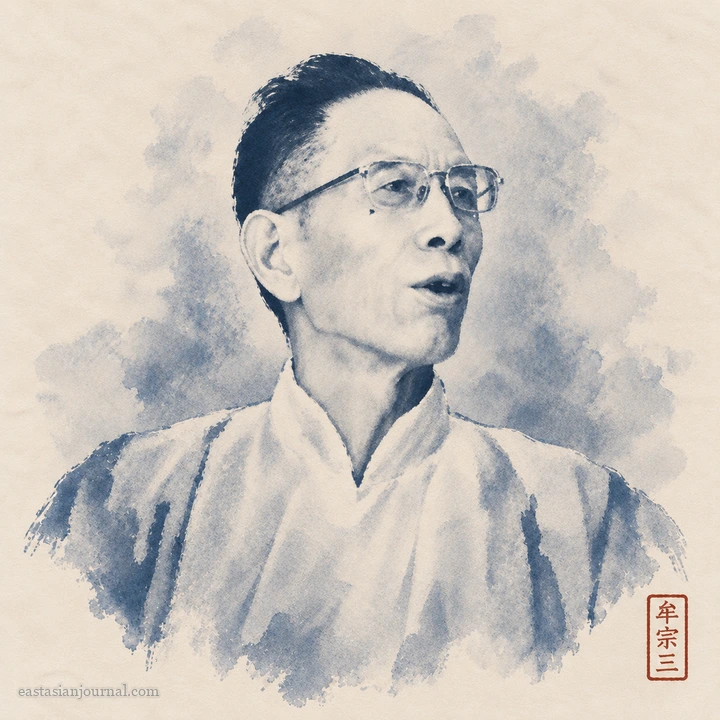
03 · ConfucianMou Zongsan牟宗三 · 1909–1995Systematic philosopherMou engaged Kant and classical Confucian thought to defend moral autonomy and the reality of freedom.Read the argument & sources ↓
Names: Móu Zōngsān
Life and setting
Mou Zongsan (1909–1995) studied philosophy in Beijing and moved from mainland China to Taiwan in 1949, later working in Hong Kong. The collapse of Republican authority and the difficulty of establishing democracy sharpened his question about Confucianism: how could moral autonomy sustain constitutional institutions without entrusting politics to the will of a supposed sage? [13]
The work
心體與性體 (Heart-Mind and Human Nature as Reality). Issued in three volumes in 1968–1969, this study revisits Song and Ming theories of moral nature. Mou replaces the familiar Cheng–Zhu versus Lu–Wang division with three lineages, placing particular weight on the Hu Wufeng–Liu Jishan and Lu Jiuyuan–Wang Yangming lines. This is his interpretive ranking, not a settled historical classification. [13][89]
The idea, step by step
Compassion and shame arise in the moral experience described by Mencius. Mou asks what must be true of a person for those responses to carry authority. Morality requires a will capable of giving itself a law, independent of external reward or command. [13]
Kant located freedom beyond possible theoretical knowledge. Mou begins instead from moral activity taken to be real: if moral action requires an autonomous will, its occurrence supports the reality of that will. Practical experience thus carries an argument theoretical observation cannot supply. [13]
Mou calls the direct awareness involved intellectual intuition. A compassionate response illustrates the experience, while his further claim is metaphysical: in acting morally, the heart-mind encounters a free self that Kant considered inaccessible to human cognition. [13]
Politics introduces an institutional limit. In Mou's separate political writings, morality must restrain its authority over public affairs so independent procedures and constitutional offices can operate. A scholar's conviction about what is good cannot serve as the only rule binding government. [13]
Who disagreed
Kant denied humans intellectual intuition of things in themselves, whereas Mou defended a limited human capacity for it. Xu Fuguan accepted lived moral responsiveness but rejected Mou's transcendental metaphysics. Mou's historical ranking also departed from conventional Cheng–Zhu and Lu–Wang classifications, treating some Song–Ming lineages as more faithful to moral self-cultivation than Zhu Xi's. [13][89]
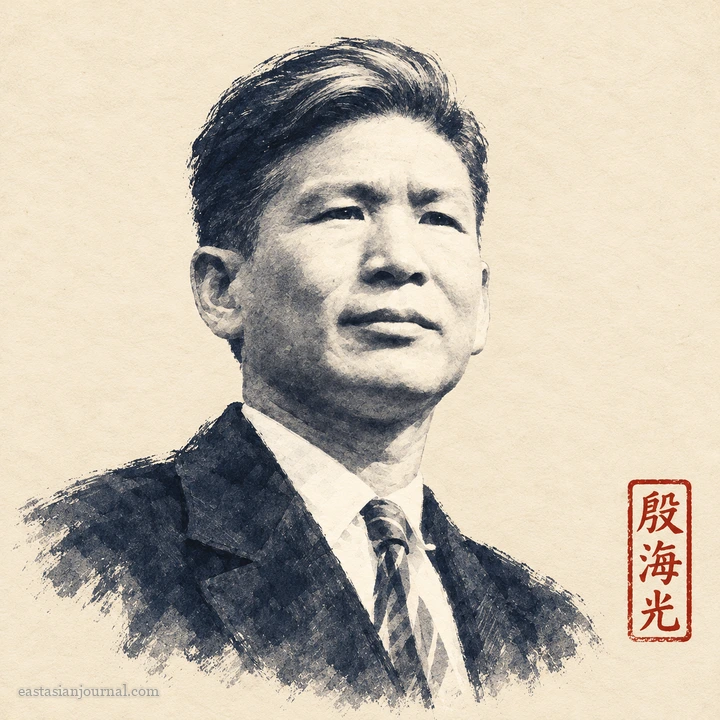
04 · Modern philosophyYin Haiguang殷海光 · 1919–1969Liberal philosopher and essayistYin defended logic, individual freedom and critical reasoning against political intellectual conformity.Read the argument & sources ↓
Names: Yīn Hǎiguāng
Life and setting
After moving to Taiwan in 1949, Yin Haiguang (1919–1969) taught logic and philosophy of science at National Taiwan University and wrote for Free China (自由中國). Born in Huanggang, Hubei, he had trained in philosophy during the war. His criticism of intellectual conformity unfolded under Nationalist one-party rule, and political interference ultimately forced him from teaching. [90][92]
The work
中國文化的展望 (Prospects of Chinese Culture). First published in 1966, this monograph applies social-scientific concepts and logical analysis to Chinese cultural change since the nineteenth century. Its first half examines inherited practices and liberalism's difficulties; its second considers modernization, with a sustained discussion of democracy and freedom in chapter 12. [93][90][91][92]
The idea, step by step
Cultural explanation begins with examinable claims. Yin investigates how practices changed through foreign contact, rather than accepting a broad label such as 'Chinese tradition' as a cause in itself. [90][92]
Explanation also requires separating description from approval. Establishing that a practice has an old history says nothing by itself about its merits. Yin's logical method asks where assertions about cultural value rely on evidence and where they express allegiance. [92]
Consider a government claiming democratic legitimacy while suppressing its critics. The question becomes whether dissent is actually possible and rights can be exercised, as distinct from the official vocabulary used to describe the regime. Yin's own university career made the test tangible. [16][91][90]
His book also calls for moral reconstruction. The difficulty is to sustain ethical commitments while allowing inherited norms and institutions to undergo independent criticism, even when their defenders claim cultural authority. [90]
Who disagreed
Xu Fuguan derived democratic commitments from Confucian moral experience; Yin feared that privileging inherited culture would insulate authority from examination. In 1957 Yin accused cultural conservatives of assisting Nationalist authoritarianism, Xu responded within ten days, and Yin renewed the dispute in 1958. His charge was a polemical allegation, not an established account of Xu, who also criticized the Nationalist regime. [92][13]
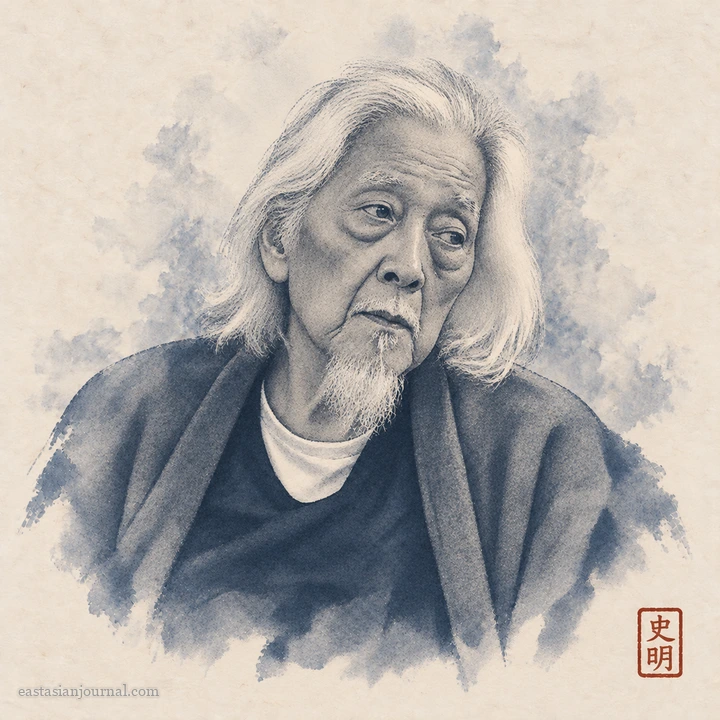
05 · Political thoughtSu Beng史明 · 1918–2019Political theorist and historianSu Beng interpreted Taiwan’s history through labor and national consciousness rather than a purely dynastic Chinese frame.Read the argument & sources ↓
Names: Su Beng
Life and setting
Su Beng, born Shih Chao-hui (施朝暉) in Taipei’s Shilin district in 1918, studied political economy at Waseda University. He joined the Chinese Communist anti-Japanese movement in 1942 and returned to Taiwan in 1949, disillusioned. An independence group he organized planned to assassinate Chiang Kai-shek. After the plot was uncovered, he fled to Japan in 1952. [54]
His Tokyo restaurant helped fund writing and opposition politics. He returned to Taiwan in 1993 and died in 2019; exile had shaped both his audience and his means of reaching it. [54]
The work
台灣人四百年史 (Taiwanese People’s Four Hundred Year History). Published in Japanese in 1962, this twelve-chapter history follows Taiwan from its early past through colonial rule and the years after 1945. Its central subjects are people living and working on the island. A subsequent Chinese version reached another readership, although institutional catalogues disagree about its year of publication. [18][54]
The idea, step by step
Choose the narrator first. A history arranged around successive governments largely records what rulers did; Su asks what laborers and other inhabitants experienced while regimes changed. Different evidence then becomes central to the account. [18][54]
Su links labor, exploitation and shared experience across regimes to the emergence of Taiwanese national consciousness. This is a political interpretation of how a community forms, not a settled claim about every islander’s identity. [18][54]
Translation also changes the argument’s reach. A Japanese-educated exile’s history moved into Chinese-language debate through a new edition; the movement of the text was part of its political life. [18][54]
Who disagreed
Chiang Kai-shek’s Kuomintang government suppressed the independence organizing that drove Su into exile. Su challenged political histories centered on the authority of the state governing Taiwan. He had also broken with the Chinese Communist movement he once joined. These were political conflicts, rather than recorded scholarly exchanges, over sovereignty and who could narrate Taiwan’s past. [54][18]
Why here. The original Japanese-language edition and later Chinese translation demonstrate how a Taiwan-centered history crossed languages and exile communities. [18]
What the popular account misses. His nationalist analysis is historically influential but contested; it is not the publication’s editorial stance on sovereignty. [18]
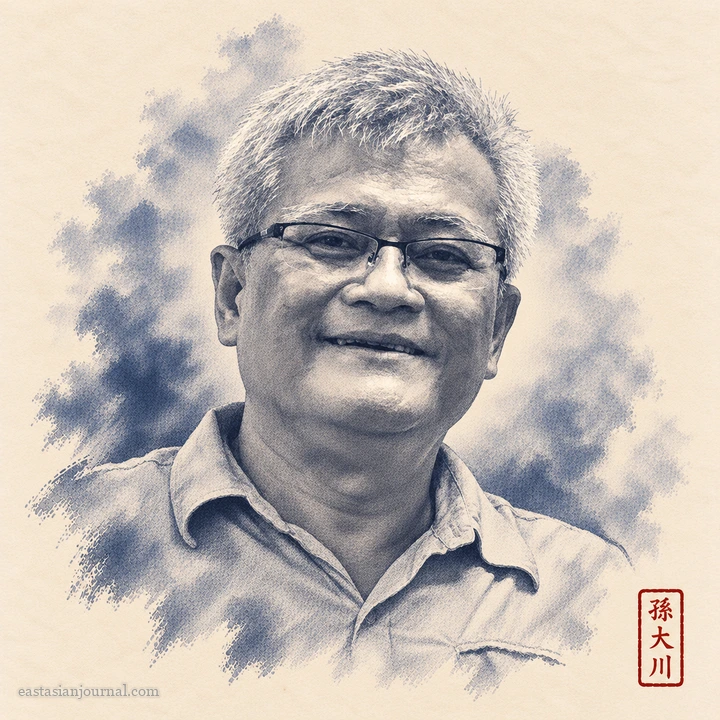
06 · Indigenous thoughtSun Ta-chuan孫大川 · 巴厄拉邦·德納班 · born 1953Indigenous intellectual and scholarA Puyuma scholar, Sun examined Indigenous language, identity, literature and cultural self-description.Read the argument & sources ↓
Names: Sun Ta-chuan / Paelabang danapan
Life and setting
For Sun Ta-chuan (孫大川, Paelabang Danapan), a Puyuma scholar born in 1953, stories and rituals learned from relatives were an early archive. In a later interview, he recalled how migration and linguistic change disrupted their transmission. [57]
He founded the Indigenous literary magazine 山海文化 in 1993 and later chaired Taiwan’s Council of Indigenous Peoples and served as vice president of the Control Yuan. Writing and government gave him different ways to address cultural recognition. [57]
The work
夾縫中的族群建構:台灣原住民的語言、文化與政治 (Ethnic Formation in Between). This essay collection, catalogued in a 2010 edition, examines Indigenous identity through language, culture and politics. The problem is how communities represent themselves when publishing and participating in institutions structured by a dominant language. This description draws on its catalogue record and published discussion of the book. [55][56]
The idea, step by step
Oral history depends on people, performance and place. When transmission weakens, writing may preserve accounts for new audiences, though it also changes their form. Sun describes this pressure from Puyuma experience. [57]
Writing only in an Indigenous language can protect linguistic continuity; Chinese can help an Indigenous writer reach and challenge a wider public. Sun regarded Chinese as a usable instrument of Indigenous authorship, while recognizing the unequal position of languages. [56]
The choice affects more than publishing. It also concerns who defines a community publicly and who participates in decisions about its culture. Sun addressed such questions through editorial and institutional work. [57][56]
Who disagreed
Walis Nokan (瓦歷斯.諾幹) defended mother-tongue writing against possible absorption into Chinese-language literature. Sun warned that requiring Indigenous-language-only writing could exclude Indigenous voices already working in Chinese. A 2025 scholarly review reconstructs this disagreement from their earlier publications; it establishes no face-to-face debate. [56]
The classical masters and the ideology of the contemporary state
The phrase Mainland China is a modern geographical frame. Pre-imperial and Song thinkers cannot be assigned PRC citizenship, although their texts shape its schools and arguments.
Why this selection: Four classical positions, Zhu Xi’s Song synthesis, and Mao Zedong as a twentieth-century leader-theorist.
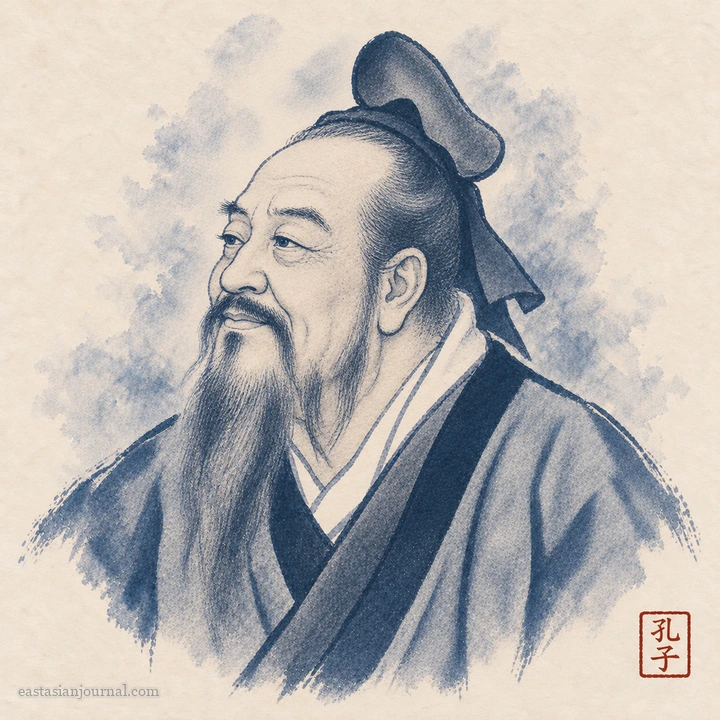
01 · ConfucianConfucius孔子 · trad. c. 551–479 BCEEthical and political philosopherThe Confucian teaching tradition centers cultivated humaneness, proper conduct, learning and the responsibilities of office.Read the argument & sources ↓
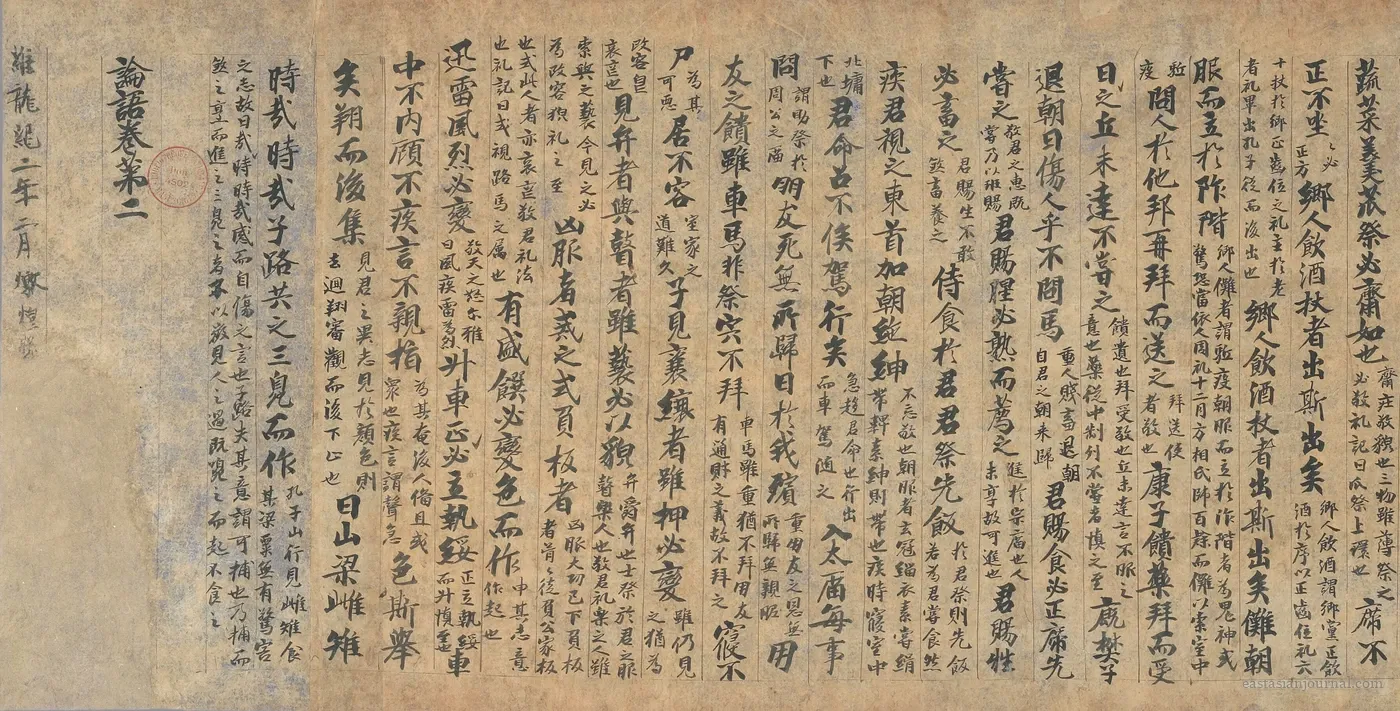
The Analects (論語) with Zheng Xuan's commentary, a Dunhuang manuscript scroll of the Tang dynasty.Original: Bibliothèque nationale de France, Pelliot chinois 2510. Public domain, via Wikimedia Commons.
Names: Kǒngzǐ · Kongzi
Life and setting
The Zhou king still had a throne when Confucius lived, though regional rulers held increasing power. Kongzi (孔子), traditionally dated 551–479 BCE, is associated with Zou and Lu in present-day Shandong. Later sources disagree about the offices he held and the routes he traveled. [19]
In this setting, inherited forms of conduct promised continuity across households and courts. His portrait as teacher and ritual specialist developed through generations of transmission. [19]
The work
論語 (Analects). Short dialogues, stories and sayings ascribed to Confucius and his circle were compiled and edited over time. The Analects preserves a changing teaching tradition rather than verbatim speeches; the different occasions for advice are part of the meaning. [19]
The idea, step by step
Government needs habits as well as orders. Rites for guests, sacrifices and public duties teach people what respect looks like. Repetition shapes responses before a conflict requires an explicit decision. [19]
In Analects 3.17, Zigong proposes ending the sheep offering associated with the new moon. The reply attributed to Confucius favors keeping the rite: even a vestige may preserve a larger practice that public life has begun to forget. [19]
A person trained in concrete relations can carry the same attention into office. The Analects also expects rulers to govern by their conduct; their own example supplies the model others are asked to follow. [19]
Who disagreed
Mozi and later Mohists opposed costly funerals, long mourning and elite music associated with Ru ritual culture. They judged practices by their social benefits and resource costs. The difference was the criterion: preservation and cultivation through inherited forms, or demonstrable welfare. Mozi’s movement arose later; no direct exchange between the two is recorded. [58][19]
Why here. Its texts became foundational to numerous later East Asian ethical arguments and educational institutions. [19]
What the popular account misses. The Analects was compiled over time; its individual sayings cannot all be treated as verbatim recordings of a single speaker. [19]
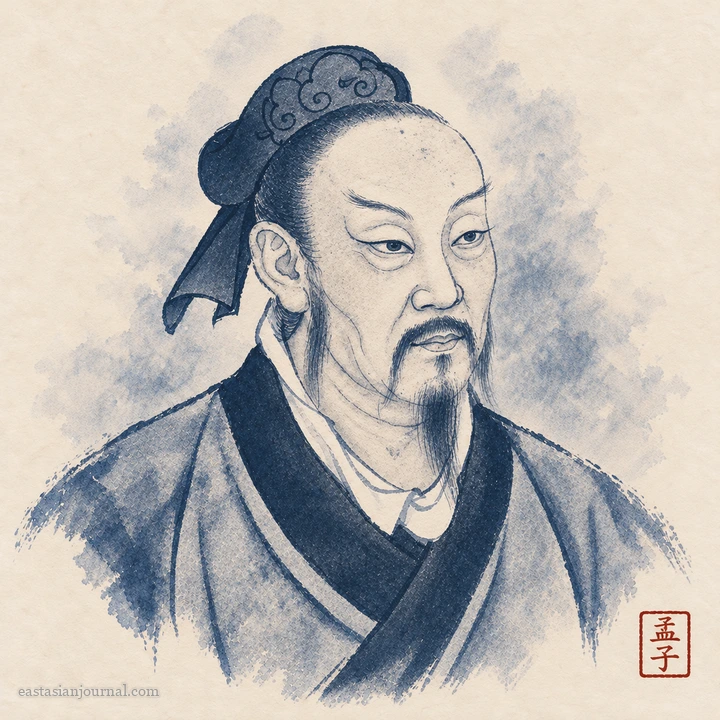
02 · ConfucianMencius孟子 · 4th century BCEEthical philosopherMencius argued that moral capacities are present in ordinary people and require cultivation.Read the argument & sources ↓
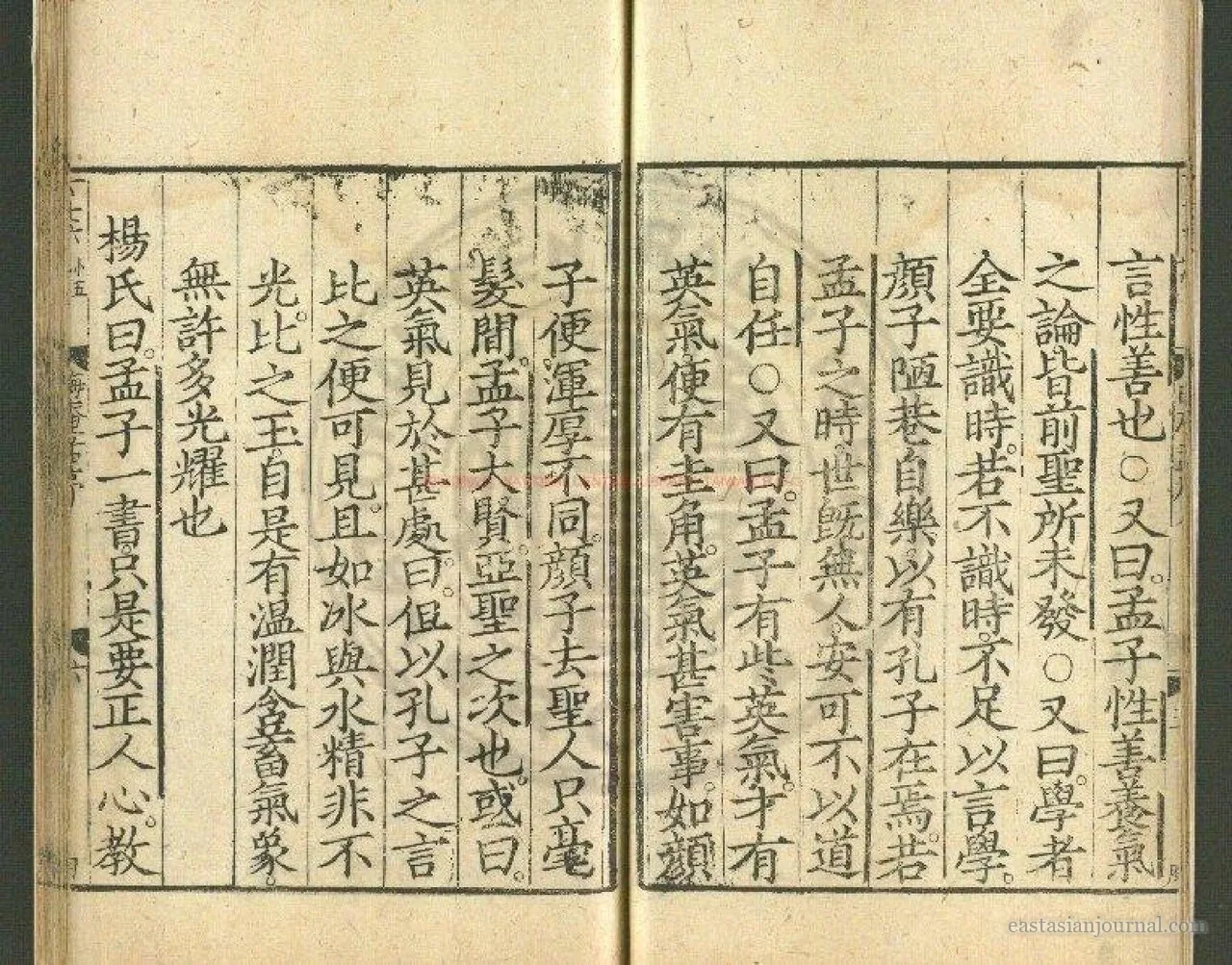
Mengzi jizhu (孟子集注), the Mencius with Zhu Xi's collected commentary, in a Yuan-dynasty reprint of a Song edition.Original: National Central Library, Taiwan. Public domain, via Wikimedia Commons.
Names: Mèngzǐ · Mengzi
Life and setting
A ruler can spare an ox from slaughter while imposing heavy burdens on his own subjects. Mencius used that disturbing inconsistency to teach fourth-century BCE courts how political action might be brought into line with moral feeling. Known as Mengzi (孟子), he worked amid wars between competing states and identified himself with the teaching of Confucius. Traditional birth and death years are approximate. [20]
The work
孟子 (Mengzi (Mencius)). Seven books of dialogues, arguments and encounters with rulers, probably compiled by disciples or their successors and subsequently edited. Alongside the much-discussed examples of moral feeling, the text asks how livelihood, education and state policy allow people to develop those capacities. The king and ox episode occurs at 1A.7. [20]
The idea, step by step
In 1A.7, a king has an ox spared because he cannot bear to witness its distress. That response gives Mencius a case in which compassion has already guided the king’s action; he need not begin by asserting a principle that the king has never experienced. [20]
Now compare the suffering of the ox with the suffering of subjects exposed to warfare and excessive taxation. Their circumstances differ, yet the relevant vulnerability can be recognized in both. Extending care requires attention, a change in feeling and a corresponding decision, rather than merely agreeing that people deserve kindness. [20]
Mencius treats such responsiveness as a beginning that requires cultivation. For most people, secure subsistence and education also matter: hunger and fear can undermine moral development. The king’s test is therefore whether compassion alters the conditions he governs, including the policies that place his people at risk. [20]
Who disagreed
Xunzi attacked Mencius by name. Mencius regarded ethical dispositions as present in incipient form and needing growth; Xunzi located virtue in learned, deliberate effort that transforms spontaneous tendencies. They also differed over what should count as human nature. The practical disagreement concerned the teacher’s task: nourish a capacity already beginning to appear, or create durable habits through consciously constructed rites and training. [20]
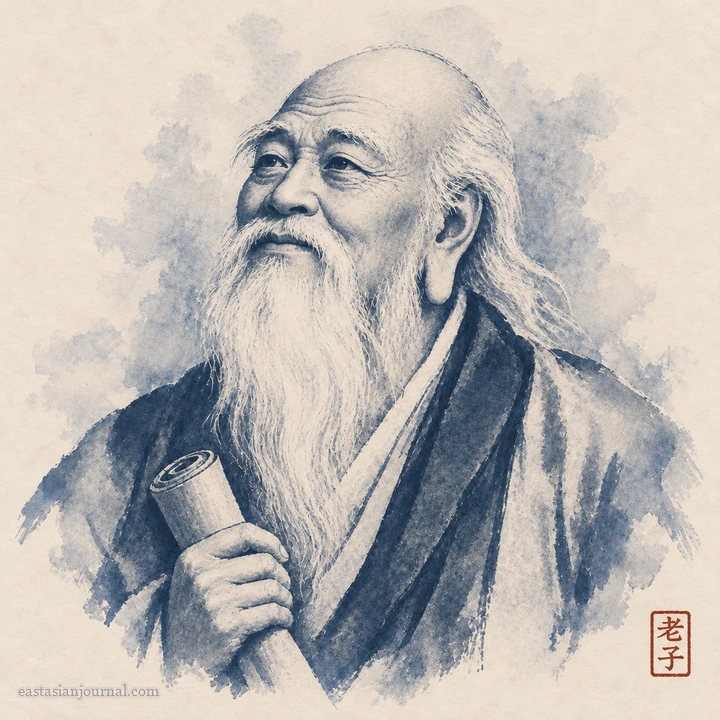
03 · DaoistLaozi (textual tradition)老子 · texts formed c. 5th–3rd centuries BCEAttributed sage and textual traditionThe Daodejing questions forceful rule and explores the Dao, simplicity and non-coercive action.Read the argument & sources ↓
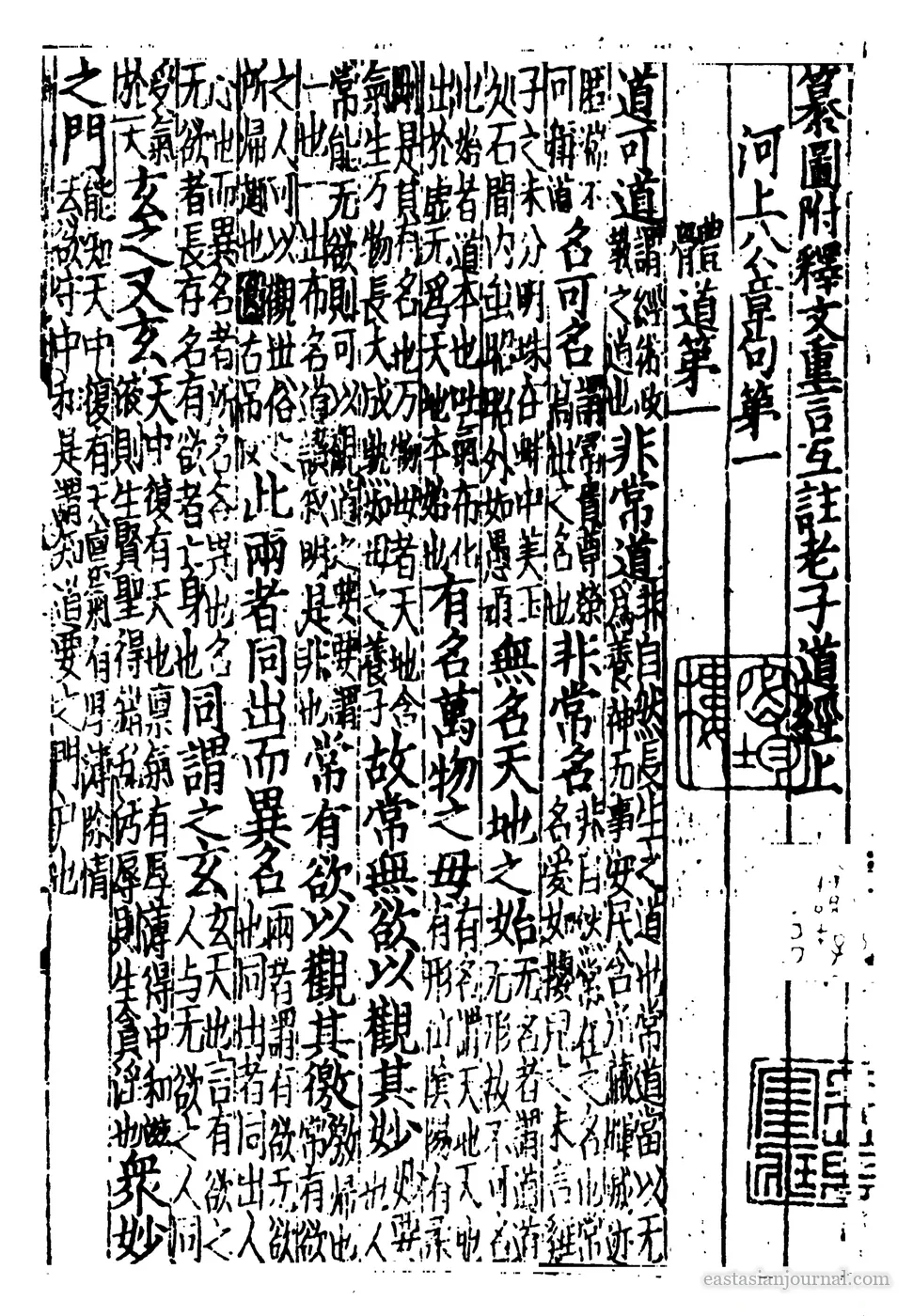
The opening of the Daodejing (道德經), 道可道,非常道, in a Southern Song woodblock edition from Jianyang.Original: Zhejiang University Library. Public domain, via Wikimedia Commons.
Names: Lǎozǐ · Lao Dan
Life and setting
Bamboo slips buried near the old Chu capital preserve passages parallel to the Laozi. The tomb dates to around 300 BCE; the manuscript history is firmer than the supposed sage’s biography. The fifth-to-third-century BCE range dates formation of the textual tradition, not the lifespan of a securely identified author. [21]
The work
道德經 (Daodejing). An aphoristic, often paradoxical collection, conventionally arranged into eighty-one chapters. Bamboo and silk manuscripts preserve different orderings and wording. Its discussions of governance, desire, simplicity and Dao emerged through a textual history that cannot be assigned confidently to one writer. [21]
The idea, step by step
Imagine a ruler advertising rare goods and exceptional rank. Chapter 3 treats such displays as invitations to rivalry. The pursuit of prestige creates desires that government must then struggle to contain. [21]
Restraint offers a different response. Reducing ostentation and intrusive command may allow people’s activities to settle without constantly provoking fresh competition. [21]
The larger principle concerns Dao, the way things unfold, and the limits of trying to force that process. The images question coercive governing habits; they cannot be converted directly into a complete policy manual. [21]
Who disagreed
Wang Bi read Dao principally through nonbeing and the conceptual ground of things. Heshang Gong placed greater weight on pervasive vital power and cultivation. Their differing commentaries help explain why the text has been read as both a philosophical account of reality and practical instruction. Its layered transmission prevents either reading from being identified confidently with a single original author. [21]
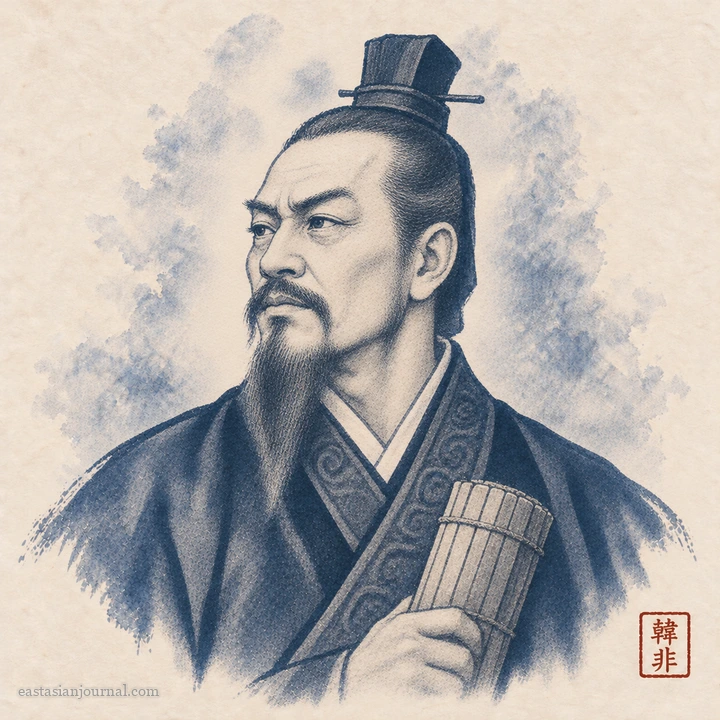
04 · LegalistHan Fei韓非 · d. 233 BCEPolitical philosopherHan Fei argued that lawlike standards, bureaucratic techniques and political authority could organize governance more predictably than personal virtue.Read the argument & sources ↓
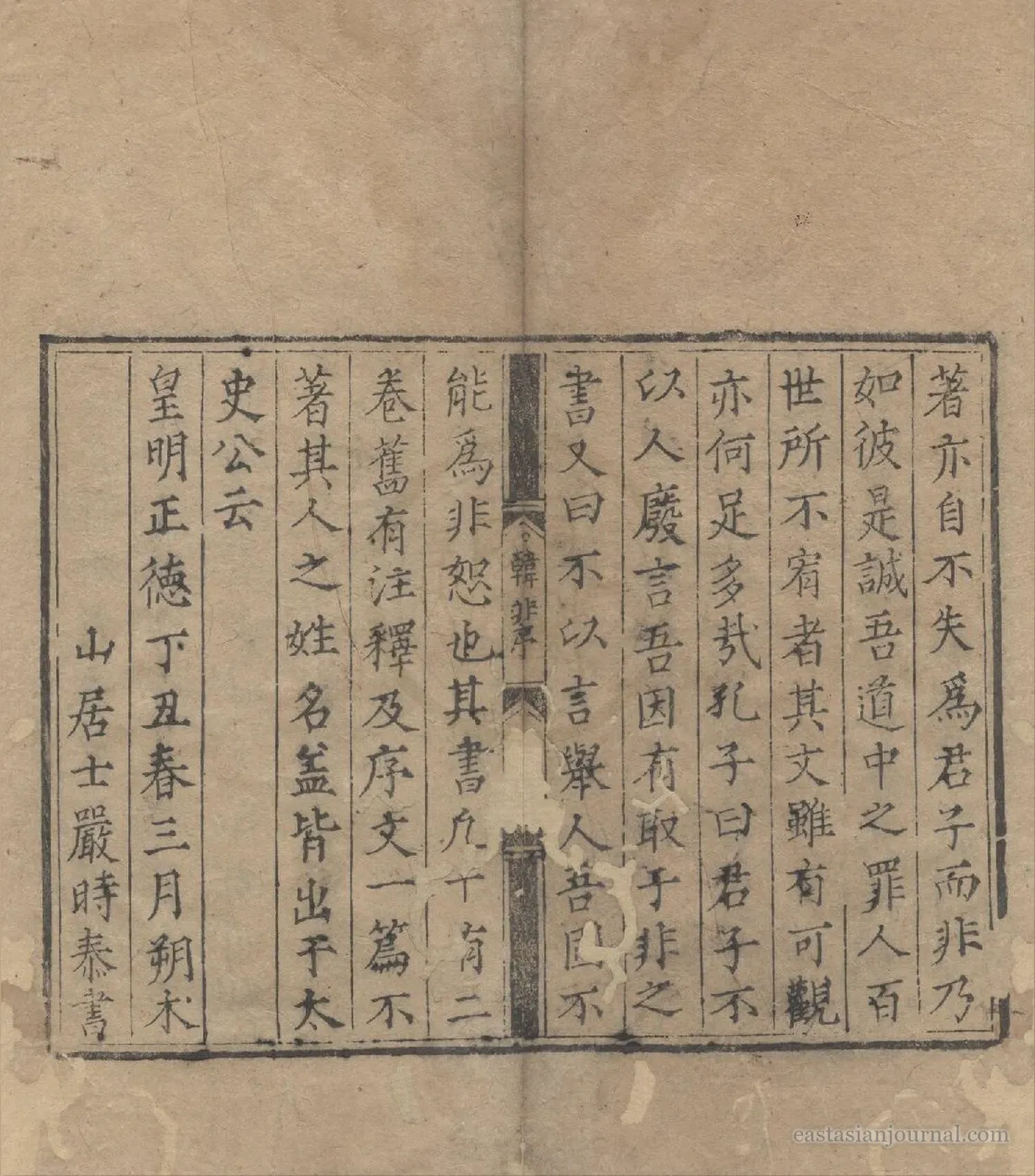
Han Feizi (韓非子) in twenty juan, a Ming woodblock edition with a preface dated 1517.Original: Tianyi Ge Museum, Ningbo. Public domain, via Wikimedia Commons.
Names: Hán Fēi · Han Feizi
Life and setting
For a Warring States ruler, the people who administered orders could also conceal information or capture power. Han Fei, who died in 233 BCE, made that danger central to political analysis. The date of his birth remains an estimate. His writings emerged from a world of rival courts, expanding bureaucracies and intense interstate competition. [59]
The work
韓非子 (Han Feizi). A collection associated with Han Fei that addresses political authority, officials, punishment, incentives and administrative standards. Its chapters do not all have securely uniform authorship. In chapter 43 Han Fei assesses two predecessors’ methods; chapter 7 develops the problem of checking an official’s declared responsibilities against performance. [59]
The idea, step by step
A ruler cannot safely read an official’s inner virtue. Ministers know more about their own operations than the sovereign does, and personal trust may give a skillful subordinate room to redirect decisions. Han Fei therefore begins from an information problem inside government. [59]
Impersonal standards, fa (法), define responsibilities and publicly legible grounds for reward or punishment. A minister’s proposed assignment can then be compared with the results produced. In Han Feizi chapter 7, even performing outside the assigned remit is treated as a danger to the ruler’s control. [59]
The sovereign retains the two levers of reward and punishment while using administrative techniques, shu (術), to monitor subordinates. These mechanisms aim at predictable command and resistance to ministerial capture. Their logic also licenses secrecy and concentrated power, which separates Han Fei’s program from modern constitutional rule of law. [59]
Who disagreed
Han Fei named Shang Yang and Shen Buhai as predecessors who had identified different pieces of the governing problem. Shang Yang emphasized standards for ordering society; Shen Buhai focused on supervising officials. Han Fei argued that a ruler who depended on only one approach left a dangerous gap. His challenge to virtue-centered governance was therefore specific: admirable personal conduct cannot substitute for mechanisms that expose deception and prevent ministers from appropriating command. [59][22]
05 · ConfucianZhu Xi朱熹 · 1130–1200Neo-Confucian philosopherZhu Xi systematized inquiry into principle, vital force, and moral cultivation while interpreting the Four Books.Read the argument & sources ↓
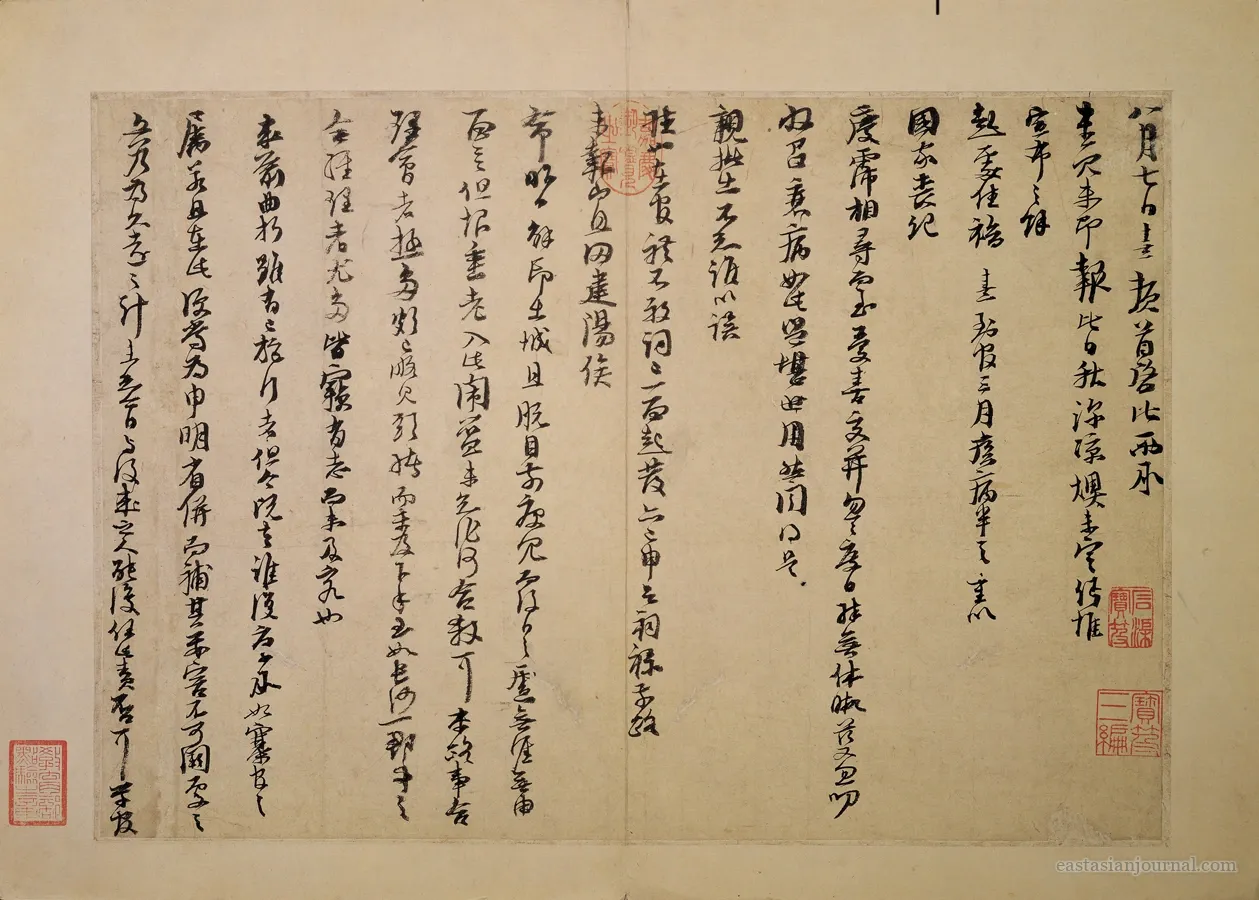
Letter on government affairs in Zhu Xi's hand, eighth lunar month of the fifth year of Shaoxi (1194).Public domain, via Wikimedia Commons.
Names: Zhū Xī
Life and setting
A commentary became an examination curriculum. Zhu Xi (朱熹, 1130–1200), born in Fujian, worked under the Southern Song and studied with Li Tong from 1160. Having passed the civil-service examinations young, he devoted much of his career to teaching and study amid disagreements with court policy. [23]
After his death, Yuan authorities adopted his Four Books for examinations. His interpretation of older texts thus acquired institutional force and shaped subsequent scholarship across East Asia. [23]
The work
四書章句集注 (Collected Commentaries on the Four Books). Annotations joining the Great Learning (大學), Analects (論語), Mencius (孟子) and Doctrine of the Mean (中庸) into a course of moral learning. Zhu made the relation between knowledge, cultivated dispositions and action central to their study. [23]
The idea, step by step
Moral life has intelligible pattern, li (理), encountered in particular people and events constituted through qi (氣). Good judgment requires attention to both ethical direction and the actual conditions in which a response occurs. [23]
Investigation joins reading, observation, reflection and practice. The Great Learning’s 格物 (gewu) directs learners toward patterns within things and relationships, so study prepares them for cases that cannot be resolved by a memorized rule. [23]
An emergency tests the training: saving a drowning sister-in-law can override ordinary restrictions on physical contact. Zhu discussed such principled exceptions as 權 (quan), discretion requiring cultivated judgment about the purpose of a norm. [23]
Who disagreed
Lu Jiuyuan held that clarifying the mind could make the right course apparent. Zhu feared that inward certainty alone left complex situations poorly understood and insisted on sustained study and observation. Wang Yangming later criticized Zhu’s method from another mind-centered position. The dispute concerned how much engagement with particular things moral knowledge requires. [23]
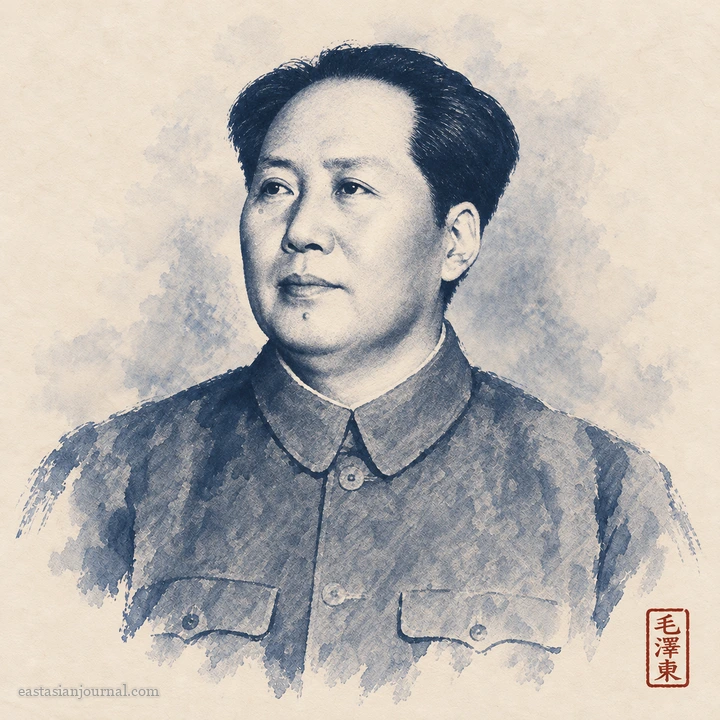
06 · Political thoughtMao Zedong毛泽东 · 1893–1976Political leader and theoristMao developed revolutionary arguments about practice, contradiction and mobilization within a Marxist-Leninist framework.Read the argument & sources ↓
Names: Máo Zédōng
Life and setting
Mao Zedong (毛泽东, 1893–1976) wrote about testing revolutionary knowledge and led the Communist movement that established the People’s Republic of China in 1949. His essays addressed disputes over Marxist dogmatism and political experience inside the party. [24][60]
His leadership also had devastating consequences. The Great Leap Forward helped precipitate catastrophic famine, while the Cultural Revolution, begun under Mao in 1966, brought persecution and mass violence. Political authority affected which judgments and evidence could be challenged. [64][65]
The work
实践论 (On Practice). A Marxist inquiry into knowledge and social action, conventionally dated to 1937 but transmitted in edited form. Its companion 矛盾论 (On Contradiction) examines competing forces and the contradiction that becomes decisive in a given setting. Scholars dispute the essays’ early composition history and the scale of subsequent revision. [60][61][62]
The idea, step by step
Practice supplies experience: production, political struggle and social activity reveal conditions that no inherited doctrine or isolated anecdote fully explains. [60]
Theory seeks the relationships beneath those observations. On Contradiction distinguishes the principal conflict in a particular historical situation from other forces that remain active. The diagnosis may change as conditions change. [60][61]
A proposed explanation returns to practice for testing and revision. Yet when leaders control criticism or reporting, adverse results may fail to correct policy. The essay’s epistemic ideal cannot by itself secure the institutions needed to apply it. [60][63][64]
Who disagreed
Mao opposed dogmatists who applied Marxist formulas without investigating Chinese conditions, and empiricists who generalized from narrow experience. After his death, Hu Yaobang helped advance the 1978 argument that practice must test political claims, unsettling the authority of canonical pronouncements. The controversy was a later struggle over Mao’s intellectual legacy, not a debate with the deceased leader. [60][63]
Why here. His political theories and exercise of state power had large-scale consequences for the PRC after 1949. [24][22]
What the popular account misses. Descriptive influence is not philosophical endorsement, and political campaigns must not be excused as intellectual abstractions. [24][22]
Scholarship in transit and modern Confucian philosophy
After 1949, New Asia College and later CUHK became a home for intellectuals debating Chinese tradition, modernization, freedom and democracy under an unusual institutional setting.
Why this selection: Six scholars with documented academic work in Hong Kong, centred on New Asia College and CUHK.
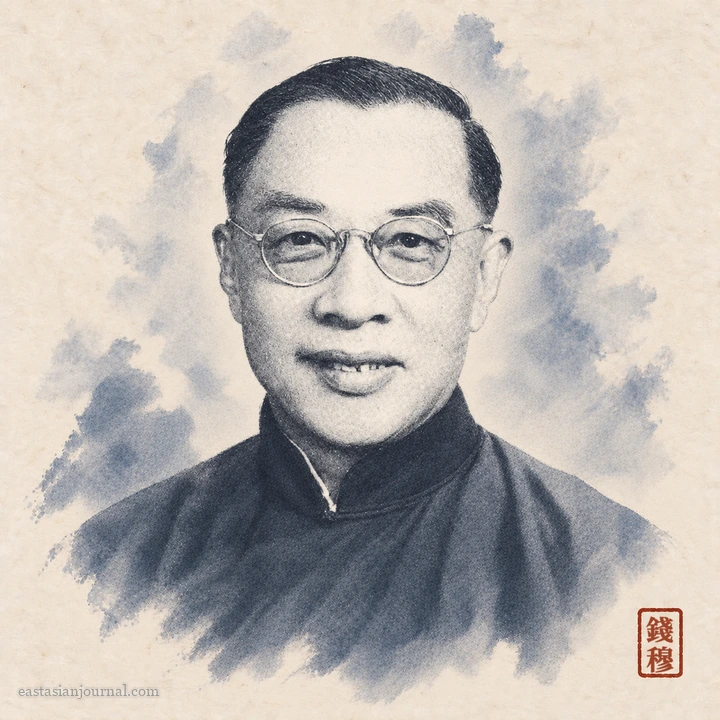
01 · ScholarshipQian Mu錢穆 · 1895–1990Historian and public intellectualQian defended historical continuity as central to understanding Chinese intellectual culture.Read the argument & sources ↓
Names: Qián Mù
Life and setting
Qian Mu was a schoolteacher in Jiangsu before he became a university historian. Born in Wuxi in 1895, he taught locally and then in Beijing; war subsequently displaced the institutions in which he worked. His history pursued a question that survived those disruptions: what endures when dynasties and political borders change? [27]
In Hong Kong after 1949, Qian helped establish New Asia College in 1950. His commitment to Chinese-language higher education made cultural continuity an institutional project as well as a historical argument. [27]
The work
國史大綱 (Outline of National History). Published in 1940, this survey of Chinese history organizes dynastic material around long-term development and the question of how to write a Chinese national history. [66]
The idea, step by step
Take a dynastic transition. Political authority changes, but the succession alone says little about what happened to schools, texts and local organization. Qian follows these practices across the break. [27]
Compare periods through recurrent questions: how was power organized, how was learning transmitted, and which social arrangements changed? On this method, continuity has to be demonstrated amid institutional alteration. [27][66]
The difficult case is a frontier or non-Han regime. If a history follows a “nation” across centuries, who counts within its subject? The boundary chosen for 國史 shapes the evidence brought into view. [66]
Who disagreed
Zhang Taiyan and Qian Mu differed over the bounds and practice of 國史, especially its relation to non-Chinese peoples. Historian Sung Chia-fu reconstructs their 1930s debate from writings; Zhang and Qian never met. Their dispute changes what the historian includes when describing a national past. [66]
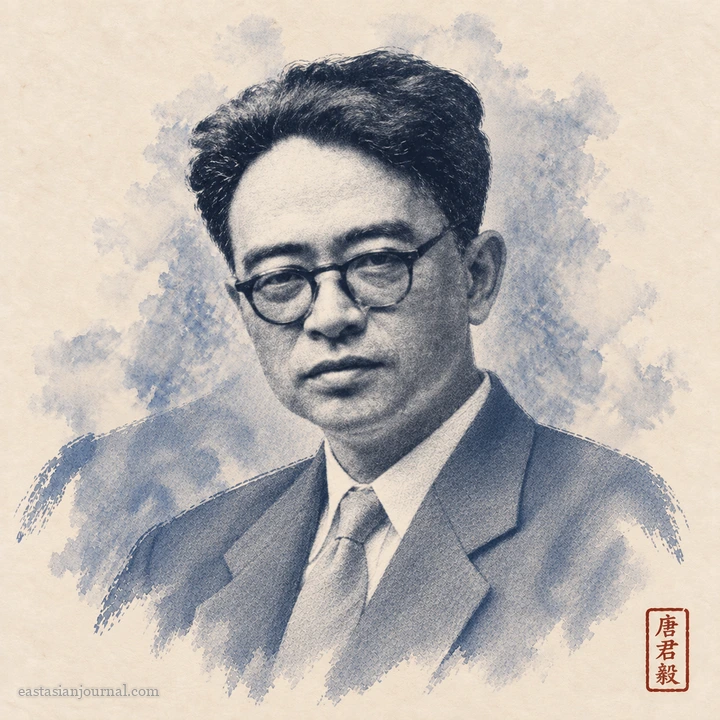
02 · ConfucianTang Junyi唐君毅 · 1909–1978Systematic philosopherTang examined moral consciousness, lived experience and the cultural dimensions of human flourishing.Read the argument & sources ↓
Names: Táng Jūnyì
Life and setting
War and exile shaped Tang Junyi’s philosophy. Born in Sichuan in 1909, he studied in Beijing and at National Central University, then became a founder of Hong Kong’s New Asia College after 1949. Scientific expertise, political authority and competing traditions each pressed a question: what makes a person a responsible moral agent? [13]
In Hong Kong, Tang pursued an ambitious account of the ways mind encounters reality. The project asks why empirical knowledge, however reliable, does not exhaust ethical experience. [13]
The work
生命存在與心靈境界 (Life Existence and the Horizons of Mind). This two-volume work of 1977 distinguishes nine horizons of mind, from empirical and conceptual understanding to moral practice and more encompassing awareness. Each horizon names a different relationship between a knowing subject and its world. [13]
The idea, step by step
A laboratory discovers a cause. Tang places causal science chiefly in the third horizon: it can explain how an event occurs without deciding what should be done about it. [13]
Logic and mathematics, located broadly in the fifth horizon, clarify relations and valid inferences. Moral practice belongs to a sixth horizon because recognizing a duty and carrying it out ask more than correct description. [13]
Suppose research shows that a policy harms strangers. Establishing the effects is an empirical achievement; recognizing those strangers as subjects makes a different demand. Tang calls the responsive connection 感通. [13]
Later horizons extend beyond a single knower and object. Their ordering expresses Tang’s normative interpretation of human fulfillment, not an attempt to replace scientific methods with moral intuition. [13]
Who disagreed
Tang and Mou Zongsan agreed that moral knowledge exceeded empirical observation. Mou emphasized the autonomous moral self, intellectual intuition and free will; Tang emphasized 感通 and the recognition of other subjects. The dispute concerns whether moral selfhood is grounded chiefly in inward autonomy or responsive relation. [13]
03 · ConfucianMou Zongsan牟宗三 · 1909–1995Systematic philosopherMou engaged Kant and classical Confucian thought to defend moral autonomy and the reality of freedom.Read the argument & sources ↓
This thinker also appears in Taiwan. The same works and cited claims are not repeated as a second dossier.
04 · ConfucianXu Fuguan徐復觀 · 1903–1982Modern Confucian philosopherXu explored classical accounts of human nature, history and political ethics in modern conditions.Read the argument & sources ↓
This thinker also appears in Taiwan. The same works and cited claims are not repeated as a second dossier.
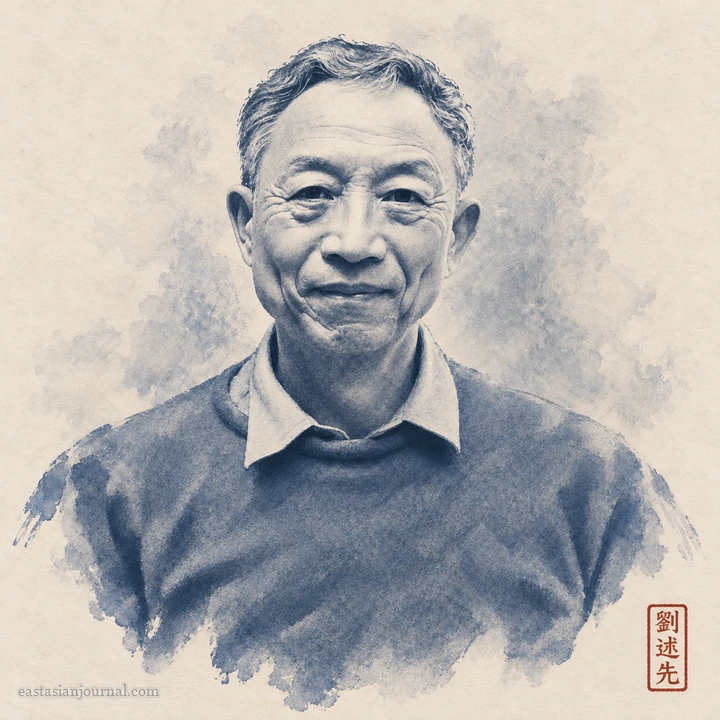
05 · ConfucianLiu Shu-hsien劉述先 · 1934–2016Modern philosopherLiu advanced comparative inquiry into Confucian self-cultivation and modern ethical life.Read the argument & sources ↓
Names: Liú Shùxiān
Life and setting
Liu Shu-hsien’s career crossed Taiwan, the United States and Hong Kong. Born in Shanghai in 1934, he studied at National Taiwan University, earned a doctorate at Southern Illinois University and became a chair professor at the Chinese University of Hong Kong. He had to explain Confucian moral ideas to readers with different assumptions about religion and modernity. [67]
After retiring in 1999, Liu worked with Academia Sinica in Taiwan. His persistent problem was how a claim to universal values could survive genuine cultural difference. [67][69]
The work
現代新儒學之省察論集 (Collected Reflections on Modern New Confucianism). Published by Academia Sinica in 2004, this collection contains fourteen essays and an interview on New Confucianism, metaphysics, global ethics and the Boston Confucian movement. Liu’s later article on 理一分殊 gives the issue its sharpest formulation. [68][69]
The idea, step by step
Zhu Xi’s formula 理一分殊 joins one principle to its many particular manifestations. Liu accepts a shared moral ground but asks how it can guide people who inhabit different institutions and traditions. [69]
Imagine two communities fulfilling duties of care through different practices. Similar ethical commitments need not yield identical institutions. Their arrangements remain open to criticism and mutual learning. [69]
Liu gives greater weight to 殊, particularity, while treating 理一, unity, as a regulative ideal. A universal principle can orient moral judgment without dictating one culture’s complete pattern of life. [69]
Who disagreed
Zhu Xi joined 理一分殊 to a comprehensive moral cosmology. Liu revisited the formula in an age of cultural pluralism, assigning unity a regulative role and particulars greater independence. Their relation is one of later reinterpretation, not a historical conversation; the issue is how tightly common principle determines practice. [69]
06 · Modern philosophyLao Sze-kwang勞思光 · 1927–2012Systematic philosopherLao understood philosophical thinking as ongoing reflection and studied reason, culture and political freedom.Read the argument & sources ↓
Names: Láo Sīguāng
Life and setting
Born in Xi’an in 1927, Lao Sze-kwang fled mainland China for Taiwan in 1949, then moved to Hong Kong in 1955. He criticized authoritarian government on both sides of the strait. Joining the Chinese University of Hong Kong in 1964, he treated the history of philosophy as a way to investigate the values by which people judge political and moral life. [70][26]
Although he worked alongside Tang Junyi and Mou Zongsan, Lao resisted identification with their New Confucian movement. His independent stance carried into a method for reconstructing older thinkers’ arguments. [70]
The work
新編中國哲學史 (New Edition of the History of Chinese Philosophy). In this multi-volume history, published from 1984 to 1986, Lao reconstructs Chinese philosophy by asking which problem each thinker sought to solve. The Fundamental Question Method combines historical reading with logical analysis. [70]
The idea, step by step
Consider 禮, ritual, in the Analects. Identify the text and its political setting, but do not assume that a catalog of ceremonies gives Confucius’ philosophical problem. [70]
Reconstruct the reasoning: ritual structures conduct; justified order requires 義, rightness; rightness ultimately rests on 仁, humaneness. Lao infers the basic question of how a disrupted society can recover legitimate order. [70]
Test this inferred question against further passages and possible rival explanations. A reconstruction must account for the texts it claims to explain. Lao’s moral reading of Chinese philosophy is itself an interpretation, open to challenge. [70]
Who disagreed
Lao faulted Hu Shi’s history for privileging textual investigation over philosophical questions and Feng Youlan’s for filtering Chinese thinkers through imported metaphysics. His challenge concerned how a tradition’s central problems are identified; it did not make philological evidence dispensable. [70]
Why here. His long CUHK career shaped teaching and scholarship in Chinese intellectual history. [26][25]
What the popular account misses. His critical philosophy differs from colleagues’ metaphysical projects, even when grouped together institutionally. [26][25]
Translation, encounter and a late Qing reform thinker
Macau’s strongest documented intellectual role here is as a physical passageway for scholarly and missionary exchange. That is not the same claim as a local school of six systematic philosophers.
Why this selection: Three interpreters and organisers of the Jesuit missions, and a reform thinker who wrote in Macau.
01 · Cross-culturalMichele Ruggieri羅明堅 · 1543–1607Missionary and language scholarRuggieri learned Chinese in Macau and joined early efforts to understand Chinese institutions and texts.Read the argument & sources ↓
The first page of the Portuguese–Chinese dictionary compiled by Michele Ruggieri and Matteo Ricci at Zhaoqing, about 1583–1588.Public domain, via Wikimedia Commons.
Names: Michele Ruggieri
Life and setting
Chinese language study preceded Michele Ruggieri’s arguments about Chinese ideas. Born in Italy in 1543, he trained in Macao from 1579 and established a residence at Zhaoqing with Matteo Ricci in 1583, with local official permission. [30][29]
He later returned to Europe to seek mission support. His work reveals how choosing a Chinese word also meant choosing a recognizable social identity. [30][71]
The work
新編西竺國天主實錄 (Newly Compiled True Record of the Lord of Heaven from India). Printed in Zhaoqing in 1584, this Chinese catechism stages questions and answers on Catholic teaching. It drew on Chinese interpreters and available religious vocabulary. A later revision, 天主聖教實錄, altered terminology and coverage. [71][72]
The idea, step by step
Initial contact needed recognizable roles. Buddhist-style robes and familiar terms for monks and temples helped Ruggieri explain who the visitors were. [72]
The same vocabulary carried assumptions. A reader might understand the exchange about creation or the soul yet mistake a European priest for a kind of Buddhist cleric. [71][72]
Later revisions reduced Buddhist- and Daoist-associated language. The comparison reveals a trade-off between immediate intelligibility and doctrinal distinction, without assigning every translation choice to Ruggieri alone. [72]
Who disagreed
Ricci later favored Confucian scholarly language and distanced the mission from Buddhist monastic identity. This was a strategic difference between successive approaches, not an evidenced personal quarrel. The question was whether successful entry vocabulary could misidentify the teaching it introduced. [72][71]
Why here. His Macao-based language preparation preceded his mainland China mission with Ricci. [30][29]
What the popular account misses. Linguistic mediation is not proof that he was a classical Chinese philosopher or a representative of Macau’s whole population. [30][29]
02 · Cross-culturalAlessandro Valignano范禮安 · 1539–1606Mission administrator and cultural strategistValignano promoted practical language and cultural preparation for Jesuit missions across East Asia.Read the argument & sources ↓
Names: Alessandro Valignano
Life and setting
Where should a guest sit in a Japanese reception room, and who should be served first? Alessandro Valignano made such questions part of missionary training. Born in 1539, he became Jesuit Visitor for Asian missions and sought to replace unfamiliar European habits with locally comprehensible conduct. [73][29]
His work also extended to Macao’s mission institutions. Rules about reception, language and rank required training and administration, not individual goodwill alone. [29][73]
The work
Advertimentos e avisos acerca dos costumes e catangues de Jappao (Warning and Advice About Habits and Traditions of Japan). Composed in 1582–83, this Portuguese manual sets out Japanese expectations for dress, hospitality, rank and cleanliness. Missionaries could rehearse its directions rather than treat accommodation as a vague aspiration. [73]
The idea, step by step
European assumptions could make missionaries appear discourteous before religious questions arose. Credibility depended partly on how others interpreted their conduct. [73]
Valignano converted observation into procedure. Positions in the zashiki, service with a sakazuki cup and care of the tea room could be taught, practiced and corrected. [73]
Language study, local expertise and revised institutional rules supported the change. These were means toward conversion, and the hierarchies being accommodated remained socially unequal. [73]
Who disagreed
Valignano disagreed with the approach associated with Jesuit superiors Francisco Cabral and Gaspar Coelho, who kept European clergy socially separate from Japanese personnel. He also faced reservations from Jesuit General Claudio Acquaviva. The disagreement was over whose habits a mission should require its members to change. [73]
Why here. The St Paul’s College enlargement in Macau in 1594 is documented in local archival scholarship. [28][29]
What the popular account misses. His strategy served a specific missionary institution; it is not an unbiased model of intercultural exchange. [28][29]
03 · Cross-culturalMatteo Ricci利瑪竇 · 1552–1610Missionary scholar and intercultural interpreterRicci engaged with Chinese classical vocabulary while presenting European religious and intellectual ideas.Read the argument & sources ↓
Kunyu wanguo quantu (坤輿萬國全圖), the world map Matteo Ricci produced with Chinese collaborators in Beijing in 1602; a seventeenth-century copy.Public domain, via Wikimedia Commons.
Names: Matteo Ricci
Life and setting
Matteo Ricci arrived in Macao in 1582 and joined Ruggieri in Zhaoqing the next year. He learned to make arguments in the vocabulary and scholarly conventions of Ming literati, where shared classical terms already carried contested meanings. [29][74]
Until his death in 1610, Ricci pursued these conversations inside China. Agreement about words could conceal differences over cosmology, the soul and moral authority. [29][74]
The work
天主實義 (The True Meaning of the Lord of Heaven). Issued in Chinese in 1603, this dialogue gives a Chinese literatus questions and objections alongside Ricci’s theological answers. Ricci reads early classical accounts of Heaven in support of a personal creator and challenges Buddhist and Neo-Confucian positions. [74][77]
The idea, step by step
Ricci first identifies 上帝 in early Confucian texts as a possible designation for the personal creator he calls 天主. The common term begins a conversation but cannot establish that its users share a theology. [77][74]
He then argues about causes, the soul and moral intention. One archery example, analyzed by later scholars, distinguishes the outward result of hitting a target from the purpose with which a person aimed. [75][76]
This argument chooses sides within Chinese intellectual history. Ricci appeals to ancient Confucian passages while criticizing Buddhist claims and Neo-Confucian accounts of immanent principle. His account depends on that selective reading. [74]
Who disagreed
The Buddhist monk Yunqi Zhuhong and his disciple Yu Chunxi answered Ricci’s criticism of Buddhism, including his treatment of abstaining from killing; Zhuhong’s written response followed Ricci’s death. They disagreed about compassion and religious authority. The convert Xu Guangqi supported Ricci’s project, underscoring the differences among his Ming readers. [77][78]
Why here. He arrived in Macau in 1582 and learned Chinese before working farther inside China. [29][28]
What the popular account misses. Ricci’s extensive mature work took place beyond Macau; the region is a gateway, not the sole setting of his philosophy. [29][28]
04 · Political thoughtZheng Guanying鄭觀應 · 1842–1922Reform thinker and writerZheng linked commercial knowledge to proposals for political and institutional reform in late Qing China.Read the argument & sources ↓
Shengshi weiyan (盛世危言), Words of Warning to a Prosperous Age, woodblock edition of 1895.Original: National Library of China. Public domain, via Wikimedia Commons.
Names: Zhèng Guānyīng
Life and setting
Zheng Guanying understood foreign commercial power as an employee before he analyzed it as a reformer. Born in Guangdong in 1842, he worked for Butterfield & Swire in Shanghai and later participated in Chinese steamship, textile and telegraph enterprises. [81][80]
In the late 1880s, Zheng returned to his family’s Mandarin’s House in Macao and developed plans for institutional reform. His death year remains disputed in the consulted records: Macao’s heritage authority gives 1921, while other records give 1922 or 1923. [32][79][81]
The work
盛世危言 (Words of Warning in Times of Prosperity). Developed before the Sino-Japanese War, this collection connects commerce and industry to education, law and government. Its discussions of 商戰 and 議院 place market rivalry beside political representation. [32][79][82]
The idea, step by step
A steamship firm can purchase vessels and still lose to foreign competitors with stronger capital, networks and market access. Zheng knew those commercial arrangements firsthand. [80][82]
He proposed stronger domestic enterprises, skills, schools, communications and commercial laws. Machines alone could not alter the conditions in which firms competed. [79][82]
He also supported deliberative or representative institutions, including 議院, as part of state reform. This was a proposal within a monarchical setting, not a demand for modern universal suffrage. [82]
Who disagreed
Li Hongzhang supported the Qing Self-Strengthening enterprises in which Zheng worked. Zheng’s writing pushed further toward legal change and representative institutions. Their programs overlapped, and a direct quarrel is unverified; the difference concerns whether industrial investment sufficed without wider political reform. [80][82]
Why here. Macao’s Mandarin’s House is where he completed his influential work, according to the local heritage authority. [31][32]
What the popular account misses. His influence crossed Macau and mainland China, but he was not the founder of a distinct autonomous Macanese philosophical school. [31][32]
Buddhist knowledge in Mongolian and Tibetan textual worlds
Mongolian intellectual history is not reducible to rulers, the steppe or imported theology. Religious teachers authored and translated sophisticated works in Tibetan and Mongolian, and their practices were locally reworked.
Why this selection: Five religious thinkers and scholar-translators documented in specialist studies; dates and transliterations are qualified where needed.
01 · BuddhistZanabazarЗанабазар · 1635–1723Religious leader and scholarThe first Khalkha Jebtsundamba embodied Buddhist authority through teaching, ritual and artistic forms.Read the argument & sources ↓
Names: Öndör Gegeen Zanabazar
Life and setting
A prayer that remains in daily use can outlast the political arrangement under which it was composed. Zanabazar (1635–1723) became the first Khalkha Jebtsundamba, an incarnate Buddhist leader, in a seventeenth-century Inner Asia contested by the Geluk establishment and the Qing empire. His installation in 1639 was associated with the mobile monastic community that developed into Ikh Khüree. His authority operated through devotional images, institutions and ritual texts as well as leadership. [40][94]
The work
Өндөр гэгээн Занабазарын тахилгын залбирал (Three Ritual Prayers attributed to Öndör Gegeen Zanabazar). This is a modern Mongolian description of a group of texts; no single historical title is established in the consulted chapter. Zsuzsa Majer's scholarly selection presents three Tibetan-language prayers associated with Zanabazar: a widely used daily prayer, a food offering for ritual use and an Avalokiteśvara practice connected with mantra and visualization. Their different settings are central to their use. [40]
The idea, step by step
A communal prayer gives otherwise scattered practitioners a repeatable act. Its importance lies partly in recurrence: Tibetan liturgical words become familiar in Khalkha practice, even when the language of instruction is not Mongolian. [40]
The food-offering text carries teaching into a material action. The prayer associated with Avalokiteśvara involves recitation and contemplative practice. These are distinct ritual genres; the Oxford chapter identifies their functions but does not establish that every later version passed unchanged from Zanabazar's hand. [40]
The Avalokiteśvara work is also connected in the scholarly account with Zanabazar's Soyombo script. Writing, visual forms and embodied rites thus offered different means of organizing a Buddhist community across locations and political change. [40][94]
Who disagreed
Compare Zanabazar's Tibetan-language ritual inheritance with the Oirat Zaya Paṇḍita Namkhai Jamtsu, whose Clear Script was designed to make Buddhist texts accessible in Mongolian languages. Richard Taupier emphasizes the Clear Script's religious and political purposes. This is a contrast between regional projects, not a documented personal controversy; the question is how script and liturgical language shape participation and authority. [40][95]
Why here. His works and reception connect Mongolian Buddhist practice to wider Tibetan Geluk textual worlds. [40][37]
What the popular account misses. Political leadership and artistic authority do not by themselves show that every devotional text was authored by him. [40][37]
02 · BuddhistKhalkha Zaya PaṇḍitaЛувсанпринлэй · 1642–1715Buddhist monk and autobiographerThe Khalkha monk narrated the work of translating Buddhist instruction into Mongolian monastic life.Read the argument & sources ↓
Names: Lobsang Trinley / Luvsanphrinle · First Khalkha Zaya Paṇḍita
Life and setting
Lobsang Trinley wanted to continue studying in Tibet. The Fifth Dalai Lama directed him back to Mongolia to teach. That tension between prolonged study and the obligation to transmit learning marks the career of the first Khalkha Zaya Paṇḍita, also rendered Luvsanphrinle or Luvsanprinlei (born 1642). Oxford contributors disagree about his death year: Sangseraima Ujeed gives 1715, Krisztina Teleki 1719. He was a Khalkha monk, distinct from the Oirat Zaya Paṇḍita who developed Clear Script. [34][96][95]
The work
Автобиография (Tibetan-Language Autobiography). The Cyrillic entry is a modern descriptive label for Tibetan life-writing translated in Sangseraima Ujeed's Oxford chapter. Ujeed describes it as the earliest known Tibetan-language biography by a Mongolian writer and observes that it combines Tibetan conventions of exemplary religious life with locally inflected narration. The underlying chapter is paywalled, so individual scenes are not invented here. [34]
The idea, step by step
A teacher's itinerary can be evidence in a Buddhist account of authority: what was learned, from whom, and why the learning could be passed on. Zaya's return from Tibet made that question practical for Khalkha communities. [34][97]
The autobiography uses an established Tibetan model of exemplary religious life, but Ujeed identifies Mongolian stylistic elements. Local experience enters a transregional genre without discarding its claim to recognized Buddhist transmission. [34]
A different set of writings takes the same movement into landscape. Teleki identifies sixteen smoke-offering texts ascribed to Zaya, including rites associated with specific sites in the Khangai Mountains. Place-specific offerings made local geography legible within Buddhist ritual, though the abstract alone does not prove when each text was composed. [96]
Who disagreed
Zaya's wish to stay in Tibet and the Fifth Dalai Lama's instruction to return to Mongolia disclose competing priorities within a shared religious project: further personal training and the diffusion of teaching. The sources attest the contrary wishes, without establishing a formal doctrinal dispute. The contrast is sharper when one remembers that his Tibetan-language literary practice was independent of the Oirat Zaya Paṇḍita Namkhai Jamtsu's separate Clear Script initiative. [34][95]
03 · BuddhistMergen GegeenМэргэн гэгээн · 18th centuryBuddhist poet and ritual scholarMergen Gegeen developed Buddhist ritual and didactic work grounded in Mongolian language and performance.Read the argument & sources ↓
Names: Mergen Gegeen · Mergen Gegen
Life and setting
At Mergen Monastery in the Urad Right Duke Banner of Inner Mongolia, Buddhist services could be conducted in Mongolian where Tibetan otherwise predominated. Uranchimeg Ujeed identifies the architect of this distinctive practice as the third Mergen Gegeen, Lubsangdambijaltsan, also transliterated Lubsangdambijalsan (1717–1766 in her study). Other catalogues give a broader eighteenth-century dating, and the records have yet to be reconciled. The tradition reached affiliated monasteries, making vernacular worship an institutional arrangement rather than an isolated literary preference. [98]
The work
Монгол хэлний зан үйлийн зохиол (Mongolian-Language Ritual Works). The Cyrillic wording describes a corpus; the consulted scholarship does not establish it as an original title. The texts discussed by Ujeed include offerings to tngri and nāgas and two prayers centered on the local deity Muna Qan. They join familiar Mongolian ritual forms to Buddhist liturgical reasoning; the English titles supplied by the editor are translations of selected pieces. [38]
The idea, step by step
An offering to a mountain or local power can already have meaning for a community before a monastery teaches Buddhist doctrine there. Mergen's texts retain those recognizable settings and names, especially Muna Qan. [38]
The texts reinterpret Muna Qan as a protector of Buddhist teaching. The incorporation is conditional: in Ujeed's account, a practice must be brought within the doctrinal purposes of Buddhism rather than simply approved because it is traditional. [38]
When these practices are taught and recited in Mongolian across a network of monasteries, practitioners can hear doctrine through their own ritual vocabulary. His didactic poetry extends the method: discussions of mortality and human rebirth lead listeners toward ethical and devotional practice. [98][99]
Who disagreed
The contrast with Zanabazar is instructional rather than personal. Zanabazar's widely recited Tibetan prayers represented one central current of Mongolian Buddhism; Mergen Gegeen organized a monastery network in which practices were performed in Mongolian. Ujeed treats the latter as an unusual institutional alternative in a Tibetan-dominated liturgical environment. Language changed who could follow a performance directly, without removing its Buddhist frame. [40][98]
Why here. His ritual texts feature as a distinct body in a specialist source anthology of Mongolian Buddhism. [38][33]
What the popular account misses. Precise dates and attribution vary across catalogues; the broad eighteenth-century frame is safer than unsupported precision. [38][33]
Record limit. Life years shown as approximate catalogue conventions; exact chronology not verified here.
04 · BuddhistDanzanravjaaДанзанравжаа · 1803–1856Buddhist teacher and poetDanzanravjaa used poems and images of ordinary nomadic life to teach meditation, cause and effect, and ethical practice.Read the argument & sources ↓
Names: Danzanravjaa
Life and setting
At Hamariin Hiid in the eastern Gobi, the fifth Noyon Khutuktu Danzanravjaa combined Buddhist teaching with poetry and performance. His school admitted girls and pupils from less privileged households, practices that drew disapproval from some senior religious figures and Qing officials. Dates remain unsettled: Oxford's anthology gives 1803–1856, while Hamid Sardar's peer-reviewed biography gives 1803–1857. Both Danzanravjaa and Danzan Ravjaa occur as transliterations. [35][100][101]
The work
Сургаалын шүлгүүд (Didactic Poetry). The Cyrillic title denotes a body of poems; the sources do not establish a single author-titled book. His Mongolian poems employ pastoral life and intimate relationships; his Tibetan verses more often engage technical Buddhist questions for trained readers. Simon Wickham-Smith's Oxford selection treats meditation, causation and ethical consequences through these poems. [35][100]
The idea, step by step
In the poem often rendered 'My Proud and Spirited Gray,' a rider crosses a familiar mountain landscape and turns toward someone held vividly in mind. Such a scene begins in experiences Mongolian herders could recognize without a vocabulary of scholastic Buddhism. [100]
Simon Wickham-Smith proposes a second reading: the beloved can be understood as the guru present through meditation. The horse and its handling then permit reflection on directing the mind. The argument depends on tantric interpretive conventions; the poem does not force every listener to this single meaning. [100]
At another level the poem concerns the clarity of awareness. Repeated reading can move from ordinary journey, to devotional relationship, to a more demanding account of perception. Mongolian and Tibetan audiences would have approached such steps with different levels of technical preparation. [100]
Who disagreed
Simon Wickham-Smith questions portrayals that reduce Danzanravjaa to an eccentric practitioner of 'crazy wisdom.' He reads transgressive behavior and emotionally direct poetry in the context of graded tantric instruction. Contemporary conservative Buddhist authorities and Qing administrators also objected to parts of his public practice, according to Wickham-Smith; the available evidence does not identify a named doctrinal opponent or substantiate stories about the cause of his death. [100][101]
05 · BuddhistZava DamdinЗава Дамдин · 1867–1937Buddhist scholar and biographerZava Damdin wrote Tibetan-language scholarship that connected intellectual lineage, monastic learning and biography.Read the argument & sources ↓
Names: Zava Damdin · Luvsandamdin
Life and setting
Three years after the Qing order collapsed, a Mongolian Buddhist scholar completed a tribute to a teacher who had died in 1906. Zava Damdin (1867–1937), identified in Oxford scholarship as Luvsandamdin, finished that Tibetan-language work in the late summer of 1914, amid the political uncertainty of autonomous Mongolia. He later recorded monastic institutions across Mongolian and Buryat regions as revolutionary governments changed the conditions under which those institutions operated. [39][102]
The work
Сүсэгтний оюуны чимэг (Beautifying Ornament for the Mind of the Faithful). The Cyrillic title is a modern rendering. The work was written in Tibetan; its original Tibetan title has not been verified here. Matthew W. King describes it as a praise-biography of Zava's teacher Sanjaa (1837–1906): episodes of his life are combined with praise verses and a closing seven-limb prayer intended for disciples' recitation. [39]
The idea, step by step
Begin with a problem faced by a teaching community when its teacher dies: how can later disciples distinguish personal remembrance from a transmissible model of learned conduct? A biography can record actions and relationships to make that model accessible. [39]
Zava embeds biographical information about Sanjaa in devotional praise. The narrative gives the prayer a particular referent; the praise supplies a form in which readers can repeatedly attend to the teacher's example. The final seven-limb liturgy turns reading into an act of communal practice. [39]
In his later 1931 survey of Buddhist colleges, Zava uses a different form of record to map monastic learning across Inner and Outer Mongolia and Buryatia. The first work sustains personal lineage; the later survey inventories institutions amid transformations that culminated in violent state purges later in the 1930s. [102]
Who disagreed
In a 1924 correspondence with the Buryat diplomat and Buddhist reformer Agvan Dorjiev, Zava addressed the Buddhist past and its future under revolutionary conditions. Their questions included Mongolian prehistory, the location of the legendary land of Li, and how Buddhist learning should confront scientific empiricism. The Oxford abstract identifies topics of exchange, without establishing which man prevailed on each. The stakes were the scholarly and institutional claims Buddhism could sustain in a changing intellectual order. [103]
Why here. An Oxford anthology treats his praise-biography as an example of Mongolian Buddhist textual history. [39][33]
What the popular account misses. Only the existence and scholarly role of the selected work are asserted; detailed school affiliations are not inferred from a publisher listing. [39][33]
A modern state’s governing ideology is not the whole peninsula’s philosophy
This section studies the institutional formation of the DPRK’s modern political ideology. It does not imply that Korean Buddhism or Joseon thought belonged exclusively to a state founded in 1948.
Why this selection: Three documented roles in the making of Juche: founding leader, theorist and codifier.
01 · Political thoughtKim Il Sung김일성 · 金日成 · 1912–1994Political leader and ideological figureThe 1955 speech is commonly used by scholars to date a key public presentation of Juche in party ideological work.Read the argument & sources ↓
Names: Kim Il-sŏng
Life and setting
A Soviet landscape, Kim Il Sung said in 1955, had been hung in a North Korean army rest home where images of Korean mountains might better serve his purposes. That anecdote belongs to his own political speech, not an independently checked report of the room. Kim (1912–1994) led the DPRK from its establishment in 1948, consolidated a highly centralized ruling party, and presided over the state's war with South Korea. Archival research documents his April 1950 appeal to Stalin for approval of an invasion, contradicting later depictions of a wholly autonomous revolutionary course. [104][41][105]
The work
사상사업에서 교조주의와 형식주의를 퇴치하고 주체를 확립할 데 대하여 (On Eliminating Dogmatism and Formalism and Establishing Juche in Ideological Work). This December 1955 party speech attacks formulaic propaganda and the uncritical replication of Soviet and Chinese examples. In the excerpt translated for Columbia University's Sources of Korean Tradition, Kim argues that socialist ideas should be applied to Korean historical conditions. It is a contemporary argument about ideological work, distinct in scope from later official narratives that retrospectively date the full Juche system to the 1930s. [104][41]
The idea, step by step
Kim describes a school whose walls displayed Russian literary figures but no Korean ones. His example argues that imported imagery failed to cultivate the national loyalty sought by the party. The scene remains his unverified account. [104]
He argues for studying Korean history, geography and revolutionary experience while learning from Marxism-Leninism. Soviet or Chinese lessons are to be adapted rather than reproduced mechanically. Thus Juche initially specifies the standpoint from which party propagandists should decide what material fits their work. [104]
Later DPRK formulations enlarge this into a doctrine of political independence, economic self-sufficiency and defense, joined to loyalty to the leader. Research ties this expansion to factional conflict and regime survival; a 1982 official text instead credits Kim with sole creation decades earlier. [41][106]
Who disagreed
Pak Chang-ok and Choe Chang-ik participated in the 1956 challenge to Kim's dominance, an episode followed by political purges and further concentration of power. Kim Jong Il's 1982 treatise credits his father with Juche's creation in 1930; independent scholarship traces its development through the 1955 speech and subsequent factional struggles. The official retrospective claim is evidence of regime self-presentation, not proof of unique authorship. [41][106]
Why here. Juche developed as a state doctrine of national autonomy, leadership and political mobilization under the DPRK. [41][44]
What the popular account misses. Official biographies attribute sweeping sole authorship to Kim; scholarship treats ideology as historically constructed and consolidated. [41][44]
02 · Political thoughtHwang Jang-yop황장엽 · 黃長燁 · 1923–2010Political ideological theoristHwang was widely described as a principal systematizer of Juche philosophy within DPRK institutions.Read the argument & sources ↓
Names: Hwang Jang-yŏp
Life and setting
Hwang Jang-yop (1923–2010), then North Korea's highest-ranking defector, sought asylum in Beijing in February 1997. He had been a philosophy professor and president of Kim Il Sung University, chaired the DPRK's Supreme People's Assembly Standing Committee, and served in senior Workers' Party posts. He later criticized the ruling system in which he had held these offices. In 1997 North Korean authorities portrayed his departure as an abduction; contemporaneous reporting treated it as a requested defection. [43][107][109]
The work
주체사상 해설 (Expositions of the Juche Idea). The Korean label describes Hwang's expositions; it does not identify a verified single book or edition. Reporting and his later statements establish his role as a philosophical interpreter. In a 1997 news conference he said he had added philosophical explanation at the direction of the Workers' Party and denied creating Juche; this is his self-account, not independent authorship evidence. [43][108]
The idea, step by step
The official Juche philosophy asks what kind of being can act on the world. Its answer is a social person capable of independence, creativity and consciousness. Kim Jong Il's 1982 exposition states this as a central principle; identifying Hwang as its sole original author would require evidence that these texts do not supply. [106][43]
The next step is political. A claim that people can shape their circumstances does not itself specify who may choose public ends, correct the government or reject the party's decisions. The official formulation places effective organization under party and leader guidance. [106]
After defecting, Hwang described his philosophical orientation as human-centered and disavowed the claim that he had created Juche. His later criticism of North Korea separated personal intellectual commitments from official leader-centered doctrine. That self-account explains his later position without settling the history of the doctrine's authorship. [108][109]
Who disagreed
The divergence between Hwang and Kim Jong Il concerns who is entitled to speak for the people. Kim Jong Il's 1982 treatise makes party and leader direction a condition of the masses' historic role. After 1997 Hwang attacked the political system he had helped explain and rejected attribution of Juche's creation to himself. His testimony challenges a simple account of an all-powerful ideological architect; it does not erase his documented service to that system. [106][108][107]
03 · Political thoughtKim Jong Il김정일 · 金正日 · 1941 or 1942–2011Political leader and ideological writerKim Jong Il’s 1982 treatise presented Juche as the regime’s systematic guiding framework.Read the argument & sources ↓
Names: Kim Jŏng-il · Kim Jong-il
Life and setting
Kim Jong Il inherited leadership in 1994 of a state whose ideology called the people the agents of history. His rule (1994–2011) sharpened the regime's claims about leadership and military priority. Official North Korean accounts give his birth as 1942 on Mount Paektu; Jae-Cheon Lim reconstructs 1941 in a Soviet camp. Both claims remain disputed. Severe famine followed in the 1990s amid economic collapse and state-directed distribution. A later UN investigation found that political controls and unequal food distribution aggravated starvation while military spending remained a priority. [41][110][111]
The work
주체사상에 대하여 (On the Juche Idea). Dated 31 March 1982, this treatise was circulated for a national Juche seminar marking Kim Il Sung's seventieth birthday. It sets out philosophical principles, the masses' place in history, and political, economic and defense policies. As a state-issued ideological primary source it establishes what the leadership officially argued, not that its historical claims or promises were fulfilled. [106]
The idea, step by step
The treatise begins from the proposition that social human beings have independence, creativity and consciousness. From that premise it calls the masses the creators of history, seemingly giving collective action the central role. [106]
It then introduces a condition: the party and supreme leader must organize and direct the masses if they are to perform that role. The declared independence of the people is thereby made dependent on compliance with a centralized political organization. [106]
The treatise also demands political autonomy, economic self-sufficiency, defense and ideological discipline. Under Kim Jong Il, scholarship identifies Songun, military-first policy, as a major strategy of regime survival. The UN later documented the human costs of an allocation system that favored politically prioritized groups and weapons expenditure during food crises. [106][41][110]
Who disagreed
Hwang Jang-yop, a senior Juche interpreter who defected in 1997, later presented his philosophy as human-centered and criticized the ruling order. Kim Jong Il's 1982 text, by contrast, states that the party and leader supply indispensable direction to the masses. The difference concerns whether popular agency can exist independently of the leadership claiming to represent it. Kim's treatise also assigns sole founding credit to his father and traces Juche to 1930; scholarly reconstructions instead examine the doctrine's gradual consolidation. [106][108][41]
Why here. KINU scholarship analyzes the doctrine alongside consolidation of political authority and hereditary succession. [42][41]
What the popular account misses. Birthplace, birth-year accounts and official heroic biographies are contested; intellectual impact must be distinguished from regime propaganda. [42][41]
Record limit. Official North Korean accounts give 1942; many external biographies report 1941.
An arrow documents a particular relationship between arguments or people. It does not claim that every line was direct instruction, nor that influence always meant agreement.
Placement is an editorial diagram, not a geospatial map or a quantified measure of influence. Colours distinguish traditions; absent links mean no sufficiently direct relation is asserted here.
Read every connection in words, with evidence
Confucius → Menciusreinterpreted. Mencius identified his thought with the Confucian way while developing a distinct account of moral sprouts. [20]
Confucius → Zhu Xireinterpreted. Zhu Xi recast the Four Books curriculum as a path of self-cultivation. [23]
Mencius → Yi Hwangreinterpreted. Toegye interpreted the Mencian Four Sprouts through principle and vital force. [9]
Zhu Xi → Yi Hwangreinterpreted. Joseon moral metaphysics worked with Zhu Xi’s system rather than reproducing it unchanged. [23] [10]
Zhu Xi → Yi Ireinterpreted. Yulgok explored the principle and material force framework transmitted through Neo-Confucian study. [10]
Yi I → Im Yunjidangcontested. Im entered debates in which Yulgok’s views remained important, while challenging assumptions about moral capacity. [10] [12]
Zhu Xi → Ogyū Soraiopposed. Sorai challenged the moral-psychological focus of Zhu Xi-oriented orthodoxy. [4]
Mencius → Mou Zongsanreinterpreted. Modern Confucians including Mou revisited Mencian moral subjectivity through dialogue with Kant. [13]
Tang Junyi → Mou Zongsancollaborated. Tang and Mou contributed to the modern Confucian manifesto and ensuing debates. [13]
Xu Fuguan → Mou Zongsancollaborated. Xu and Mou were co-participants in the modern Confucian manifesto project, not identical thinkers. [13]
Mou Zongsan → Liu Shu-hsienlater tradition. Liu belonged to a subsequent generation of modern Confucian inquiry rather than the original manifesto circle. [13] [25]
Alessandro Valignano → Michele Ruggierisupported. Valignano directed early missionaries toward Chinese-language cultural preparation. [30] [29]
Michele Ruggieri → Matteo Riccipreceded. Ruggieri began language and mission work before Ricci joined the China mission. [29]
Kim Il Sung → Kim Jong Ilreworked. The later leadership formalized and promoted Juche as governing ideology. [42]
Hwang Jang-yop → Kim Jong Ilsystematized. Hwang’s intellectual role and the regime leadership’s public ideological texts must be kept analytically distinct. [43] [42]
FIELD GUIDE / 03
An uneven chronology
Move through a common time axis. A dot may mark a life, a text, an institution or an explicitly modern political event. They are not interchangeable measures of philosophical importance.
Use Left and Right Arrow to move a year at a time. The nearest documented events are also available in the complete chronological list below.
Confucian ethical and Daoist writings take shapeMainland China · Classical manuscript traditions arose over centuries, not as simultaneous books by two certain authors. Evidence [19]
Mencian debates about human natureMainland China · Fourth-century BCE texts develop moral responses into competing accounts of the good life. Evidence [20]
Wonhyo and Silla Buddhist thoughtSouth Korea · Korean Buddhist philosophical synthesis precedes the modern peninsula division. Evidence [9]
Kūkai’s Shingon periodJapan · Esoteric Buddhist training links body, speech and mind with enlightenment. Evidence [2]
Zhu Xi and the Four BooksMainland China · A Song scholarly synthesis becomes important for later East Asian curricula. Evidence [23]
Dōgen and Sōtō Zen practiceJapan · Buddhist practice becomes a distinct site of Japanese philosophical argument. Evidence [3]
Joseon dynasty beginsSouth Korea · Neo-Confucian government becomes a powerful framework for scholarly debates. Evidence [10]
Four-Seven correspondenceSouth Korea · Yi Hwang and Ki Taesŭng begin letters on emotions, virtue and causation. Evidence [9]
Ricci arrives in MacauMacau · Language preparation precedes the better-known mission work in China. Evidence [29]
St Paul’s College enlargementMacau · A documented institutional site of Chinese-European language and philosophical exchange. Evidence [28]
Zanabazar’s era beginsMongolia · The Khalkha religious scholar’s life links Mongolian and Tibetan Buddhist learning. Evidence [37]
Edo disputationsJapan · Alternative classical readings challenge Neo-Confucian orthodoxy. Evidence [4]
Im Yunjidang’s lifeSouth Korea · A Korean woman reformulates arguments about sagehood and moral capacity. Evidence [12]
Danzanravjaa and didactic poetryMongolia · Buddhist instruction appears in accessible Mongolian poetic forms. Evidence [35]
Japanese colonial rule beginsTaiwan · The modern history of Taiwan’s ideas cannot omit the 1895–1945 period. Evidence [18]
DPRK foundedNorth Korea · A modern sovereign state is created; earlier Korean thinkers predate both successor states. Evidence [41]
New Asia philosophical milieuHong Kong · New Asia College begins a major academic center for modern Confucian inquiry. Evidence [25]
ROC institutions relocate to TaiwanTaiwan · Modern Confucian and liberal debates develop in a new political setting. Evidence [13]
Early Juche formulationNorth Korea · Kim Il Sung’s speech introduces Juche into the documented party ideological record. Evidence [41]
Su Beng’s history first publishedTaiwan · A Taiwan-centered historical account appears initially in Japanese. Evidence [18]
CUHK is establishedHong Kong · Three colleges bring scholarship together, including major Confucian philosophers. Evidence [25]
On the Juche IdeaNorth Korea · Kim Jong Il’s public ideological treatise codifies the leadership’s claims. Evidence [42]
New intellectual debates broadenTaiwan · Multiple philosophical inheritances continue to contend in modern Taiwan. Evidence [13]
Mongolian Buddhist texts in translationMongolia · Oxford University Press publishes a specialist anthology with original-language text traditions. Evidence [33]
Zheng Guanying legacy exhibitionMacau · Macau’s cultural authority documents the local setting of a reform thinker. Evidence [31]
FIELD GUIDE / 04
Same character. Different arguments.
Choose a concept and up to three intellectual settings. Only attested comparisons are offered; no artificial Chinese-character equivalent is assigned to Mongolian Buddhist thought or to Macau’s missionary encounter.
仁
Humaneness
The graph does not imply that 仁 means the same moral act everywhere. These are arguments within related Confucian traditions.
Mainland China
仁 · rén
Confucius: exemplary conduct includes responsibility to other people and the cultivation of humaneness. Evidence [19]
South Korea
인 · 仁 · in
Yi Hwang places benevolent response amid the Mencian Four Sprouts and a debate over their relation to everyday emotions. Evidence [10]
Hong Kong
仁 · jan4
Tang discusses moral awareness and the humane heart-mind as irreducible to descriptive empirical knowledge. Evidence [13]
Taiwan
仁 · rén
Mou works with a Confucian account of moral agency to argue about autonomy and modern freedom. Evidence [13]
理
Principle / pattern
The same graph can denote different positions in debates about causation, morality and institutions.
Mainland China
理 · lǐ
Zhu Xi makes principle central to an account of moral self-cultivation and investigation. Evidence [23]
South Korea
이 · 理 · i
Yi Hwang and Yi I disagree on how principle and vital force operate in human feelings. Evidence [9]
Japan
理 · ri
Ogyū Sorai criticizes Neo-Confucian expectations that inward mind control establishes good government. Evidence [4]
Hong Kong
理 · lei5
Tang and Mou bring Confucian moral metaphysics into conversation with modern philosophy. Evidence [13]
心
Heart-mind
心 is not simply the English word mind: its philosophical valence changes between Buddhist, Confucian and modern accounts.
South Korea
심 · 心 · sim
Wonhyo’s Buddhist One Mind is not identical to Yi Hwang’s later Confucian moral psychology. Evidence [9]
Mainland China
心 · xīn
Mencius argues from affective moral responses toward cultivation of human capacities. Evidence [20]
Hong Kong
心 · sam1
Tang focuses on lived moral awareness, while Mou develops moral metaphysics. Evidence [13]
Taiwan
心 · xīn
Mou connects the moral heart-mind to autonomy, a claim he debates with Kant. Evidence [13]
道
Way / path
Dao in the Daodejing is not reducible to the Confucian Way or the Japanese Buddhist path.
Mainland China
道 · dào
The Laozi tradition presents Dao in relation to spontaneity, simplicity and non-coercive rule. Evidence [21]
Japan
道 · dō / michi
Zen expresses a lived path in which disciplined practice and philosophical insight are connected. Evidence [3]
South Korea
도 · 道 · do
Korean philosophy treats the Way through practical ethical training as well as Buddhist cultivation. Evidence [9]
孝
Filial responsibility
Do not infer modern people’s beliefs from the persistence of a character in educational texts.
Mainland China
孝 · xiào
Confucian filial duty is embedded in broader questions about ritual and obligations to others. Evidence [19]
South Korea
효 · 孝 · hyo
Joseon Neo-Confucian rites made familial duties a matter of moral learning and social institutions. Evidence [10]
Japan
孝 · kō
Edo Confucian arguments differed on the relation between inherited rites and inner cultivation. Evidence [4]
Taiwan
孝 · xiào
The classical ideal forms part of Taiwan’s inherited Chinese reading traditions, not a uniform contemporary norm. Evidence [23]
The selected region or regions have no supported interpretation for this concept in this feature. Try a different combination. The missing comparison is intentional, not evidence that the idea was absent in that place.
FIELD GUIDE / 05 · EXAMINATION READING DESK
Exams, ideas and evidence
The point is to grasp the argument, not to guess the name. Survey eight examination settings here, then open each complete reading desk for the cited doctrines, original-language exercises and detailed rationales.
Research reviewed: 17 October 2026Access: FreeIndependence: No affiliation with examination authorities
Editorial distinction: Official documents establish named examinations, curriculum frameworks and assessment formats. Scholarly sources establish the philosophical arguments. Inclusion here does not mean an examination board prescribes each thinker or that a particular question will appear. All practice is original, never reproduced from past papers.
Each region has a permanent link, verified examination references and a concise reading outline. The full doctrinal notes, complete terms deck, matching drill and annotated practice are on the dedicated reading sheet, accessible with or without scripts.
20 original practice questions · 5 reading units
大学入学共通テスト
Common Test for University Admissions
The current Common Test has 公共,倫理. MEXT Ethics guidance explicitly discusses Motoori and Fukuzawa, Buddhism and Confucian encounters. The other selected figures are defensible comparative context, not a promise that DNC will ask about them.
Examination authority
大学入試センター (DNC)
Relevant subject
「公共,倫理」; relevant curriculum in 高等学校「倫理」
School stage
高等学校2–3年 / upper secondary, especially exam-year students
Format reference
Source interpretation and contextual comparison with single-best-answer options
Documented: MEXT expressly mentions Motoori Norinaga and Fukuzawa Yukichi; selected Korean/Chinese comparisons and all other Japanese figures are editorial enrichments. Limit: No DNC statement guarantees any named thinker in a future sitting. This is original, curriculum-aligned supplementary practice, not a complete exam course.
Official examination record · complete citations on the full sheet
Follow the curriculum-linked questions in sequence. The full terminology, philosophical reasoning and evidence are preserved on the dedicated reading sheet.
For Kūkai, embodied, verbal and mental practices (the Three Mysteries) express a path toward realizing Buddhahood in this very body; this is not simply postponing awakening until after death.
Dōgen emphasizes just sitting and dropping off body-mind. Through the unity of practice and realization, meditation is not merely an external transaction yielding a future reward.
Original ja-language questions, an English-language toggle, a reason for every answer choice, profile references and a saved mistakes review. A separately paginated print key is available on the full sheet. No scripts are needed to read it.
The 2027 cycle retains Ethics and Thought/Life and Ethics. From 2028, the revised integrated Social Studies exam replaces separate social-studies subject choice; check the applicant year before studying.
Examination authority
한국교육과정평가원 (KICE); 교육부
Relevant subject
2027학년도 사회탐구 「윤리와 사상」, 「생활과 윤리」; 2028학년도 통합사회
School stage
고등학교 2–3학년; 2027학년도 선택 과목과 2028학년도 개편 구별
Format reference
Five-option comparative statements (original, not official CSAT questions)
Documented: 2015 curriculum-based Ethics and Thought includes Korean/Chinese ethical thought. An academic textbook analysis verifies Yi I and Dasan discussion; do not imply KICE lists every other chosen thinker by name. Limit: EBS and curriculum sources confirm fields, not the appearance of each question or person. Classic Korean thinkers receive deeper coverage, but Kim Iryeop is enrichment rather than a verified named CSAT requirement.
Official examination record · complete citations on the full sheet
Follow the curriculum-linked questions in sequence. The full terminology, philosophical reasoning and evidence are preserved on the dedicated reading sheet.
Original ko-language questions, an English-language toggle, a reason for every answer choice, profile references and a saved mistakes review. A separately paginated print key is available on the full sheet. No scripts are needed to read it.
General Scholastic Ability Test / Advanced Subjects Test
GSAT Social Studies and advanced Civics and Society test broad historical, political and civic skills. The named Taiwanese thinkers are useful applications but are not verified CEEC compulsory individual authors.
Examination authority
財團法人大學入學考試中心 (CEEC)
Relevant subject
學測「社會」(含公民與社會、歷史);分科測驗「公民與社會」
School stage
高中二、三年級;依報考校系選擇考科
Format reference
Scenario-based data/argument reading, four-option practice
Documented: 108課綱 emphasizes competencies and applying learning to contexts; our paths teach civic ideas through documented thinkers without claiming a fixed list of prescribed figures. Limit: No identified CEEC curriculum names Mou, Yin, Su Beng, or Sun Ta-chuan as compulsory test figures. Do not mistake editorial examples for examinable required authors.
Official examination record · complete citations on the full sheet
Follow the curriculum-linked questions in sequence. The full terminology, philosophical reasoning and evidence are preserved on the dedicated reading sheet.
Two examples from the complete interactive deck. Open either card to check the native explanation and English gloss.
仁與禮rén / lǐTurn ↗
《論語》中仁關乎人際倫理,禮形塑實踐方式。不能把仁化約成無條件贊同,也不能把禮當作純粹刑罰。
The Analects relates humaneness to how people treat others, with ritual shaping conduct; neither indiscriminate approval nor punishment alone captures this.
Original zh-Hant-language questions, an English-language toggle, a reason for every answer choice, profile references and a saved mistakes review. A separately paginated print key is available on the full sheet. No scripts are needed to read it.
The Chinese national examination includes Chinese; Politics is an elective administered under provincial arrangements, not one nationwide philosophy paper. The compulsory Philosophy and Culture module contains Marxist-philosophy learning and cultural discussions.
Examination authority
教育部;省级教育考试机构
Relevant subject
语文古文阅读;部分省份高中学业水平选择性考试「思想政治」及必修《哲学与文化》
School stage
高中二、三年级;以本省当年选考政策为准
Format reference
Material-based reasoning and brief analysis (adapted into self-marked choices)
Documented: Curriculum alignment covers philosophy and cultural heritage, but individual figures beyond Mao and the traditional classics are editorial selections unless independently named in a syllabus. Limit: Do not imply all Chinese students take 思想政治 or that all six EAJ names are mandatory in any provincial test. Classical author passages depend on that year’s actual paper.
Official examination record · complete citations on the full sheet
Follow the curriculum-linked questions in sequence. The full terminology, philosophical reasoning and evidence are preserved on the dedicated reading sheet.
Original zh-Hans-language questions, an English-language toggle, a reason for every answer choice, profile references and a saved mistakes review. A separately paginated print key is available on the full sheet. No scripts are needed to read it.
EDB prescribed Chinese classics explicitly includes Analects selections, Mencius 魚我所欲也 and Zhuangzi 逍遙遊. New Confucian scholars on this page are local intellectual-history enrichment, not named required set texts.
Examination authority
香港考試及評核局 (HKEAA);教育局 (EDB)
Relevant subject
中國語文指定文言經典;選修倫理與宗教/中國歷史
School stage
中四至中六 / Secondary 4–6
Format reference
Classical-text comparison and source comprehension; original four-choice prompts
Documented: Direct prescribed author/text evidence exists for Analects and Mencius; other selected contemporary thinkers are interpretive extensions. Limit: No claim that Tang Junyi or Mou Zongsan appears on the compulsory Chinese-language paper. Ethics and Religious Studies is elective.
Official examination record · complete citations on the full sheet
Follow the curriculum-linked questions in sequence. The full terminology, philosophical reasoning and evidence are preserved on the dedicated reading sheet.
Original zh-Hant-language questions, an English-language toggle, a reason for every answer choice, profile references and a saved mistakes review. A separately paginated print key is available on the full sheet. No scripts are needed to read it.
Joint Admission Examination of Four Macao Higher Education Institutions (JAE)
Four-university JAE covers languages and mathematics. JC01 is Chinese language knowledge, reading and composition, with no separate philosophy paper and no verified list of four featured historical figures.
Examination authority
澳門大學、澳門理工大學、澳門旅遊大學、澳門科技大學
Relevant subject
中文 JC01:語言知識、閱讀能力、寫作
School stage
中六或同等學歷;以各校招生規定為準
Format reference
Interpretive reading practice, not a verified philosopher-specific paper
Documented: JAE Chinese language reading and writing competence, not a philosophy curriculum. Limit: These prompts build relevant interpretation skills only. The four mediators/reformers are not advertised as named official JAE syllabus items.
Official examination record · complete citations on the full sheet
Follow the curriculum-linked questions in sequence. The full terminology, philosophical reasoning and evidence are preserved on the dedicated reading sheet.
Original zh-Hant-language questions, an English-language toggle, a reason for every answer choice, profile references and a saved mistakes review. A separately paginated print key is available on the full sheet. No scripts are needed to read it.
The official EEC website publishes entrance-exam Social Studies materials. It does not confirm these Mongolian Buddhist scholars as required individual names for 2026.
Documented: Broad social-studies intellectual/cultural context; roster names not verified as named syllabus entries. Limit: The four questions are contextual history-of-ideas enrichment, not a claim to reproduce the EEC Social Studies blueprint.
Official examination record · complete citations on the full sheet
Follow the curriculum-linked questions in sequence. The full terminology, philosophical reasoning and evidence are preserved on the dedicated reading sheet.
Original mn-language questions, an English-language toggle, a reason for every answer choice, profile references and a saved mistakes review. A separately paginated print key is available on the full sheet. No scripts are needed to read it.
Publicly documented DPRK university selection (paper unverified)
South Korea’s Ministry of Unification documents DPRK political-ideological curriculum in universities, but the contents of a publicly verifiable philosophy entrance examination could not be established.
Examination authority
공개 확인 가능 자료: 대한민국 통일부 북한정보포털
Relevant subject
정치사상 교육 관련 설명; 대학 입학 시험 문제는 확인되지 않음
School stage
관찰 자료; 실제 시험 준비용으로 사용 불가 / contextual public research
Format reference
Critical-reading practice only; no claimed DPRK entrance-test format
Documented: Contextual reading about Juche and official accounts, contrasted with independent scholarship; not an exam-unit equivalence. Limit: There is no documented, verifiable national university entrance philosophy paper for this roster; these are original critical reading exercises, not exam simulations.
Official examination record · complete citations on the full sheet
Follow the curriculum-linked questions in sequence. The full terminology, philosophical reasoning and evidence are preserved on the dedicated reading sheet.
01
주체사상과 정치사상 교육의 구별
Juche doctrine and political education
김일성의 주체 관련 정치사상과 김정일의 체계화, 황장엽의 이론적 관여를 구별해야 한다. 공개 자료로 특정 대학 입학시험 문항은 확인되지 않았다.
Original ko-KP-language questions, an English-language toggle, a reason for every answer choice, profile references and a saved mistakes review. A separately paginated print key is available on the full sheet. No scripts are needed to read it.
Every profile claim, diagram edge, selected event and concept gloss resolves to an identified source below. Source links open the publisher’s page; an abstract or catalogue record is labeled as such. Citing an academic interpretation does not imply that the complete original-language work has been newly translated for this page.
Full bibliography (111 works)
[1] Japanese Philosophy. Stanford Encyclopedia of Philosophy (SEP). Original record ↗scholarship · consulted 2026-10-17
[3] Japanese Zen Buddhist Philosophy. SEP. Original record ↗scholarship · consulted 2026-10-17
[4] Japanese Confucian Philosophy. SEP. Original record ↗scholarship · consulted 2026-10-17
[5] The Kokugaku (Native Japan Studies) School. SEP. Original record ↗scholarship · consulted 2026-10-17
[6] Nishida Kitarō. SEP. Original record ↗scholarship · consulted 2026-10-17
[7] FUKUZAWA Yukichi: Portraits of Modern Japanese Historical Figures. National Diet Library, Japan. Original record ↗institution · consulted 2026-10-17
[8] Gakumon no susume: Second edition (1880), bibliographic record. National Diet Library of Japan. Original record ↗national library catalogue · consulted 2026-10-17Access note: Bibliographic metadata consulted; the complete original text has not been newly transcribed or translated.
[9] Korean Philosophy. SEP. Original record ↗scholarship · consulted 2026-10-17
[10] Korean Confucianism. SEP. Original record ↗scholarship · consulted 2026-10-17
[11] Korean Confucianism: Figures and their Works. SEP. Original record ↗scholarship · consulted 2026-10-17
[12] Im Yunjidang. Sungmoon Kim, Cambridge University Press. Original record ↗publisher abstract · consulted 2026-10-17Access note: Publisher abstract consulted; complete paid book not consulted.
[13] Modern Confucianism. SEP. Original record ↗scholarship · consulted 2026-10-17
[14] The Formation and Development of the Three Principles of the People. Sun Yat-sen Academic Database, National Dr. Sun Yat-sen Memorial Hall. Original record ↗institution · consulted 2026-10-17
[15] Three Principles of the People: Nationalism, Lecture One (1924). Sun Yat-sen Academic Database, archival transcript. Original record ↗primary · consulted 2026-10-17
[16] 沒有顏色的思想: 殷海光與自由主義讀本. National Taiwan University Press. Original record ↗publisher abstract · consulted 2026-10-17
[17] 孫大川: 個人資料. National Museum of Taiwan Literature. Original record ↗institution · consulted 2026-10-17Access note: Institutional biography may have outdated present-tense positions; only historical career and published works used.
[18] 臺灣人四百年史: catalogue and description. National Museum of Taiwan History. Original record ↗institution · consulted 2026-10-17
[19] Confucius. SEP. Original record ↗scholarship · consulted 2026-10-17
[20] Mencius. SEP. Original record ↗scholarship · consulted 2026-10-17
[21] Laozi. SEP. Original record ↗scholarship · consulted 2026-10-17
[22] Social and Political Thought in Chinese Philosophy. SEP. Original record ↗scholarship · consulted 2026-10-17
[23] Zhu Xi. SEP. Original record ↗scholarship · consulted 2026-10-17
[24] Mao Zedong. Encyclopaedia Britannica. Original record ↗reference · consulted 2026-10-17Access note: Biographical orientation, not validation of state political claims.
[25] History of the Department of Philosophy. The Chinese University of Hong Kong. Original record ↗institution · consulted 2026-10-17
[26] The Masters: Professor Lao Sze-kwang. The Chinese University of Hong Kong, University Gallery. Original record ↗institution · consulted 2026-10-17Access note: Official university biographical summary; examined at source.
[27] The Masters: Dr Ch’ien Mu. The Chinese University of Hong Kong, University Gallery. Original record ↗institution · consulted 2026-10-17Access note: Official university biographical summary; examined at source.
[28] Macao and the art of the Society of Jesus in China: St Paul’s College. Cultural Affairs Bureau of Macau, Revista de Cultura (1994). Original record ↗archival scholarship · consulted 2026-10-17
[29] Macao and the Art of the Society of Jesus in China: Ruggieri and Ricci. Cultural Affairs Bureau of Macau, Revista de Cultura (1994). Original record ↗archival scholarship · consulted 2026-10-17
[30] Michele Ruggieri. Biographical Dictionary of Chinese Christianity. Original record ↗reference · consulted 2026-10-17
[31] Exhibition of the Legacy of Zheng Guanying. Cultural Affairs Bureau of Macau (2024). Original record ↗government · consulted 2026-10-17
[32] Mandarin’s House Permanent Exhibition. Macao Heritage authority, wh.mo. Original record ↗government · consulted 2026-10-17
[33] Sources of Mongolian Buddhism (edited collection). Vesna A. Wallace (ed.), Oxford University Press (2020). Original record ↗publisher abstract · consulted 2026-10-17Access note: Chapter contents and abstracts available; full translated texts not read.
[34] The Autobiography of the First Khalkha Zaya Paṇḍita Lobsang Trinley. Sangseraima Ujeed, Oxford University Press (2020). Original record ↗publisher abstract · consulted 2026-10-17Access note: Full text behind paywall; consulted abstract.
[35] Didactic Poetry of Danzanravjaa. Simon Wickham-Smith, Oxford University Press (2020). Original record ↗publisher abstract · consulted 2026-10-17Access note: Full text behind paywall; consulted abstract.
[36] International Mongolian Studies Conference: Danzanravjaa holdings. Library of Congress (2025). Original record ↗institution · consulted 2026-10-17
[37] Buddhist Archeology in Mongolia: Zanabazar and the Géluk tradition. University scholarly repository (Indiana University). Original record ↗scholarship · consulted 2026-10-17Access note: PDF search abstract available; detailed historical assertions kept cautious.
[38] Ritual Texts of Mergen Gegeen. Uranchimeg Ujeed, Oxford University Press (2020). Original record ↗publisher abstract · consulted 2026-10-17
[39] Zava Damdin: praise-biography of Sanjaa. Oxford University Press (2020). Original record ↗publisher abstract · consulted 2026-10-17Access note: Metadata only; avoided unsupported detail.
[40] Three Ritual Prayers by Öndör Gegeen Zanabazar. Oxford University Press (2020), chapter listed in anthology. Original record ↗publisher contents · consulted 2026-10-17
[41] North Korean Political Thinking as a Reflection of Regime Survival Strategy. Korea Institute for National Unification. Original record ↗scholarship · consulted 2026-10-17Access note: PDF excerpt consulted through search text; full article not exhaustively reviewed.
[42] Juche: independence, self-sufficiency and self-reliant defense. Korea Institute for National Unification, research publication. Original record ↗scholarship · consulted 2026-10-17Access note: PDF excerpt; content of state ideology, not endorsement.
[43] Hwang Jang-yop: key architect of Juche defects. The Washington Post (1997). Original record ↗contemporaneous reporting · consulted 2026-10-17Access note: Publication web text may be paywalled; headline/lead retrieved.
[44] Turning Marx on His Head? North Korean Juche as Developmental Nationalism. Critical Asian Studies (2023). Original record ↗peer-reviewed scholarship · consulted 2026-10-17
[45] Korean Philosophy: section on Buddhist nun Kim Iryŏp. SEP. Original record ↗scholarship · consulted 2026-10-17
[46] Dōgen (1200–1253). St Andrews Encyclopaedia of Theology. Original record ↗scholarship · consulted 2026-10-18
[47] Speaking in Tongues? Daimyo, Zen Monks, and Spoken Chinese in Japan, 1661–1711. Cambridge University Press, The Journal of Asian Studies. Original record ↗scholarship · consulted 2026-10-18
[48] GAKUMON NO SUSUME. Keio University. Original record ↗institutional · consulted 2026-10-18
[49] Leaving Asia? The Meaning of Datsu-A and Japan’s Modern History. The Asia-Pacific Journal: Japan Focus. Original record ↗scholarship · consulted 2026-10-18
[50] An Encouragement of Learning: Section One (translated by David A. Dilworth). Columbia University Press, via Oxford Academic. Original record ↗primary · consulted 2026-10-18
[51] On the Ālayavijñāna in the Awakening of Faith: Comparing and Contrasting Wŏnhyo and Fazang’s Views on Tathāgatagarbha and Ālayavijñāna. Religions (MDPI). Original record ↗scholarship · consulted 2026-10-18
[52] Mengzi: Gong Sun Chou I (2A.6). Chinese Text Project. Original record ↗primary · consulted 2026-10-18
[53] Liji: Li Yun (Record of Rites, Evolution of Rites). Chinese Text Project. Original record ↗primary · consulted 2026-10-18
[54] 史明主題特展. National Chengchi University Library. Original record ↗institutional · consulted 2026-10-18
[55] 夾縫中的族群建構:台灣原住民的語言.文化與政治. National Chengchi University Academic Hub. Original record ↗catalogue · consulted 2026-10-18
[56] 在文字的邊界翻土:原住民青年作家的混語書寫. Council of Indigenous Peoples, 原住民族文獻 63 (蔡佩含). Original record ↗scholarship · consulted 2026-10-18
[57] Interview: Literary defence of Indigenous culture in Taiwan. Melbourne Asia Review, University of Melbourne. Original record ↗primary · consulted 2026-10-18
[58] Mohism. Stanford Encyclopedia of Philosophy. Original record ↗scholarship · consulted 2026-10-18
[59] Legalism in Chinese Philosophy. Stanford Encyclopedia of Philosophy. Original record ↗scholarship · consulted 2026-10-18
[60] On Practice. Mao Zedong, Selected Works (Marxists Internet Archive reproduction). Original record ↗primary · consulted 2026-10-18
[61] On Contradiction. Mao Zedong, Selected Works (Marxists Internet Archive reproduction). Original record ↗primary · consulted 2026-10-18
[62] Mao ZeDong’s On Contradiction and On Practice: Pre-Liberation Texts. The China Quarterly / Cambridge University Press (Nick Knight). Original record ↗scholarship · consulted 2026-10-18
[63] The Scientific Ethos of Modern China: A Genealogy of Seeking Truth from Facts. Journal of Chinese History / Cambridge University Press. Original record ↗scholarship · consulted 2026-10-18
[64] The Great Leap into Famine (1958–1961). Cambridge University Press (Felix Wemheuer). Original record ↗scholarship · consulted 2026-10-18
[65] Chronology of Mass Killings during the Chinese Cultural Revolution (1966–1976). Sciences Po Mass Violence and Resistance. Original record ↗scholarship · consulted 2026-10-18
[66] Guoshi or National History in Modern Chinese Historiography: From Zhang Taiyan to Qian Mu. Tsing Hua Journal of Chinese Studies / National Tsing Hua University. Original record ↗scholarship · consulted 2026-10-18
[67] Obituary of Professor Liu Shu-hsien. Chinese University of Hong Kong, Department of Philosophy. Original record ↗institutional · consulted 2026-10-18
[68] 現代新儒學之省察論集: publication catalogue. Academia Sinica, Institute of Chinese Literature and Philosophy. Original record ↗catalogue · consulted 2026-10-18
[69] A Reinterpretation and Reconstruction of Confucian Philosophy. Journal of Chinese Philosophy / Wiley. Original record ↗primary · consulted 2026-10-18
[70] Lao Sze-kwang (Lao Siguang). Internet Encyclopedia of Philosophy. Original record ↗scholarship · consulted 2026-10-18
[71] The Tianzhu Shilu Revisited: China’s First Window into Western Scholasticism. Frontiers of Philosophy in China. Original record ↗scholarship · consulted 2026-10-18
[72] A Study of the First Chinese Catechism Tian zhu sheng jiao shi lu: Focusing on Comparison between the Latin Text and its Chinese Translations. Korea Citation Index / Church History Studies (Suh and Choi, 2018). Original record ↗scholarship · consulted 2026-10-18
[73] Japanese Manners Through the Eyes of a Late-Renaissance Jesuit: Alessandro Valignano’s Advertimentos of 1583. Jesuit Educational Quarterly / Boston College Institute of Jesuit Sources. Original record ↗scholarship · consulted 2026-10-18
[74] The True Meaning of the Lord of Heaven, chapter 10 of A Jesuit in the Forbidden City. Oxford University Press (R. Po-chia Hsia, 2010). Original record ↗scholarship · consulted 2026-10-18
[75] Motivation to Act in Confucianism and Christianity: In Matteo Ricci’s The True Meaning of the Lord of Heaven. Frontiers of Philosophy in China (Michele Ferrero, 2019). Original record ↗scholarship · consulted 2026-10-18
[76] A cross-cultural archery analogy in Matteo Ricci’s Tianzhu shiyi. Bulletin of the School of Oriental and African Studies / Cambridge University Press. Original record ↗scholarship · consulted 2026-10-18
[77] Studying the Acceptance and Application of Tianzhu shiyi: Bianxue yidu, Xu Guangqi and Yi Ik. Korea Citation Index / Mission and Theology (Seo, 2024). Original record ↗scholarship · consulted 2026-10-18
[78] Yunqi Zhuhong’s Thought on Abstaining from Killing and Releasing Life and the Buddhist–Christian Debate in the Late Ming Dynasty. Religions (2025). Original record ↗scholarship · consulted 2026-10-18
[79] Mandarin’s House: Zheng Guanying. Cultural Affairs Bureau, Macao SAR. Original record ↗institutional · consulted 2026-10-18
[80] The Man Behind the Mandarin’s House. Macao Magazine. Original record ↗institutional · consulted 2026-10-18
[81] Zheng Guanying: Author Profile. Chinese University of Hong Kong, Research Centre for Translation. Original record ↗institutional · consulted 2026-10-18
[82] 郑观应《盛世危言》启国人. People’s Daily Overseas Edition. Original record ↗institutional · consulted 2026-10-18
[83] 允摯堂遺稿 (Yunjidang’s Posthumous Writings). Academy of Korean Studies, Encyclopedia of Korean Culture. Original record ↗institutional · consulted 2026-10-18
[84] 목민심서 (Mokminsimseo), original-work catalogue and description. Literature Translation Institute of Korea. Original record ↗institutional · consulted 2026-10-18
[85] Reflections of a Zen Buddhist Nun. University of Hawaiʻi Press. Original record ↗catalogue · consulted 2026-10-18
[86] Women and Buddhist Philosophy: Engaging Zen Master Kim Iryŏp. University of Hawaiʻi Press. Original record ↗scholarship · consulted 2026-10-18
[87] Selections from A Program of National Reconstruction: The Three Stages of Revolution (1918). Columbia University, Asia for Educators. Original record ↗primary · consulted 2026-10-18
[88] 孫中山與梁啟超之革命觀及其書藝. National Dr. Sun Yat-sen Memorial Hall, conference proceedings. Original record ↗scholarship · consulted 2026-10-18
[89] 心體與性體 (book description, volumes and intellectual lineages). Taipei Confucius Temple Governing Board. Original record ↗institutional · consulted 2026-10-18
[90] 中國文化的展望(上)(平裝版). National Taiwan University Press. Original record ↗catalogue · consulted 2026-10-18
[91] 中國文化的展望(下)(平裝版). National Taiwan University Press. Original record ↗catalogue · consulted 2026-10-18
[92] Morality versus Science: The Two Cultures Discourse in 1950s Taiwan. East Asian Science, Technology and Society (Rueylin Chen, 2010). Original record ↗scholarship · consulted 2026-10-18
[93] 中國文化的展望 (original 1966 edition bibliographic record). Google Books, University of California copy. Original record ↗catalogue · consulted 2026-10-18
[94] A Monastery on the Move: Art and Politics in Later Buddhist Mongolia. Smithsonian Libraries and Archives (catalogue summary). Original record ↗catalogue · consulted 2026-10-18
[95] The Western Mongolian Clear Script and the Making of a Buddhist State. Richard Taupier, Oxford University Press (2015). Original record ↗scholarship · consulted 2026-10-18
[96] The Khalkha Zaya Paṇḍita’s Smoke Offering Rituals to the Khangai Mountain Range. Krisztina Teleki, Oxford University Press (2020). Original record ↗scholarship · consulted 2026-10-18
[97] The Thob yig gsal ba'i me long by Dza-ya Paṇḍita Blo-bzang 'phrin-las (1642–1715): an enquiry into biographies as lineage history. Sangseraima Ujeed, University of Oxford DPhil thesis (2017). Original record ↗scholarship · consulted 2026-10-18
[98] Establishment of the Mergen Tradition of Mongolian Buddhism. Uranchimeg B. Ujeed, Oxford University Press (2015). Original record ↗scholarship · consulted 2026-10-18
[99] Didactic Poetry of Mergen Gegeen. Uranchimeg Ujeed, Oxford University Press (2020). Original record ↗scholarship · consulted 2026-10-18
[100] In the Presence of the Guru: Listening to Danzanravjaa’s Teaching Through His Poetic Voice. Simon Wickham-Smith, Religions 16(7) (2025). Original record ↗scholarship · consulted 2026-10-18
[101] Noyon Khutuktu Danzan Ravjaa. Hamid Sardar, The Treasury of Lives (peer-reviewed). Original record ↗scholarship · consulted 2026-10-18
[102] Zava Damdin’s “A 1931 Survey of Mongolian Monastic Colleges”. Matthew W. King, Oxford University Press (2020). Original record ↗scholarship · consulted 2026-10-18
[103] Agwan Dorjiev’s Questions about the Past and Future of Mongolian Buddhism. Matthew W. King, Oxford University Press (2020). Original record ↗scholarship · consulted 2026-10-18
[104] On Eliminating Dogmatism and Formalism and Establishing Juche in Ideological Work (1955). Kim Il Sung speech, translation in Sources of Korean Tradition, Columbia University Press (2000). Original record ↗primary · consulted 2026-10-18
[105] Preparing for War: Soviet-North Korean Relations, 1947–1950. Wilson Center, Cold War International History Project. Original record ↗scholarship · consulted 2026-10-18
[106] On the Juche Idea (1982). Kim Jong Il, DPRK-issued treatise reproduced in Marxists Internet Archive. Original record ↗primary · consulted 2026-10-18
[107] Hwang Jang-Yop’s Defection and the Future of North Korea. Korea Institute for Industrial Economics & Trade (1997). Original record ↗institutional · consulted 2026-10-18
[108] Hwang Jang-yop Holds Press Conference To Explain Why He Defected from North. 1997 press conference transcript, reprinted by GlobalSecurity.org. Original record ↗primary · consulted 2026-10-18
[109] Highest-ranking N. Korean defector Hwang Jang-yop dies of suspected heart attack. Yonhap News Agency (10 October 2010). Original record ↗primary · consulted 2026-10-18
[110] Report of the Commission of Inquiry on Human Rights in the Democratic People’s Republic of Korea, A/HRC/25/63. United Nations Human Rights Council (2014). Original record ↗institutional · consulted 2026-10-18
[111] Kim Jong Il’s Leadership of North Korea. Jae-Cheon Lim, Routledge (2009), publisher preview. Original record ↗scholarship · consulted 2026-10-18
THE ARGUMENT / 07
What changed when ideas crossed borders?
Profiles begin with people. The short essays below begin with the problem each setting makes visible, and with the people who disagreed inside it.
01 · JAPAN / 日本
Reception was where the thinking started
Buddhist ideas reached the Japanese archipelago through continental networks; Confucian materials became resources for teaching, political order and interpretation; later Western philosophical methods entered university life. At each moment Japanese writers had room to make intellectual choices. Kūkai’s arguments about the body, Dōgen’s analysis of practice and Ogyū Sorai’s criticism of Neo-Confucian moral psychology are not variations of one doctrine. They are different answers to different questions. OverviewShingonZen
The Sorai case particularly repays attention. Orthodox accounts of ethical training could assume that a well-cultivated inner moral life was the appropriate foundation for good rule. Sorai argued instead for the practical authority of the institutions and rites established by exemplary ancient rulers. The disagreement was not whether the classics mattered, but how to read them and what counted as an effective cause of social order. Japanese Confucian philosophy
Motoori Norinaga’s philology pursued a different distinction. His careful reading of old Japanese literature offered a way to ask what had been obscured by Chinese scholarly terminology. The approach became influential in claims about national identity, but a modern reader must not turn his eighteenth-century work into an unbroken explanation of all later Japanese nationalism. Fukuzawa’s arguments for learning and independence and Nishida’s attempt to engage European philosophy with Buddhist resources show two further transformations under modern institutional pressure. The Kyoto School’s wartime entanglements belong to that record. KokugakuFukuzawaNishida
02 · SOUTH KOREA / 대한민국
The argument that feelings can educate us
In 1559 Yi Hwang and the younger scholar Ki Taesŭng began an exchange of letters that became the Four-Seven Debate. Their subject was the relation between the Four Sprouts of moral responsiveness and the Seven Emotions of everyday life. Does principle itself initiate moral feelings? How is the vital force of embodied emotion implicated? Can a person deliberately cultivate moral responses without imagining that emotion is merely an enemy of ethics? The answers they worked out over several years were an original development of Zhu Xi’s philosophy, made in Korea. The Four-Seven debate
Yi I explored the interrelation of principle and vital force differently, providing another reminder that a common ethical tradition is not a unanimous philosophical school. Jeong Yak-yong later approached public administration and moral action with fresh urgency. These writers worked under Joseon institutions, centuries before the Republic of Korea. Korean Confucianism
Equally important is who was able to enter a philosophical argument. Im Yunjidang’s surviving writings engage complex disputes about nature and embodied capacities, while insisting that women are capable of sagehood. This is a sharply specified claim in a highly constrained context. Before Joseon, Wonhyo’s attempt to reconcile Buddhist teachings had already shown another rigorous mode of Korean reasoning. In the twentieth century Kim Iryŏp developed Buddhist reflections on the self amid disputes over modern women’s lives. Im YunjidangBuddhist traditions
03 · TAIWAN / 臺灣
Several inheritances, one island
The political geography of Taiwan makes an intellectual shortcut especially hazardous. Chinese classical thought is one historical inheritance. Japanese colonial rule between 1895 and 1945 belongs to another formative period. The arrival of ROC institutions after 1945, followed by the government’s relocation in 1949, created conditions for both the promotion of Republican political principles and the criticism of authoritarian rule. Distinct Indigenous traditions and writers have histories that neither Chinese imperial chronology nor modern Republican textbooks can absorb without remainder. Modern philosophical settingIndigenous perspective
Sun Yat-sen’s Three Principles of the People became a framework for the ROC’s political tradition, but the theorist died in 1925, long before the government’s later relocation. Xu Fuguan and Mou Zongsan belong to different intellectual work: modern Confucian accounts that sought a place for moral agency, democracy and freedom in conversation with inherited texts. Yin Haiguang, by contrast, argued as a liberal critic of orthodoxy and intellectual constraint. It is misleading either to treat liberalism and modern Confucianism as one camp or to claim that their shared interest in political freedom made their disagreements unimportant. Three PrinciplesModern ConfucianismYin
Su Beng’s history offered an explicitly Taiwan-centered understanding of the island and its social actors, first appearing in Japanese before later Chinese publication. Sun Ta-chuan, a Puyuma intellectual whose work spans language, literature, ritual and culture, challenges the assumption that a survey of Taiwan could be complete after listing six Han Chinese texts. He represents one perspective among many Indigenous intellectual worlds, not a substitute for them. Su BengSun Ta-chuan
04 · MAINLAND CHINA / 中国大陆
Old moral questions and a very modern state
China’s early thinkers disputed what good government depended on. Confucian teaching made exemplary moral conduct important, while Mencius described capacities for virtue that can be cultivated. The textual tradition associated with Laozi cautioned against coercion and strained forms of control, although the idea that its entire text came from one historical individual is not supported by the surviving record. Han Fei’s arguments for impersonal standards and techniques of administration locate stability in political institutions, not in trusting the ruler’s private goodness. Set side by side, they leave a generic East Asian love of harmony with little to explain. ConfuciusMenciusLaoziHan Fei
Zhu Xi’s Song synthesis brought new philosophical order to inherited Confucian sources. Its influence is remarkable partly because the interpretation was powerful enough to become a curriculum and partly because it provoked opponents. The same Four Books could authorize both orthodoxy and articulate dissent. Zhu Xi
For the twentieth century, the distinction between philosophical work and state ideology is indispensable. Mao Zedong’s writing on practice and contradiction adapted Marxist-Leninist thought to revolutionary organizing and government. Its consequences cannot be assessed only as abstract conceptual moves: the exercise of power and the suffering associated with political campaigns are part of its historical importance. Karl Marx, whose work substantially influenced modern Chinese politics, appears here as an external theorist. Mao’s historical role
05 · HONG KONG / 香港
An intellectual home after political displacement
New Asia College opened in 1949, founded by scholars who had left the mainland amid war and political division. The later Chinese University of Hong Kong brought together scholars who treated classical Chinese thought as an active intellectual problem. A department could defend the value of Confucian ethical inquiry while also participating in debates about democracy, rationality, personal autonomy and the significance of Western philosophy. CUHK institutional history
Tang Junyi asked how people experience themselves as moral agents within culture, and how cultural commitments may be judged and revised. Mou Zongsan approaches autonomy through a different philosophical synthesis with Kant. Xu Fuguan’s political and historical scholarship shares some of their concerns while placing a different weight on metaphysics. Calling them all New Confucians is useful only if the label permits these differences to remain visible. In 1958 Tang, Mou and Xu signed a joint manifesto on Chinese culture with Carsun Chang; their later books show how much they still disagreed. SEP modern Confucianism
The later educational history matters just as much. Lao Sze-kwang examined reflective thinking and rationality while authoring a widely used history of Chinese philosophy. Liu Shu-hsien represents a later generation of scholarly reinterpretation rather than a founding 1950s author. Qian Mu’s historical scholarship helped sustain the humanistic milieu from which these debates grew. LaoInstitutional history
06 · MACAU / 澳門
A port of translation
Macau makes the method difficult in a constructive way. The record strongly supports Macau as a location of language learning, translation, religious instruction and contact between Chinese and European textual worlds in the late sixteenth century. It less strongly supports a neat roll call of six independent philosophers who can be called Macanese in a modern national sense. For that reason this guide offers four selected people, with conspicuous differences in the work they actually performed. Cultural Affairs Bureau, historical college
Michele Ruggieri arrived in Macau in 1579 and learned Chinese as part of early Jesuit attempts to engage Chinese-language society. Matteo Ricci arrived in 1582, before his later, better-known mainland scholarship. Alessandro Valignano directed a strategy of language and cultural preparation, and archival material places the expansion of St Paul’s College in 1594 at the center of this institutional story. What passed through such a gateway included philosophy, religion, politics, mathematics and linguistic knowledge. The missionaries approached Chinese traditions with specific religious goals. The exchanges were real, and so were those aims. Ricci and RuggieriRuggieri biography
Zheng Guanying brings the subject into the nineteenth century. A reform thinker active across commercial centers, he completed the influential Words of Warning in Times of Prosperity at his residence in Macau. His writing addressed institutions and national strength. The cultural bureau’s exhibitions and archival accounts document the house and his work there; they say much less about his later political influence. Mandarin’s HouseExhibition evidence
07 · MONGOLIA / МОНГОЛ УЛС
The language of the path across the steppe
A picture of Mongolian history made only from rulers and campaigns almost erases its intellectual life. Religious specialists wrote, taught, debated and recorded ritual practice in Tibetan and Mongolian. Their texts were not passive copies of a single tradition arriving unchanged from the south. They belonged to communities and literary settings with their own teaching techniques and spiritual priorities. A recent Oxford collection brings together Buddhist source genres from philosophical teaching and biography to poetry and ritual. Sources of Mongolian Buddhism
Zanabazar stands at a junction of religious teaching, artistic expression and institutional authority. Another important intellectual appears under the name Khalkha Zaya Paṇḍita, whose Tibetan-language autobiography is treated as a significant development in the historical literature. He must not be confused with Zaya Pandita Namkhaijamts, the different Oirat monk of the earlier seventeenth century associated with Clear Script. Names and transliteration conventions can conceal difference as effectively as translation can. Mergen Gegeen’s Mongolian ritual texts offer another example of philosophy and practice operating together. Khalkha Zaya PaṇḍitaMergen Gegeen
Danzanravjaa’s didactic poetry draws ideas of meditation, causality and Buddhist ethical discipline into the world of nomadic travel and landscape. The teaching is an aesthetic achievement as well as a philosophical one, and the Library of Congress documents the continuing importance of his works to Mongolian collections. Zava Damdin’s biographical scholarship represents a different form of textual continuity. Oxford on DanzanravjaaLibrary of CongressBiographical writing
08 · NORTH KOREA / 조선민주주의인민공화국
Doctrine, power and the limits of an official record
The two contemporary Korean states emerged after Japanese rule ended in 1945; the Democratic People’s Republic of Korea was founded in 1948. The peninsula’s Buddhist and Confucian arguments are many centuries older. This section concerns the political ideology formed within the DPRK. Korean philosophical historyKINU research
Kim Il Sung’s 1955 speech is frequently identified by researchers as an important public moment in the development of Juche, commonly associated with self-reliance and political autonomy. Hwang Jang-yop, subsequently a prominent defector, was a significant systematizer of the doctrine. Kim Jong Il later presented an extensive official account of the idea in a 1982 treatise. These are three different roles: a founding state leader who promoted the ideology, an elite theorist who elaborated it, and a successor leader who helped codify its political claims. KINUHwang, contemporary reportingJuche texts in context
Official narratives attribute ideological success to individual leaders and often present the system as the unique expression of the people’s will. Academic analyses instead reconstruct its development through Marxism-Leninism, nationalism, succession and strategies of political survival. Evidence from a tightly controlled information environment is also uneven. The scholarly question is not whether a regime called its doctrine a philosophy. It did. The task is to explain what its authors argued, how the doctrine operated and where independent verification reaches its limit. Critical Asian StudiesKINU
CONCLUSION
Ideas travel. Authority does not travel intact.
The eight settings in this guide do not have matching numbers of preserved thinkers, a shared institutional history or a single answer to what a philosopher is. The asymmetry is part of the evidence. A Han-period text may matter in contemporary Taiwan without being Taiwanese by origin. A seventeenth-century scholar moving through Macau may matter for its intellectual history without representing local society as a whole. A state leader may wield extraordinary ideological power while offering few arguments that could be separated from the authority of the state he led.
More useful than a contest for the greatest thinker is a series of testable connections. What did Zhu Xi receive from earlier thinkers, and why did his ideas provoke different responses in Joseon and Edo Japan? Why do modern Confucians disagree about Kant, science and democracy? What changes when a philosophical message is taught through Buddhist poetry, translated at a port, or imposed in a political education system? Each such question takes readers from a familiar proper name to a recoverable text and a specific historical debate. That is the purpose of the constellation and comparative reading desk above.
There are also absences that a source-led publication should display rather than hide. Female philosophers have been excluded from many inherited canons even where their writings survive. Indigenous knowledge is not exhausted by the scholars best represented in academic bibliographies. Oral traditions resist any survey that counts only books. Some manuscripts are inaccessible, catalogued unevenly or still untranslated, and the most frequently repeated account is not necessarily the best documented one. An honest feature describes the boundary of its knowledge and shows where further research might change the roster.
Finally, this is a history of argument, not a guide to how an entire modern population thinks. It makes no inference about what a Japanese office worker believes from Dōgen, what a Korean reader endorses from Toegye, or what a citizen of the DPRK personally accepts from state ideology. The durable lesson is straightforward: shared classics gave later generations a vocabulary, and those generations spent centuries disagreeing about what the vocabulary required.
Editorial method and corrections
Selections are based on documented intellectual effect in each setting, identifiable arguments or works, representativeness of different traditions and periods, and the ability to cite a specific source for a given claim. They are not an objective ranking of genius. Philosophers, religious teachers, philologists, public intellectuals, political theorists and state ideological figures are all explicitly marked as such. Six is an editorial ceiling, and smaller rosters follow the surviving record: in Mongolia that record is far fuller for monastic men than for secular, female or Indigenous thinkers. This edition has 42 regional selections representing 40 distinct entries, with 4 for Macau, 5 for Mongolia and 3 for North Korea.
We do not claim full direct access to every historical work mentioned. Stanford reference essays are read as scholarship; catalogue records establish bibliographic information; accessible publisher abstracts establish the scope of volumes whose full text is restricted. We do not quote historical figures without an edition and translator. Source access limitations are separately noted in the evidence desk. Dates marked traditional, disputed or approximate remain so, even where a diagram uses one numerical position to plot them.
The editorial shortlist excludes several important figures not because they lacked influence, but because a responsible eight-setting treatment needs a finite size. Notable alternatives include Hayashi Razan and Watsuji Tetsurō in Japan; the Joseon critic Jeong Do-jeon and the religious thinker Choe Je-u in Korea; Lee Teng-hui and Chiang Wei-shui in Taiwan; Xunzi, Wang Yangming and Deng Xiaoping in China; the Hong Kong economist-administrator John Cowperthwaite, whose influence is real but different in type; other Oirat and Mongolian Buddhist scholars; and earlier Korean thinkers whose lives cannot meaningfully be classified as DPRK intellectual careers. They are subjects for a future dossier.
Editorial notice: Published 17 October 2026. Revised 18 October 2026: prose tightened; added a worked reading of Mencius 2A.6 and its later interpretations, a note on the guide’s scope, and two dates (the 1559 start of the Four-Seven letters and the 1958 manifesto), all within the sources already cited. No earlier factual claim was changed. Historical writing images are public-domain reproductions. The bibliography distinguishes primary texts, institutional records, scholarly syntheses, and abstracts; follow each citation for its scope and evidentiary limits. Corrections are dated on this page.
Funding and competing interests
Prepared by East Asian Journal Editorial as an independent research feature. No external commission, paid placement, sponsor or affiliate link is included in this feature. No external institution is claimed to have reviewed or endorsed the article.
Reading
Written variant
Romanized place name (not a verified pronunciation)
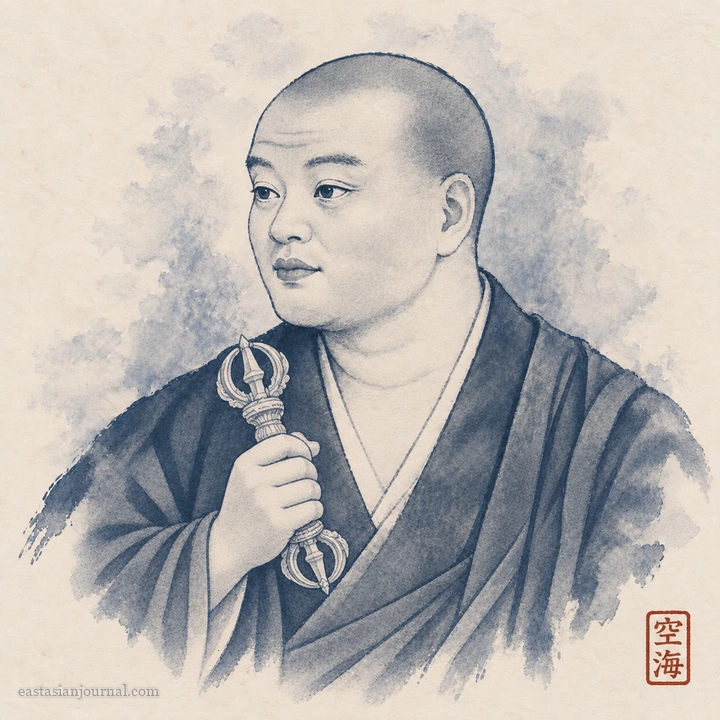 01 · BuddhistKūkai空海 · 774–835Religious philosopherKūkai developed Shingon accounts of embodiment and the three mysteries of body, speech and mind as means of awakening.